

By Will Duru, BSc (Hons) Sport and Exercise Science, Award-winning Personal Trainer with over 10 years of experience in strength training and optimising recovery
This gym leg and core workout covers your legs and abs in one session, using machines, dumbbells and a TRX suspension trainer. It has eight exercises, each done for 4 sets with 60 seconds of rest. It trains your quads, glutes, hamstrings, outer hips and core.
It is my go-to session for legs and core when I have a full gym to use. Each tool does a job the others cannot, and the order keeps you moving between stations without long waits.
Not in a full gym? Use the version that matches your equipment:
- Dumbbells only, at home: the four-move dumbbell leg session.
- Dumbbells and a TRX at home or while traveling: the home and travel version with suspension straps.
- A smaller gym with a leg extension and abductor machine: the five-exercise beginner leg workout.
- A legs-only day with barbells and kettlebells: the kettlebell and barbell leg day.
What each piece of equipment adds
Machines for focused work. Both machines guide the weight along a set track, so you can push hard without balancing anything. The leg extension isolates your quadriceps. The abductor trains the glute muscles at the side of your pelvis that move your thigh outward.
Dumbbells for big movements. Reverse lunges train one leg at a time. Romanian deadlifts and glute bridges load your hamstrings and glutes. Is free weight work better than machine work? When Haugen and colleagues (2023) pooled 13 training studies, neither came out clearly ahead for strength or size in head-to-head tests. Mixing both is a practical choice, not a requirement.
A TRX for core work. Once your feet hang in the straps, your abs and hips must hold your body still. Research backs this up, with caveats. A review of 18 muscle-activity studies found that suspension versions usually drew more trunk and upper-body muscle activity than the traditional versions, apart from the inverted row. The size of that effect differed widely from study to study (Aguilera-Castells and colleagues, 2020).
The gym leg and core workout
The session moves from machines to a TRX core move, then alternates dumbbell lifts with TRX work. Start with a few minutes on a bike or rower, then one light set of leg extensions.
| Exercise | Sets | Reps | Rest |
|---|---|---|---|
| Leg extension | 4 | 12 | 60 seconds |
| Hip abductor machine or mini band crawl | 4 | 12 | 60 seconds |
| TRX pike | 4 | 12 | 60 seconds |
| Dumbbell reverse lunge | 4 | 16 (8 per leg) | 60 seconds |
| TRX knee tuck | 4 | 10 | 60 seconds |
| Dumbbell Romanian deadlift (RDL) | 4 | 12 | 60 seconds |
| Mountain climbers (TRX) | 4 | 20 seconds | 60 seconds |
| Dumbbell glute bridge | 4 | 15 | 60 seconds |
That is 32 sets. With 60 seconds of rest, plan for roughly an hour including your warm-up.
How often should you do it? A 2016 meta-analysis pooled 10 studies on training frequency. When the total weekly work was matched, training a muscle group twice a week produced more growth than once a week (Schoenfeld and colleagues, 2016). If your schedule allows, run this session twice a week with at least one rest day in between.
Exercise technique, station by station
1. Leg extension
- Set the seat so the backs of your knees reach the front edge and the shin pad rests low on your shins.
- Hold the side handles and extend your knees to raise the pad.
- Hold the top position briefly while your quads tighten.
- Return the weight slowly instead of letting it drop.
2. Hip abductor machine or mini band crawl
- On the machine, sit tall with the pads against the outside of your thighs.
- Press your thighs outward as far as you can control.
- Hold for a moment, then let the pads come back in without the weight stack touching down.
No machine free? Loop a mini band around your ankles, sink into a half-squat and shuffle sideways in small steps. The band crawl demo is in the swaps section below.
3. TRX pike
- Lower the straps so the foot cradles hang at about mid-calf. Hook your feet in and walk your hands forward into a push-up position.
- Lock your knees and tighten your abs.
- Drive your hips up, legs straight, until you reach an inverted V.
- Return under control until your body is straight again.
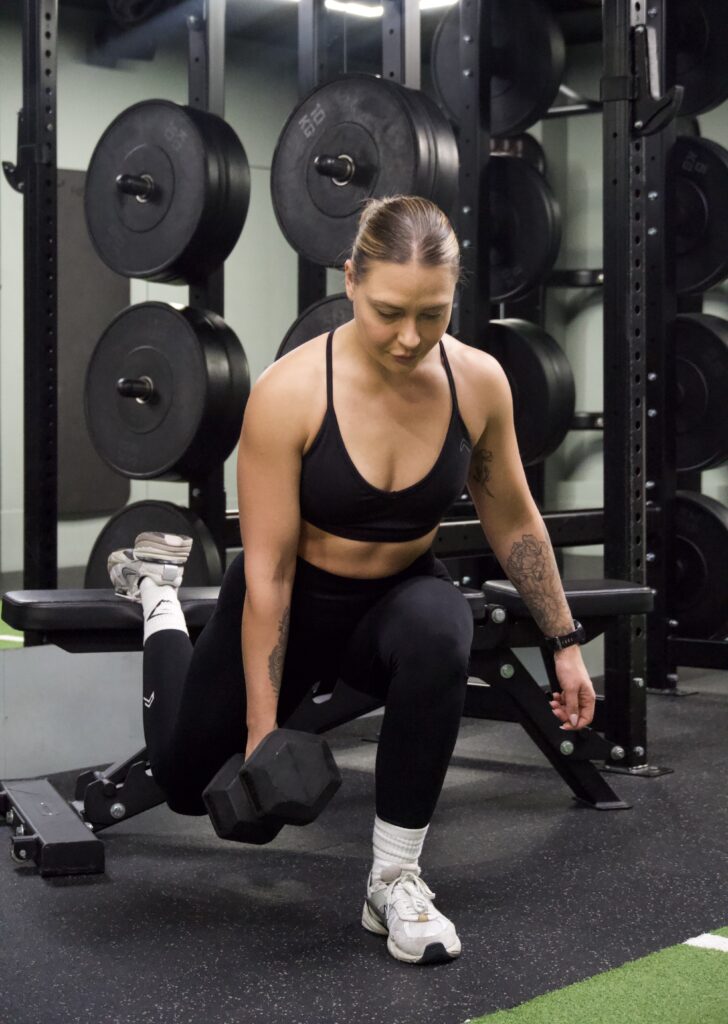
4. Dumbbell reverse lunge
- Stand tall with the dumbbells hanging beside your hips.
- Take a long step back and drop your back knee toward the floor until both knees reach roughly 90 degrees.
- Lean slightly over the front leg so it does most of the work.
- Drive through the front heel to bring the back foot forward, then lunge with the other leg.
For lunge variations and common faults, read the lunge technique guide.
5. TRX knee tuck
- From the push-up position, feet hooked in the cradles, line your hips up with your shoulders.
- Bend your knees and draw them toward your elbows.
- Straighten your legs again without letting your lower back dip.
6. Dumbbell Romanian deadlift (RDL)
- Rest the dumbbells against the front of your thighs, knees unlocked.
- Send your hips toward the wall behind you while your spine stays long.
- Let the weights travel close to your legs and stop when your hamstrings feel tight.
- Bring your hips forward to come up, finishing with your glutes squeezed.
The Romanian deadlift form guide covers the hip hinge in detail.
7. Mountain climbers (TRX)
- Hold a push-up position with both feet in the cradles.
- Bring one knee forward under your hips, then swap legs in a running rhythm.
- Keep going for 20 seconds without letting your hips bounce or rise.
8. Dumbbell glute bridge
- Lie face up with knees bent and feet about hip-width apart.
- Place the dumbbell across the crease of your hips and steady it with both hands.
- Dig your heels into the floor and raise your hips until your glutes are fully tight.
- Lower slowly until your hips almost reach the floor.
If you want to load this pattern more heavily later, learn the barbell hip thrust.
Gym busy? Swaps that keep the session moving
An eight-station workout depends on kit being free. These swaps train the same areas:
- Abductor machine taken: do the mini band crawl.
- TRX in use: do hanging knee tucks for the knee tuck, and floor mountain climbers.
- No TRX at all: replace the pike with a plank.
Video: Resistance band crab walk. This shows the band crawl used as the abductor swap. Watch how the half-squat position stays the same with every step.
Video: Hanging knee tuck. Use this when the TRX is busy. It trains the same knees-to-chest pattern while you hang from a bar.
How to progress
Once you beat your rep target by one or two reps, raise the load by 2 to 10%. That is the ACSM’s progression guidance (ACSM, 2009). On the machines and dumbbells, that usually means the next weight setting or dumbbell size. The TRX moves have no weight to add, so make them harder with a slower tempo and a pause at the top of each pike or tuck.
Want a heavier legs-only day? Try this strength and size leg workout or the women’s intermediate lower body plan.
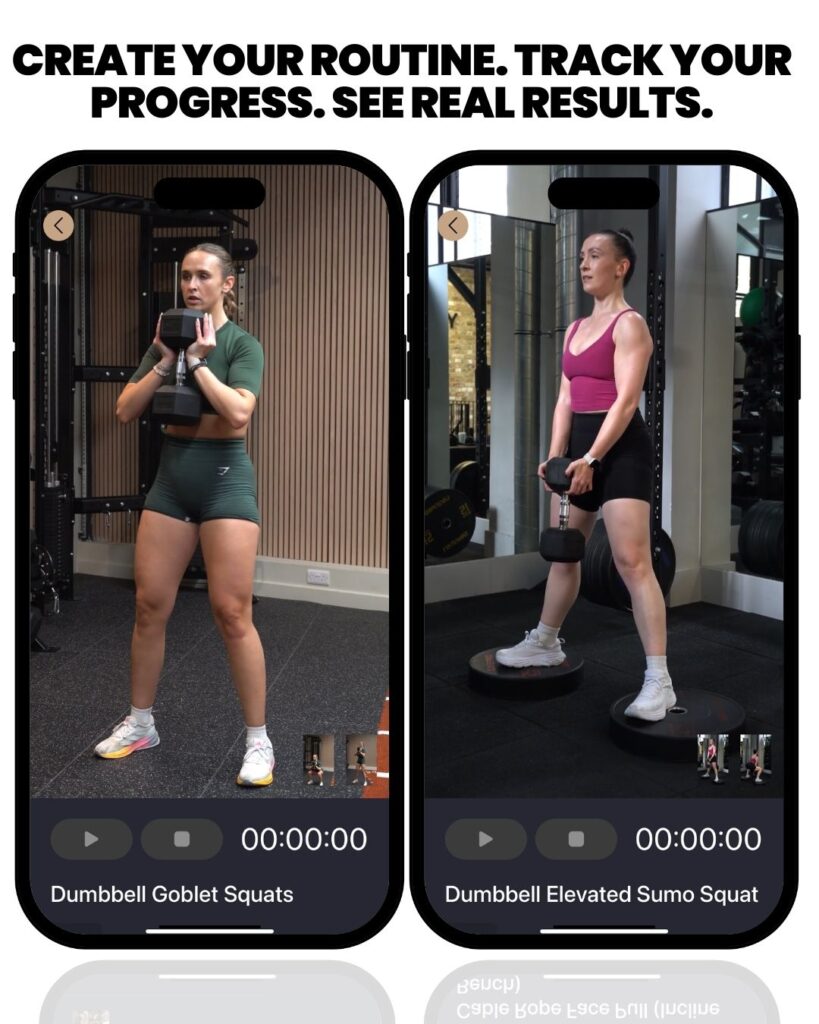
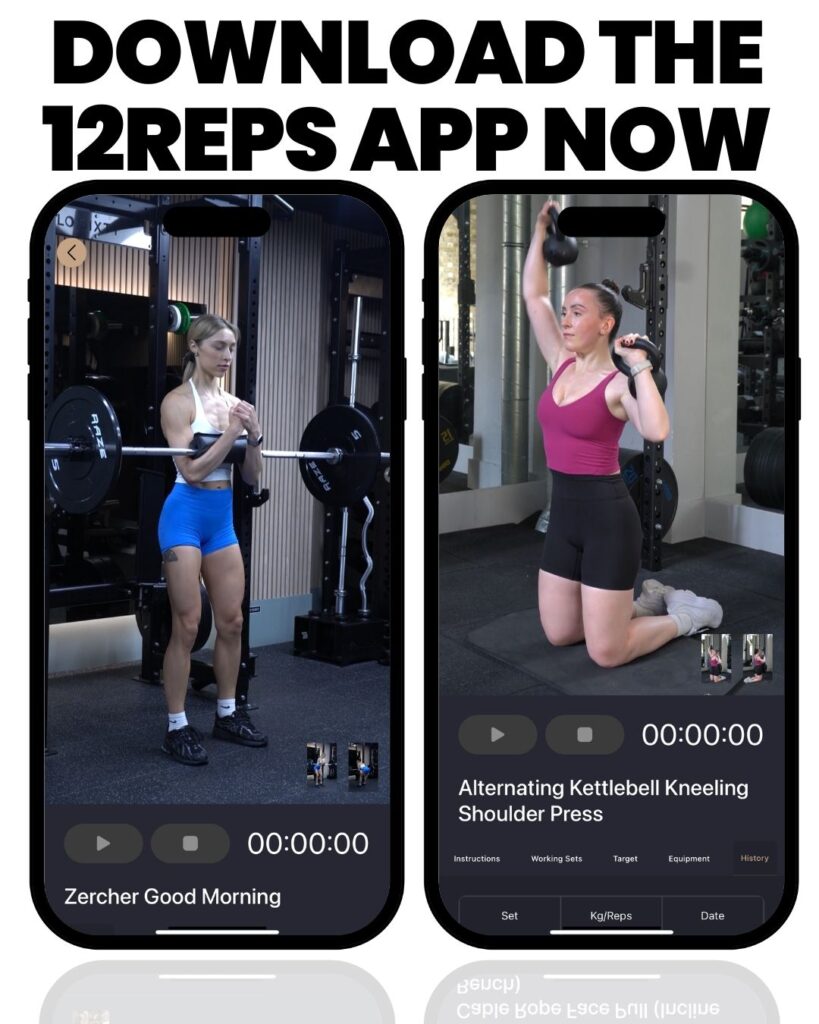
If you want sessions like this set out for you, 12REPS plans workouts around your goal, equipment and time. A trainer demonstrates every exercise, and the app records your sets, reps and weights so you can see your progress.
Sources
- Effect of free-weight vs. machine-based strength training on maximal strength, hypertrophy and jump performance: a systematic review and meta-analysis. Haugen ME, Vårvik FT, Larsen S, Haugen AS, van den Tillaar R, Bjørnsen T. BMC Sports Science, Medicine and Rehabilitation, 2023. https://doi.org/10.1186/s13102-023-00713-4
- Muscle activation in suspension training: a systematic review. Aguilera-Castells J, Buscà B, Fort-Vanmeerhaeghe A, Montalvo AM, Peña J. Sports Biomechanics, 2020. https://doi.org/10.1080/14763141.2018.1472293
- Effects of Resistance Training Frequency on Measures of Muscle Hypertrophy: A Systematic Review and Meta-Analysis. Schoenfeld BJ, Ogborn D, Krieger JW. Sports Medicine, 2016. https://pubmed.ncbi.nlm.nih.gov/27102172/
- American College of Sports Medicine position stand. Progression models in resistance training for healthy adults. American College of Sports Medicine. Medicine and Science in Sports and Exercise, 2009. https://pubmed.ncbi.nlm.nih.gov/19204579/