




By Vijune Penikaite
A 2-day strength training split for women means two full-body gym sessions a week, with a few days between them. Each session trains your legs, glutes, back, chest, shoulders and core. Two sessions meet the NHS guideline for muscle-strengthening activity, and this 12-week plan builds from light weights to heavier lifts.
Many women I meet feel overwhelmed by the gym. They are unsure where to start, which exercises to do or how to fit training into a packed schedule. If that sounds like you, this plan keeps things simple: two sessions, one clear plan, 12 weeks.

Why strength training matters for women
For a long time, women’s fitness advice focused on cardio and getting smaller. Strength training offers more than that.
- You will get stronger, not bulky. A 2020 meta-analysis found that women and men gained muscle at similar relative rates on the same programs. Women usually start with less muscle, so a 2-day plan builds strength and shape, not bulk.
- Your bones benefit. A UK consensus statement on exercise for osteoporosis recommends resistance and impact exercise to maximize bone strength.
- Long-term health. A 2022 meta-analysis of cohort studies linked muscle-strengthening activity to a 10 to 17% lower risk of early death, heart disease, cancer and diabetes. That is an association, not proof of cause.
- Mood. A 2018 meta-analysis of 33 trials found resistance training was linked to fewer depressive symptoms.
There is also the simple feeling of lifting a weight you once thought was too heavy. That builds confidence inside and outside the gym.

Why two days a week is enough
Life is busy. Work, family and social plans can make five gym sessions a week unrealistic. The good news is that two well-planned sessions cover the basics.
- The NHS recommends strengthening activities for all the major muscle groups on at least 2 days a week.
- In the 2022 meta-analysis above, the biggest drop in risk came at about 30 to 60 minutes of muscle-strengthening activity a week.
- The ACSM position stand recommends total-body sessions 2 to 3 days a week for beginners.
- Research programs in women have used the same dose. For example, in the LIFTMOR trial, postmenopausal women with low bone mass trained twice a week for 8 months.
Full-body sessions train each muscle twice a week. A 2019 meta-analysis found that how often you train a muscle matters less than total weekly sets. So two full sessions can work as well as more, shorter ones. For a deeper look, read how many days per week women should strength train.

Track your sessions to keep progressing
Progressive overload means gradually increasing the demand on your muscles, for example by adding weight or reps. Tracking each session is the easiest way to make sure that happens.
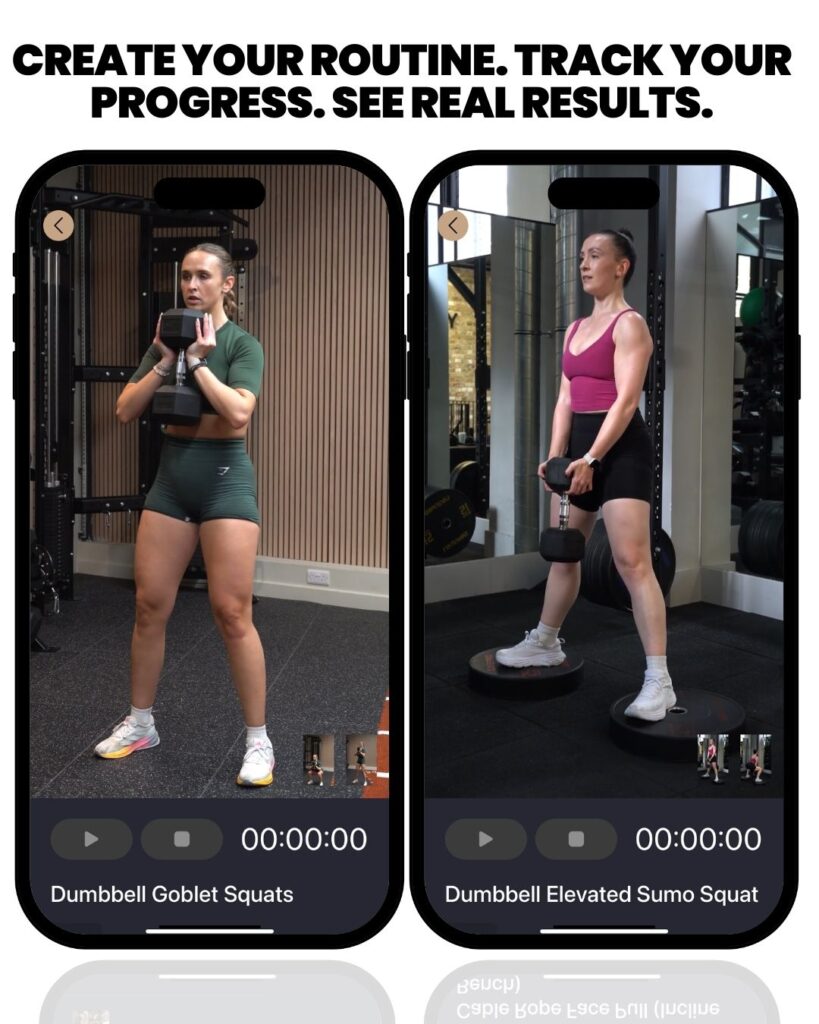
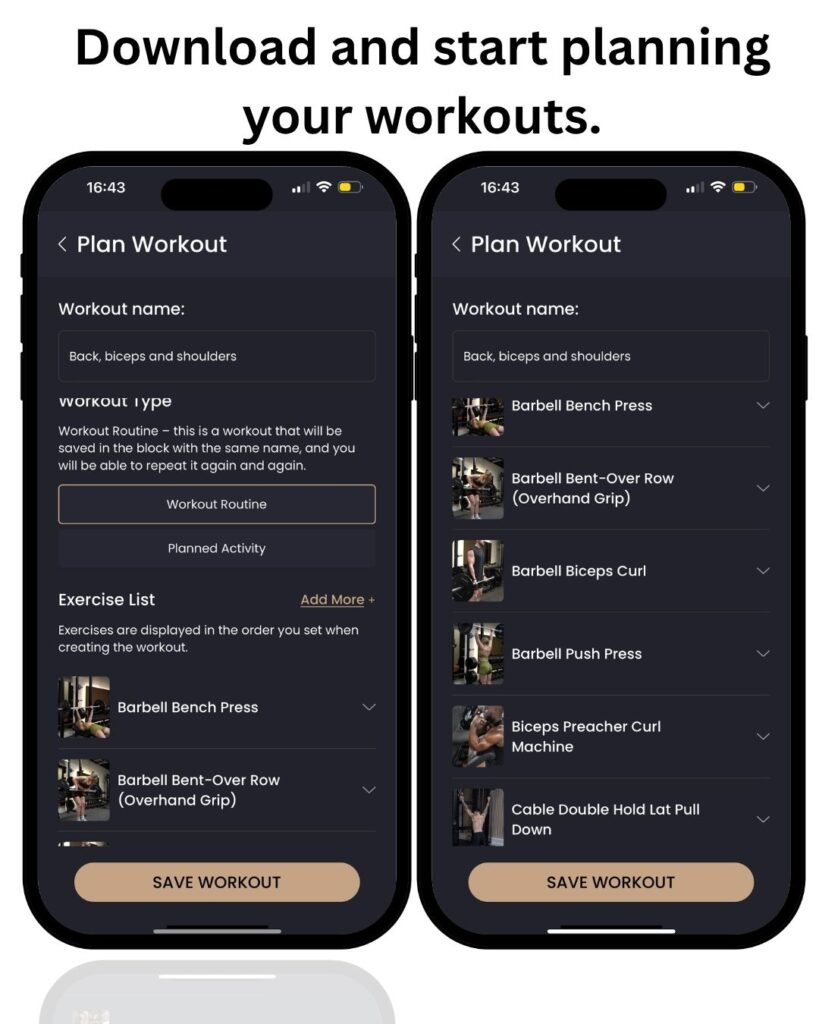
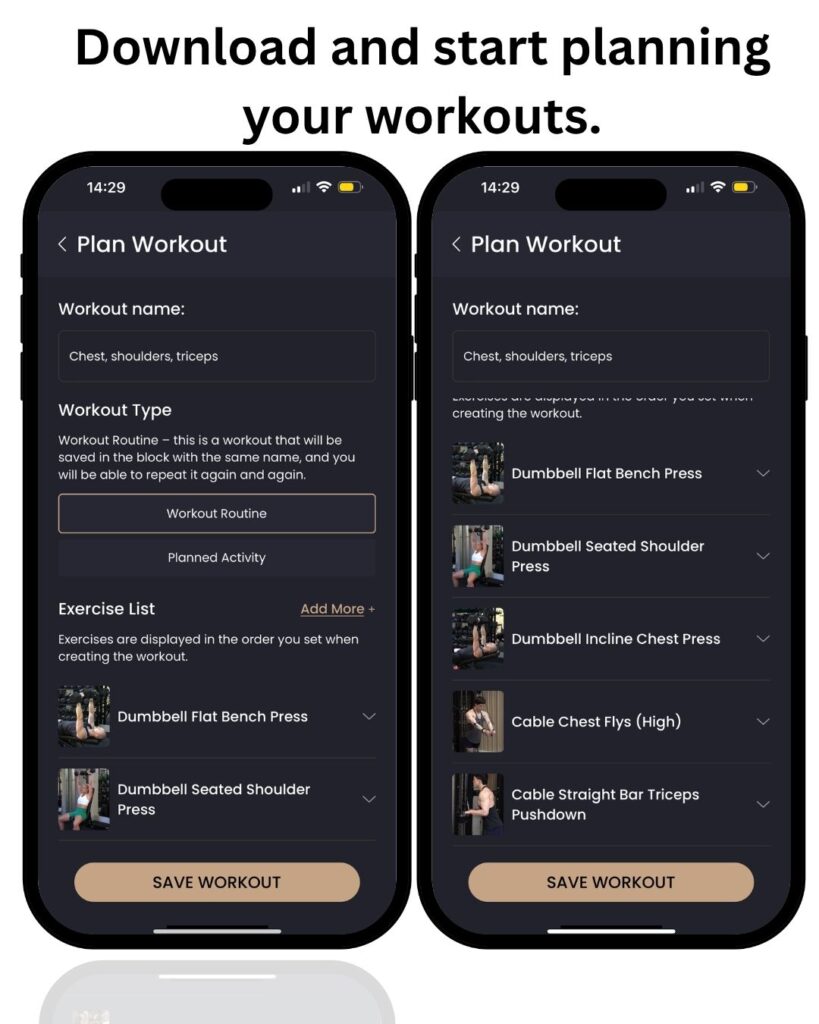
A notebook works. An app can make it faster. In the 12REPS app, you start your workout, watch a trainer demonstration, then enter your reps and weight for each set. The app remembers what you lifted, so you always have a number to beat next time.
The 12-week 2-day strength training plan
This plan uses dumbbells, kettlebells, loop bands, a TRX, barbells and gym machines. Train on two days with at least two rest days between them, for example Monday and Thursday.
Warm-up (10 minutes)
Do 10 minutes of easy cardio on an incline treadmill or rowing machine. Then do these mobility stretches.
| Stretch | Sets | Reps/Duration |
|---|---|---|
| Cat-Cow | 2 | 10 reps |
| World’s Greatest Stretch | 2 | 5 per side |
| Hamstring Stretch | 2 | 30s per side |
Cool-down (10 minutes)
Finish with 10 minutes on the StairMaster or an incline treadmill walk.
Optional daily finisher
On any day you like, morning or evening, you can add this short core and lower body routine.
| Exercise | Sets | Reps |
|---|---|---|
| Plank | 2 | 30-60s hold |
| Leg Raises | 2 | 10 |
| Bird-Dog | 2 | 10 per side |
| Russian Twists | 2 | 10 per side |
| Sit-ups | 2 | 10 |
| Calf Raises | 2 | 10 |
| Glute Bridges | 2 | 10 |

Phase 1: Foundation (weeks 1 to 4)
The first month is about learning good form and building muscular endurance. The weights should feel light to moderate. Each workout has 6 exercises with 4 to 5 sets each.
Workout A
| Exercise | Sets | Reps | Weight | Rest |
|---|---|---|---|---|
| Goblet Squat (Dumbbell) | 4-5 | 10-12 | Light | 60-90 s |
| Dumbbell Bench Press | 4-5 | 10-12 | Light | 60-90 s |
| Seated Cable Row | 4-5 | 10-12 | Light | 60-90 s |
| Dumbbell Lunges | 4-5 | 10 per leg | Light | 60 s |
| Glute Bridges (Loop Band) | 4-5 | 15-20 | Bodyweight | 60 s |
| Plank | 4-5 | 30-60 s | Bodyweight | 60 s |
Video: Dumbbell goblet squats. The goblet squat opens Workout A. Watch how the dumbbell stays at the chest and the torso stays upright.
Workout B
| Exercise | Sets | Reps | Weight | Rest |
|---|---|---|---|---|
| Romanian Deadlift (Dumbbell) | 4-5 | 10-12 | Light | 60-90 s |
| Lat Pulldown Machine | 4-5 | 10-12 | Light | 60-90 s |
| Dumbbell Shoulder Press | 4-5 | 10-12 | Light | 60-90 s |
| Leg Press Machine | 4-5 | 12-15 | Light | 60 s |
| Hip Abduction (Loop Band) | 4-5 | 15-20 | Bodyweight | 60 s |
| Lying Leg Raises | 4-5 | 15-20 | Bodyweight | 60 s |
Video: Dumbbell RDL. The Romanian deadlift opens Workout B. The hip hinge is hard to learn from text, so watch how far the hips travel back.
Phase 2: Strength and muscle (weeks 5 to 8)
Now that you have a base, Phase 2 brings in barbell lifts and moderate weights. Reps drop to 8 to 12 so you can lift a little heavier. Start each workout with one very light full-body warm-up set.
Workout A
| Exercise | Sets | Reps | Weight | Rest |
|---|---|---|---|---|
| Warm-up Set (Full Body) | 1 | 15 | Very Light | 30 s |
| Barbell Back Squat | 4 | 8-10 | Moderate | 90 s |
| Dumbbell Walking Lunges | 4 | 8-10 | Moderate | 90 s |
| Barbell Bent-Over Row | 4 | 8-10 | Moderate | 90 s |
| Dumbbell Romanian Deadlift | 4 | 10-12 | Moderate | 90 s |
| Dumbbell farmer’s carry | 4 | 20 meters | Heavy | 60 s |
Workout B
| Exercise | Sets | Reps | Weight | Rest |
|---|---|---|---|---|
| Warm-up Set (Full Body) | 1 | 15 | Very Light | 30 s |
| Dumbbell Chest Press | 4 | 8-10 | Moderate | 90 s |
| Seated Dumbbell Shoulder Press | 4 | 8-10 | Moderate | 90 s |
| TRX Row | 4 | 10-12 | Bodyweight | 90 s |
| Dumbbell Lateral Raises | 4 | 10-12 | Moderate | 90 s |
| Cable Rope Face Pulls | 4 | 12-15 | Light | 60 s |
Phase 3: Strength and power (weeks 9 to 12)
In the final phase, you lift heavier weights for fewer reps. Rest longer between sets on the big lifts so you can keep your form sharp. If a heavy lift feels unsteady, stay at a moderate weight for another week.
Workout A
| Exercise | Sets | Reps | Weight | Rest |
|---|---|---|---|---|
| Warm-up Set (Full Body) | 1 | 15 | Very Light | 30 s |
| Barbell Deadlift | 4 | 5-6 | Heavy | 120-180 s |
| Barbell Bench Press | 4 | 6-8 | Heavy | 120 s |
| Weighted Pull-Ups (or Assisted) | 4 | 6-8 | Heavy | 120 s |
| Seated Cable Row | 4 | 8-10 | Moderate | 90 s |
| Dumbbell Lateral Raises | 4 | 12-15 | Light | 60 s |
Workout B
| Exercise | Sets | Reps | Weight | Rest |
|---|---|---|---|---|
| Warm-up Set (Full Body) | 1 | 15 | Very Light | 30 s |
| Heavy Goblet Squat (Kettlebell) | 4 | 6-8 | Heavy | 120 s |
| T-Bar Row | 4 | 6-8 | Heavy | 120 s |
| Overhead Press (Barbell) | 4 | 6-8 | Heavy | 120 s |
| Leg Press (Feet High) | 4 | 8-10 | Moderate | 90 s |
| Hanging Knee Raises | 4 | 12-15 | Bodyweight | 60 s |
How to progress, week by week
The ACSM suggests adding 2 to 10% to the load once you can do 1 to 2 reps more than your target on two sessions in a row. With dumbbells, that usually means moving up to the next pair.
Ready for more after 12 weeks? Our beginner push pull legs program for women moves you to three days a week. Over 50? See our strength training program for women over 50.
Your next step
Consistency matters more than any single workout. Show up on the days you do not feel like it, be patient with your body and celebrate small wins. For the research behind all of this, read our science-based guide to strength training for women.
Want a plan built around your goal, your equipment and your time? The 12REPS app sets out each session and shows a trainer demonstration for every exercise.
Sources
- Sex differences in resistance training: a systematic review and meta-analysis. Roberts BM, Nuckols G, Krieger JW. Journal of Strength and Conditioning Research, 2020. https://pubmed.ncbi.nlm.nih.gov/32218059/
- Strong, steady and straight: UK consensus statement on physical activity and exercise for osteoporosis. Brooke-Wavell K et al. British Journal of Sports Medicine, 2022. https://pubmed.ncbi.nlm.nih.gov/35577538/
- Muscle-strengthening activities are associated with lower risk and mortality in major non-communicable diseases: a systematic review and meta-analysis of cohort studies. Momma H, Kawakami R, Honda T, Sawada SS. British Journal of Sports Medicine, 2022. https://bjsm.bmj.com/content/56/13/755
- Association of efficacy of resistance exercise training with depressive symptoms: meta-analysis and meta-regression analysis of randomized clinical trials. Gordon BR et al. JAMA Psychiatry, 2018. https://doi.org/10.1001/jamapsychiatry.2018.0572
- Physical activity guidelines for adults aged 19 to 64. NHS, 2024. https://www.nhs.uk/live-well/exercise/physical-activity-guidelines-for-adults-aged-19-to-64/
- Progression models in resistance training for healthy adults (position stand). American College of Sports Medicine, Medicine & Science in Sports & Exercise, 2009. https://pubmed.ncbi.nlm.nih.gov/19204579/
- High-intensity resistance and impact training improves bone mineral density and physical function in postmenopausal women with osteopenia and osteoporosis: the LIFTMOR randomized controlled trial. Watson SL et al. Journal of Bone and Mineral Research, 2018. https://doi.org/10.1002/jbmr.3284
- How many times per week should a muscle be trained to maximize muscle hypertrophy? A systematic review and meta-analysis. Schoenfeld BJ, Grgic J, Krieger J. Journal of Sports Sciences, 2019. https://doi.org/10.1080/02640414.2018.1555906

