




By Personal Trainer Vijune Penikaite – level 3 qualified
Strength training for beginner runners can be simple. Do three short gym sessions a week, using machines, cables, dumbbells and your body weight. Start light, learn each movement and add weight slowly.
This 12-week, 3-day plan does exactly that, alongside your normal runs. It trains push, pull and legs on separate days, so no single session wipes out your legs.
Who this beginner plan is for
- You are new to running, or you run but have never followed a gym plan.
- You are building toward a 5K, 10K or your first longer race.
- Your legs feel heavy late in runs, or your form fades when you get tired.
- You want a clear plan you can repeat, measure and improve.
Already lifting regularly? The off-season plan for advanced runners uses heavier barbell work. In the middle of a race build? Try the 3-day strength training split for runners. Only have time for two sessions? See this two-workout plan for runners.

Why beginner runners should add strength training
Running trains your heart and lungs. It does not train every major muscle group. Health guidelines advise all adults to do muscle-strengthening activity on at least 2 days a week, working the legs, hips, back, abdomen, chest, shoulders and arms (CDC).
Lifting may help your running too. Running economy is how much energy you use at a given pace. A systematic review found strength training often improved it, and short time trials also tended to improve, though not in every study (Blagrove and colleagues, 2018). Most of those studies used trained runners, so the effect in beginners is less certain.
Will it stop me getting injured?
No plan can promise that. One trial gave first-time marathon runners a 10-minute strength routine to do three times a week. It did not reduce the overuse injuries that stopped people finishing (Toresdahl and colleagues, 2020).
Runners who did the routine at least twice a week had fewer minor injuries but slightly more major ones. The study was not designed to test this, so it does not settle the question.
What strength training can help with
- Stronger legs and glutes for hills and the last part of a run.
- Training the upper body and core, which running does not load much.
- Getting comfortable in the gym with simple, repeatable exercises.
- A measurable plan: you can see your weights go up week by week.
You do not need to train like a bodybuilder. You need a plan that supports your running rather than competing with it.

How the 3-day push, pull and legs split works
Each session trains one group of muscles. Not sure which split suits you? This guide compares upper/lower, push/pull/legs and full body splits for beginners.
Day one: push
You train your chest, shoulders, triceps and core. These are the muscles that push weight away from you.
Day two: pull
You train your back, rear shoulders, biceps and core. Rows and pulldowns balance out all the pushing.
Day three: legs and running strength
You train your quadriceps (front of the thigh), hamstrings (back of the thigh), glutes and core. This is the session that matters most for running, so give it your best effort.
How to fit the plan around your running
Leave at least one day between strength sessions where you can. Keep the leg session away from your longest or fastest run. Here is one example week.
| Day | Session |
|---|---|
| Monday | Push workout, plus an optional easy run |
| Tuesday | Run |
| Wednesday | Legs and running strength |
| Thursday | Rest or easy recovery run |
| Friday | Pull workout |
| Saturday | Longer run |
| Sunday | Rest or mobility |
Your exact week can change around work, family and recovery. On days with both, space the run and the gym session a few hours apart where you can.
Warm up before each session with 5 minutes of easy cardio and a few bodyweight moves. These pre-run warm-up exercises work well before lifting too.
Video: What every new gym beginner should know. If the gym is new to you, watch this before your first session. It covers the basics that make the first few weeks less daunting.

The 12-week beginner runner program
The plan has three 4-week phases. You repeat the same exercises throughout, which makes progress simple to measure. Sets and reps change each phase.
- Weeks 1 to 4, learn the movements. Control every rep. Rest 60 to 90 seconds between sets.
- Weeks 5 to 8, build volume. Do four sets of the first three exercises and three sets of the rest. Rest 75 to 120 seconds after hard sets.
- Weeks 9 to 12, build strength. Focus on heavier sets and single-leg control. Rest 90 to 120 seconds after the main exercises.
In the tables, 3 x 8-12 means 3 sets of 8 to 12 reps. Tap an exercise name to see its demo.
Video: What beginners should use: free weights or machines. This plan mixes cables, machines and dumbbells. This video explains why both have a place when you are starting out.
Day one: push and core
| Exercise | Weeks 1-4 | Weeks 5-8 | Weeks 9-12 |
|---|---|---|---|
| Bodyweight press-up | 3 x 8-12 | 4 x 8-12 | 4 x 6-10 |
| Dumbbell close-grip chest press | 3 x 10-12 | 4 x 8-12 | 4 x 6-10 |
| Seated cable chest press | 3 x 10-12 | 4 x 8-12 | 4 x 8-10 |
| Dumbbell chest fly | 3 x 12 | 3 x 12-15 | 4 x 10-15 |
| Swiss ball dumbbell lateral raise | 3 x 12-15 | 3 x 12-15 | 4 x 10-15 |
Day two: pull and posture
| Exercise | Weeks 1-4 | Weeks 5-8 | Weeks 9-12 |
|---|---|---|---|
| Cable machine lat pulldown | 3 x 10-12 | 4 x 8-12 | 4 x 6-10 |
| Ring row | 3 x 8-12 | 4 x 8-12 | 4 x 6-10 |
| Cable rope bent-over row | 3 x 10-12 | 4 x 8-12 | 4 x 8-10 |
| Seated cable reverse fly | 3 x 12-15 | 3 x 12-15 | 4 x 10-15 |
| Cable straight-bar biceps curl | 3 x 10-15 | 3 x 12-15 | 4 x 10-15 |
Day three: legs, glutes and running strength
| Exercise | Weeks 1-4 | Weeks 5-8 | Weeks 9-12 |
|---|---|---|---|
| Swiss ball dumbbell goblet squat | 3 x 10-12 | 4 x 8-12 | 4 x 6-10 |
| Cable straight-bar Romanian deadlift | 3 x 10-12 | 4 x 8-12 | 4 x 6-10 |
| TRX kettlebell split lunge | 3 x 8-10 each leg | 4 x 8-10 each leg | 4 x 8-10 each leg |
| Bodyweight hip thrust | 3 x 12-15 | 3 x 12-15 | 4 x 10-15 |
| Cable glute kickback | 3 x 12 each leg | 3 x 12-15 each leg | 4 x 10-15 each leg |
Core finisher: end of every session
| Exercise | Weeks 1-4 | Weeks 5-8 | Weeks 9-12 |
|---|---|---|---|
| Front plank | 3 x 20-40 sec | 3 x 30-45 sec | 3 x 40-60 sec |
| Bird dog | 3 x 8 each side | 3 x 10 each side | 3 x 10-12 each side |
| Dead bug | 3 x 8-10 each side | 3 x 10 each side | 3 x 10-12 each side |
How to progress
| Weeks | Main focus | Sets | Reps | Rest |
|---|---|---|---|---|
| 1-4 | Technique and movement control | 3 | 8-15 | 60-90 sec |
| 5-8 | Muscle and training volume | 3-4 | 8-15 | 75-120 sec |
| 9-12 | Strength and single-leg control | 4 | 6-15 | 90-120 sec |
Add weight when you can complete the top number of reps with good form on every set. Keep one to three reps in reserve. Reps in reserve (RIR) means how many more good reps you could have done before stopping. You should feel challenged without reaching failure on every set.
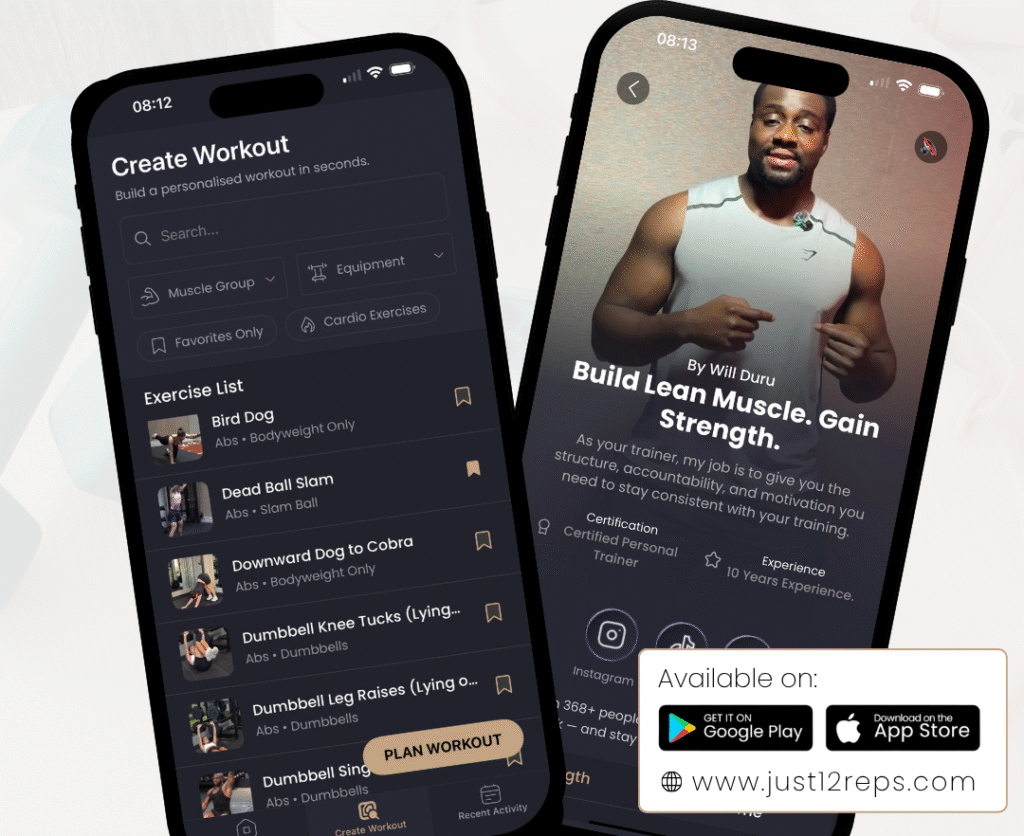
Track the plan so you can see progress
You should not need to remember every exercise, set or weight. Use the links in the tables to watch each demo, or search the 12REPS exercise library by muscle group and equipment.
If you want a plan built around your goal, the equipment you have and the time you’ve got, 12REPS sets out each session with a trainer demonstration for every exercise. It also remembers what you lifted, so you know what to beat next time.
Your 12-week checklist
- Pick starting weights you can lift with clean form.
- Complete your three weekly workouts.
- Record what you lift.
- Make small improvements each week.
- Protect your running recovery.
After 12 weeks, you will not just be a runner who sometimes uses weights. You will have a routine, a record of your lifts and a stronger base to build on.
Beginner runner strength training FAQs
What if I miss a session?
Pick up where you left off. Do not try to squeeze two sessions into one day. If you miss a whole week, repeat the previous week’s weights.
What should I do after week 12?
If you plan to keep running through a race, move to the in-season 3-day split for runners. If you have a quiet few months, the advanced runner plan is the next step. For extra exercise ideas, see the best strength training exercises for runners.
Sources
- Adult Activity: An Overview. Centers for Disease Control and Prevention (CDC), 2023. https://www.cdc.gov/physical-activity-basics/guidelines/adults.html
- Effects of Strength Training on the Physiological Determinants of Middle- and Long-Distance Running Performance: A Systematic Review. Blagrove RC, Howatson G, Hayes PR. Sports Medicine, 2018. https://pubmed.ncbi.nlm.nih.gov/29249083/
- A Randomized Study of a Strength Training Program to Prevent Injuries in Runners of the New York City Marathon. Toresdahl BG, McElheny K, Metzl J, et al. Sports Health, 2020. https://pubmed.ncbi.nlm.nih.gov/31642726/

