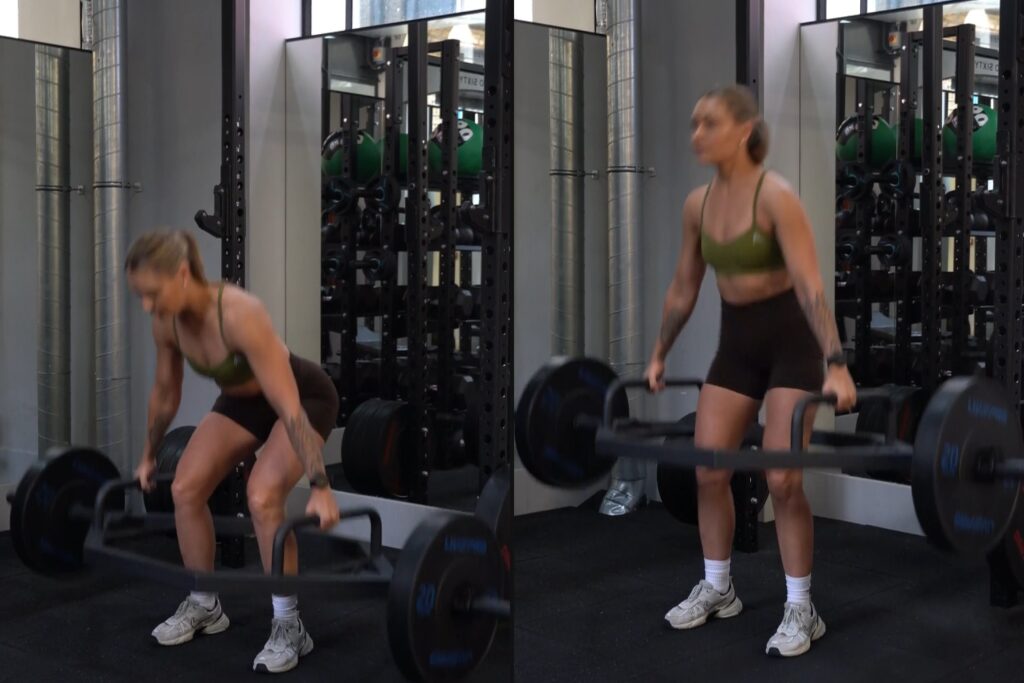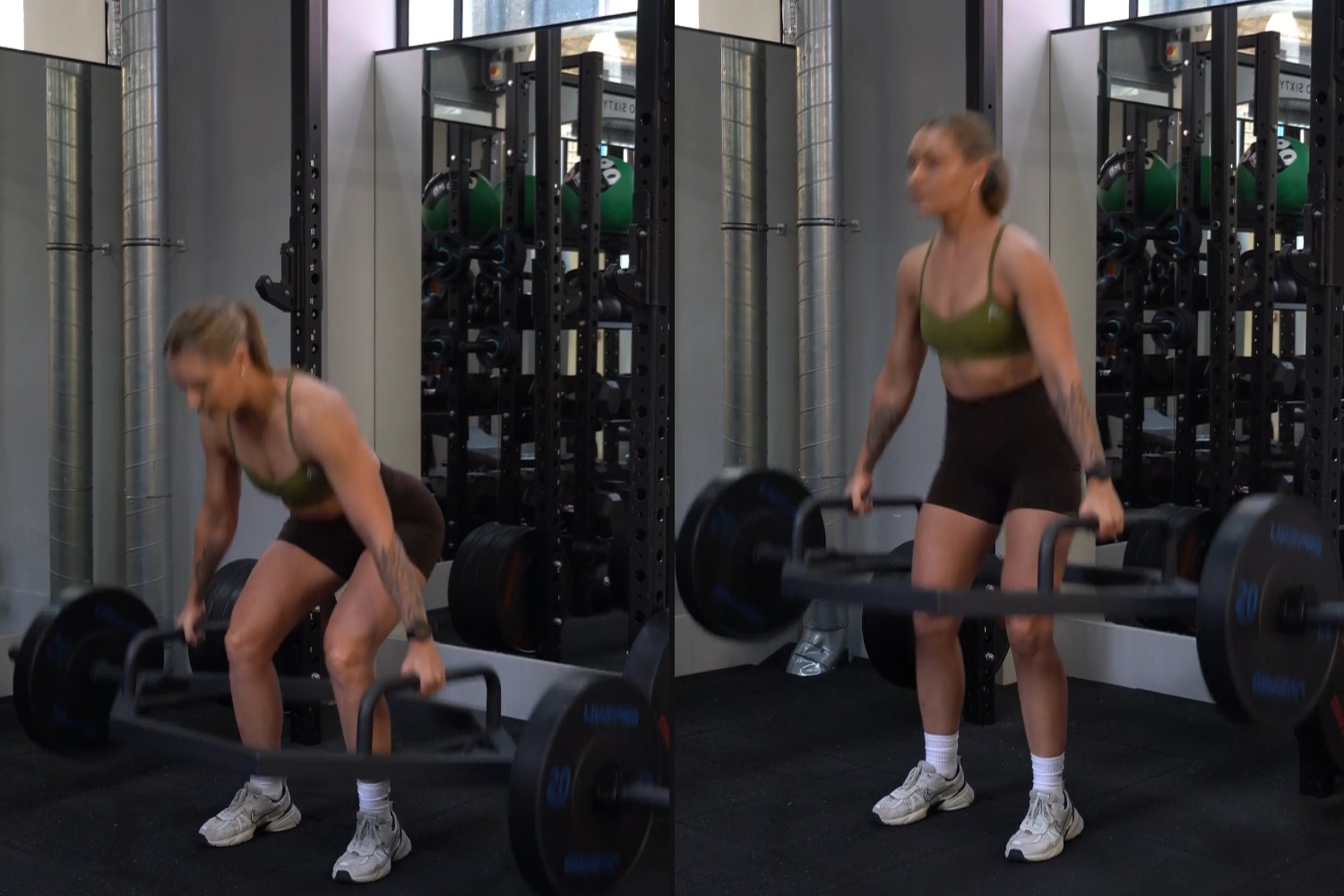



Quick answer: To do a trap bar deadlift, step inside the bar and line the handles up with the middle of your feet. Then push your hips back, grip the handles and brace your core. Push the floor away until you’re standing tall, and lower the bar back down with control. The bar sits beside you instead of in front of you. For many people, that makes it easier to learn than a straight-bar deadlift.
A trap bar, also called a hex bar, is a six-sided bar that you stand inside. You hold it with your palms facing in, like carrying two heavy shopping bags.
This guide is for you if you’re new to deadlifts, or if the barbell version never felt right. It’s also useful if you already deadlift and want a variation that lets you lift heavy and move fast.
You’ll learn how the trap bar compares to a barbell, how to set up and lift step by step, the mistakes I see most, and how to fit it into your program.
Trap bar vs barbell deadlift: what’s the difference?
With a barbell, the weight sits in front of your shins. With a trap bar, the weight sits beside you, in line with your body. That small change shifts where the effort goes.
| Trap bar deadlift | Barbell deadlift | |
|---|---|---|
| Where the weight sits | Beside your body | In front of your shins |
| Grip | Palms facing in | Palms facing you, or mixed |
| Body position | More knee bend, more upright chest | More hip hinge, chest further forward |
| Muscles worked hardest | More thigh (quads) | More hamstrings and hips near the top |
| Load on the lower back | Lower, in lab measurements | Higher |
| Learning curve | Easier for most beginners | Takes longer to learn well |
What the research says:
- Less strain on the lower back, more on the knees. In 19 male powerlifters, the trap bar lowered the peak load on the lower back, hips and ankles. It raised the load on the knees (Swinton et al., 2011).
- More quads, less hamstrings. In 20 men with deadlift experience, the trap bar worked the front thigh harder. The barbell worked the hamstrings and lower back harder (Camara et al., 2016).
- The same pattern in women. In 11 strength-trained women, the trap bar produced more knee involvement and faster bar speed. Conventional and sumo deadlifts worked the hips harder near lockout (Gundersen et al., 2025).
- Often heavier and faster. Several studies found people lifted more weight with the trap bar and moved it faster (Swinton et al., 2011; Lake et al., 2017). One study found no difference in max weight, though (Camara et al., 2016).
- It builds strength and muscle. In an 8-week trial, 22 recreationally active women trained twice a week with either trap bar deadlifts or half squats. Both groups got stronger and gained lean mass, with no clear winner (Hagerupsen et al., 2024).
One caution: lower back load in a lab is not the same as lower injury risk. No study here tracked injuries. It’s fair to call the trap bar more back-friendly. It’s not fair to call it injury-proof.
Which should you choose? In my coaching, the trap bar is usually where I start people who are new to deadlifts. The barbell is still a great lift if your goal is powerlifting, or if you want more hamstring work.
How to do a trap bar deadlift, step by step
Setup
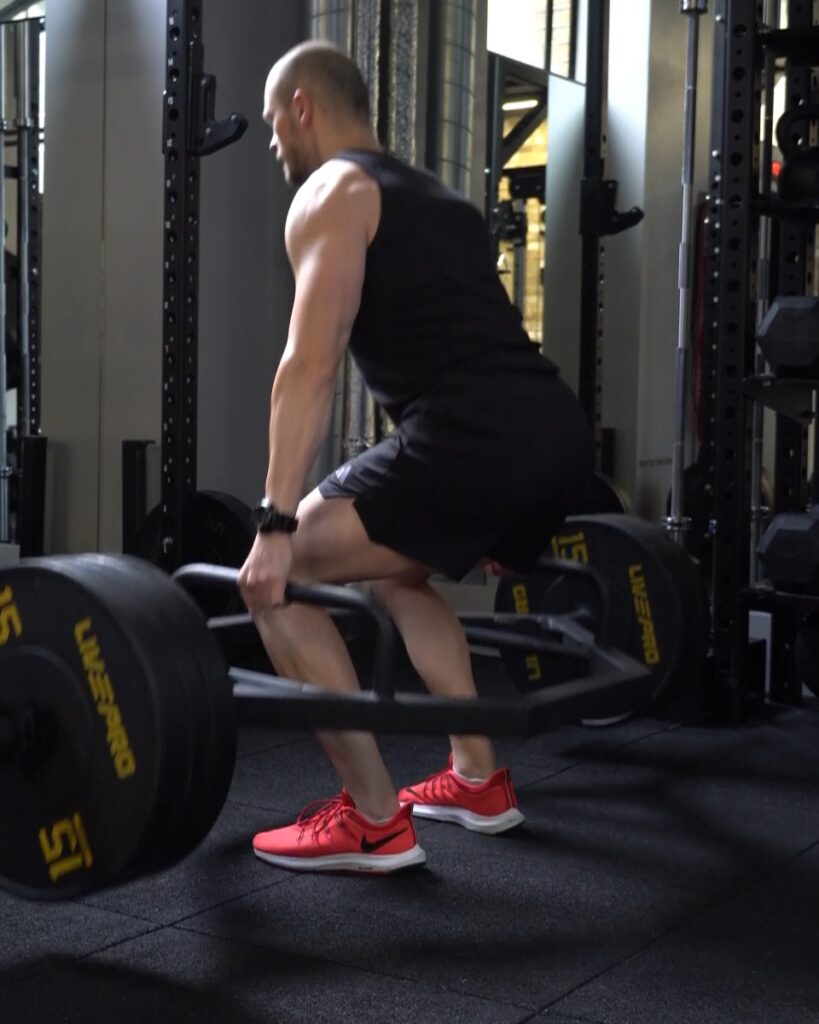
- Step inside the bar. Stand in the center so the handles line up with the middle of your feet. Your feet should be about hip-width apart.
- Hinge down. Push your hips back and bend your knees until you can reach the handles. Keep your chest up and your back flat.
- Grip the middle of the handles. Gripping off-center makes the bar tip forward or back.
- Brace. Take a breath into your belly and tighten your core as if someone’s about to poke you in the stomach. Pull your shoulders down, away from your ears.
The lift
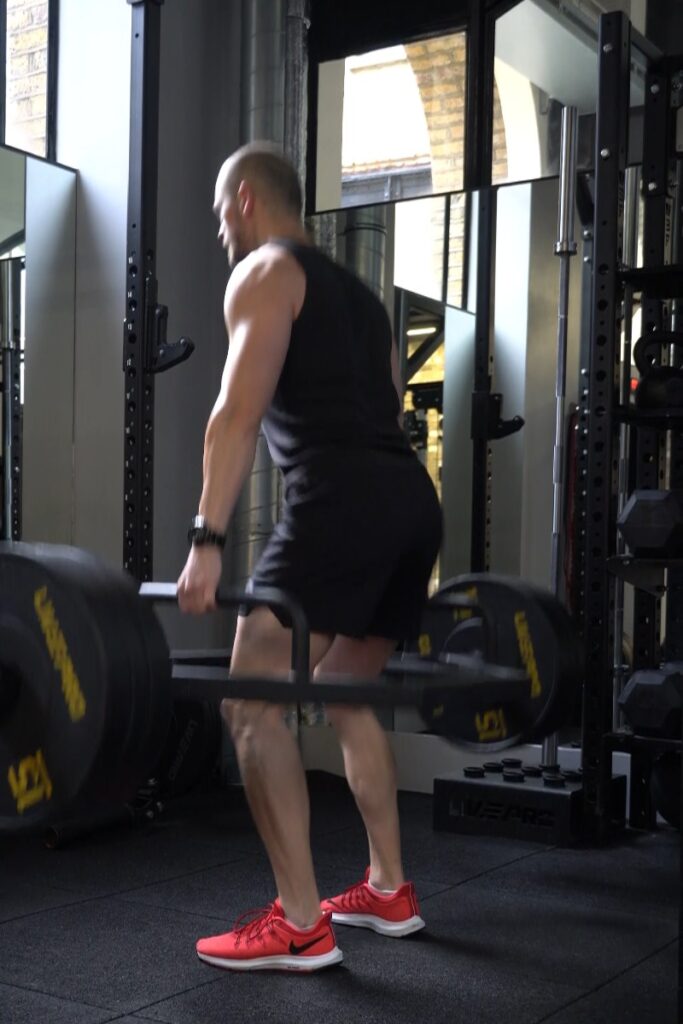
- Push the floor away. Drive through your whole foot. Your hips and shoulders should rise at the same speed.
- Stand tall. Finish with your hips and knees straight and your glutes squeezed. Don’t lean back.
- Lower with control. Push your hips back first, then bend your knees once the bar passes them. Set the bar down, reset your brace and go again.
Coaching cues I use
- “Push the floor away” instead of “pull the bar up.”
- “Proud chest” to keep your back flat.
- “Squeeze your armpits” to keep the bar close and your back tight.
- Breathe out at the top. Take a new breath before each rep.
Here’s another angle:
Common trap bar deadlift mistakes
| Mistake | What it looks like | Fix |
|---|---|---|
| Turning it into a squat | Hips drop low, knees shoot forward, chest stays very upright | Start with your hips higher than your knees. Think “hips back,” not “sit down” |
| Rounding your back | Your lower back curves as the bar leaves the floor | Lower the weight. Brace before every rep and keep a proud chest |
| Standing off-center | The bar tips forward or back, or one side lifts first | Line the handles up with the middle of your feet before you grip |
| Jerking the bar | Arms bend and the bar snaps off the floor | Pull the slack out first: tighten up until the plates nearly lift, then push |
| Leaning back at the top | Hips push forward and shoulders fall behind them | Finish tall with your glutes squeezed. Your body should form a straight line |
| Dropping the weight | The bar falls fast on the way down | Lower over about 2 seconds, hips first |
The one I see most is the first. Because you stand inside the bar, it’s easy to squat the weight up. Some knee bend is normal with a trap bar. But you should still feel your hamstrings and glutes working, not just your thighs.
High handles or low handles?
Most trap bars have two sets of handles. Flip the bar over to switch between them.
- High handles shorten the distance the bar travels. In one study of 31 strength-trained men and women, the lift distance was 22% shorter with high handles. People lifted about 20 kg (44 lb) more than in a conventional deadlift (Lockie et al., 2018).
- Low handles make you go deeper, so each rep covers more range.
In my coaching, I start beginners and taller lifters on the high handles. It’s easier to keep a flat back when you don’t have to reach as far down. Once that’s solid, move to the low handles for more range.
Sets and reps for the trap bar deadlift
These are my starting points, not fixed rules. Pick the row that matches your goal.
| Goal | Sets | Reps | Rest | Effort |
|---|---|---|---|---|
| Learning the lift | 3 | 8 to 10 | 90 sec | Light. Stop with 3 or 4 reps to spare |
| Building muscle | 3 to 4 | 6 to 10 | 2 min | Stop with 1 to 3 reps to spare |
| Building strength | 3 to 5 | 3 to 5 | 2 to 3 min | Heavy, but every rep looks the same |
Twice a week is plenty for most people. Put it first in your session while you’re fresh. On the other leg day, you can do a squat or a lunge.
How to progress. When you can do every rep of every set with good form, add 5 to 10 lb next time. If your form breaks, stay at that weight until it doesn’t. Writing down what you lift each session makes this much easier.
Summary
- Stand in the center of the bar with the handles in line with the middle of your feet.
- Hinge down, grip the middle of the handles, brace, and push the floor away.
- Finish tall without leaning back. Lower with your hips first.
- Compared with a barbell, the trap bar puts less load on your lower back and works your quads more. Most people find it easier to learn.
- Start on the high handles if you’re new or tall. Move to the low handles for more range.
- Add weight only when every rep looks the same.
Track your trap bar deadlift with 12REPS
Getting stronger on the trap bar comes down to adding a little weight at a time, and that’s easier when you know what you lifted last time. The 12REPS gym log shows your previous sets as you train, and the app gives you progressive overload guidance on when to add weight. Every exercise comes with two demo videos, and a rest timer keeps your heavy sets on track. You can add the trap bar deadlift to your own routine, or follow a trainer-built 6 to 12 week program. New users get a 7-day free trial.
Download 12REPS and see what you’ll get:
Sources
- Swinton PA et al. A biomechanical analysis of straight and hexagonal barbell deadlifts using submaximal loads. J Strength Cond Res, 2011
- Camara KD et al. An examination of muscle activation and power characteristics while performing the deadlift exercise with straight and hexagonal barbells. J Strength Cond Res, 2016
- Lake J et al. Effect of a hexagonal barbell on the mechanical demand of deadlift performance. Sports (Basel), 2017
- Lockie RG et al. The 1 repetition maximum mechanics of a high-handle hexagonal bar deadlift compared with a conventional deadlift. J Strength Cond Res, 2018
- Hagerupsen K et al. Barbell half squats vs trap bar deadlifts on strength, power and lean mass in recreationally active females: an eight-week randomized trial. BMC Sports Sci Med Rehabil, 2024
- Gundersen AH et al. A biomechanical comparison between conventional, sumo, and hex-bar deadlifts among resistance trained women. J Strength Cond Res, 2025
Related reading
- How to deadlift properly: the complete guide for women
- Romanian deadlift (RDL) form guide
- Strength training for back pain
- The beginner’s guide to progressive overload
- How to get stronger
I’m Will Duru, a personal trainer and the founder of 12REPS. I hold a BSc (Hons) in Sport and Exercise Science and have more than a decade of experience coaching people in strength training.