
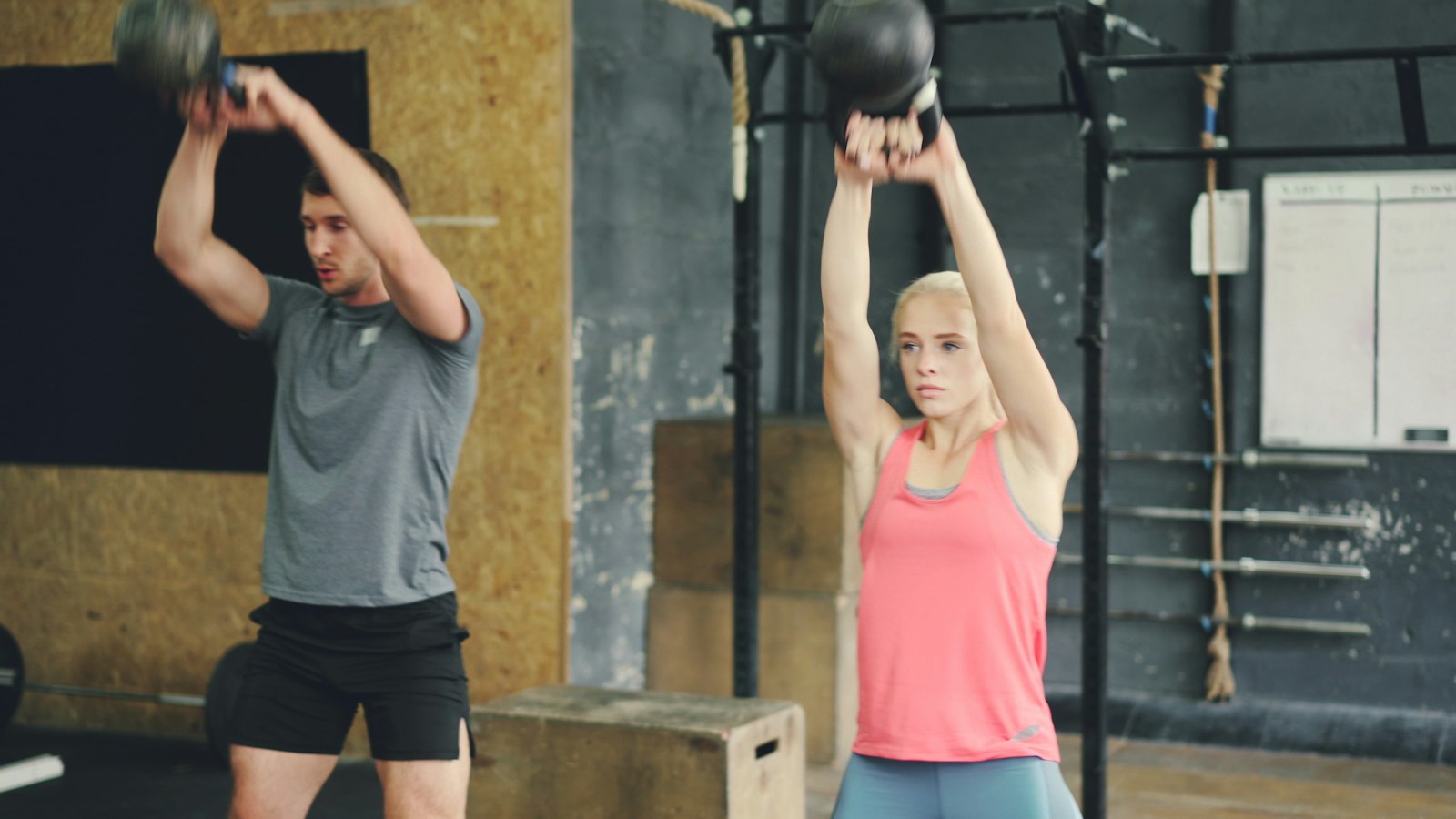



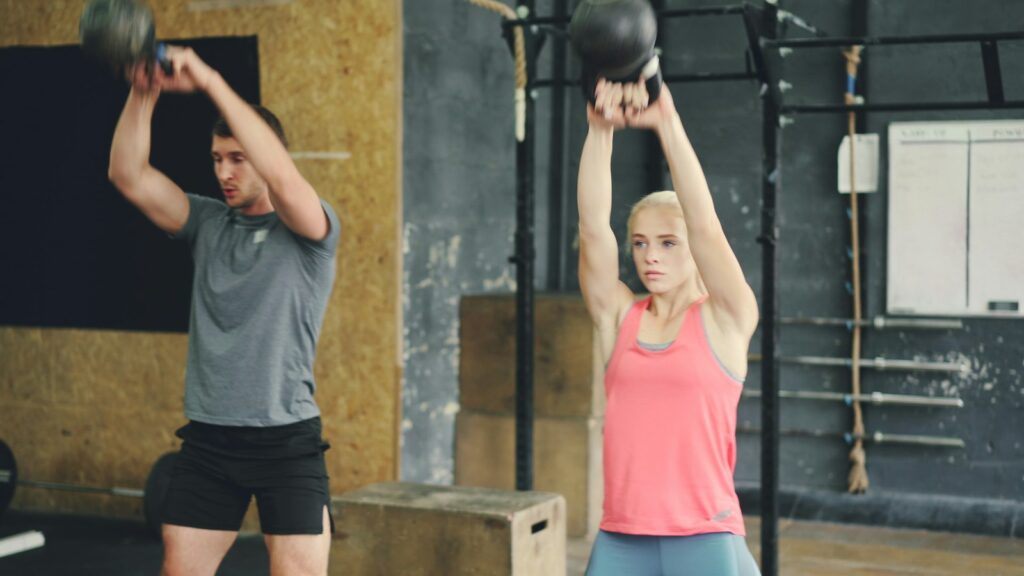
The short answer: the kettlebell snatch is a one-arm movement that takes the bell from between your legs to overhead in one smooth pull. Your hips create the power, your arm guides the bell, and you finish with your arm locked out overhead. It trains your glutes, hamstrings, back, shoulders, grip and heart and lungs in a single movement. It’s one of the best kettlebell exercises for power and conditioning, but it’s also one of the most technical. Learn the swing first, keep the bell close and punch through at the top so it doesn’t crash onto your forearm.
This guide is for anyone who can already swing a kettlebell and wants to take the next step. I’ll cover what the snatch works, what the research shows, how to learn it in stages, the mistakes I see most and how to use it in your training.
What muscles does the kettlebell snatch work?
| Area | What it does in the snatch |
|---|---|
| Glutes and hamstrings | Snap your hips forward to drive the bell up |
| Lower and upper back | Keep your spine strong as the bell swings back and rises |
| Lats | Guide the bell back between your legs and keep it close on the way up |
| Shoulders and triceps | Stabilize the bell overhead at lockout |
| Core | Stops you leaning or twisting under a one-arm load |
| Grip and forearms | Hold the handle through every rep |
| Heart and lungs | Work hard because the movement is fast and uses the whole body |
What the research says
Kettlebell research is still small. A 2019 scoping review found that most kettlebell studies are small and of low quality, so treat these findings as promising rather than proven.
- The snatch and the swing produce similar power. A 2014 study of 22 men measured both lifts with a 24 kg (53 lb) kettlebell on a force plate. The snatch moved the lifter-and-bell system higher, and the swing had more forward drive, but overall mechanical output was similar. The authors suggested the two could be used interchangeably for power training.
- Snatch intervals can improve aerobic fitness. In a 2015 study of 17 female college soccer players, one group did 20 minutes of kettlebell snatches (15 seconds on, 15 seconds off) three times a week for 4 weeks. Their VO2max, a measure of aerobic fitness, rose by about 6%. A group doing 20 minutes of circuit weight training showed no change.
- A snatch workout is hard work. In a 2009 study of 10 adults using the same 15-on, 15-off snatch workout for 20 minutes, heart rate averaged about 93% of each person’s kettlebell maximum, and estimated energy use was about 13.6 calories per minute. The author noted this was likely an underestimate.
So the snatch looks like a strong option for power and conditioning, with a few small studies to back it up. The coaching advice below comes from my experience teaching it.
Before you snatch: are you ready?
I’d hold off on the snatch until you can do these:
- A solid two-hand kettlebell swing with a strong hip snap and a flat back.
- Single-arm swings with control on both sides.
- A clean and a strict overhead press with the same bell, as in the kettlebell clean and press demo.
- A comfortable overhead lockout, with your arm next to your ear and no pain or arching of your lower back.
If overhead pressing hurts your shoulder, skip the snatch for now and use swings instead.
How to do a kettlebell snatch
Setup
- Place the kettlebell about a foot in front of you, between your feet. Stand with your feet about shoulder width apart.
- Hinge at your hips, keep your back flat and grab the handle with one hand.
- Hike the bell back between your legs, as you would at the start of a swing.
The pull
- Snap your hips forward hard. Let the hip drive move the bell, not your arm.
- As the bell rises past your waist, keep your elbow bent and the bell close to your body. Think of pulling your elbow up and back, like starting a lawnmower.
- As the bell reaches about face height, punch your hand up through the handle so the bell rolls around your hand and settles on the back of your forearm.
- Finish with your arm locked out overhead, biceps by your ear and the bell over your shoulder.
The drop
- Shift your weight slightly toward the working side and let the bell fall from overhead, turning your palm toward you as it drops.
- Keep your arm close as the bell falls, then hinge at your hips to guide it back between your legs.
- Go straight into the next rep, or park the bell on the floor to reset.
Coaching cues I use: “hips, not arms,” “keep it close” and “punch the ceiling” at the top. If the bell bangs your forearm, your punch-through is too late or the bell is too far from your body.

A simple progression to learn the snatch
- Two-hand swing: build the hip snap.
- One-arm swing: learn to control the bell with one hand.
- High pull: swing the bell up and pull your elbow back so the bell stops at chest height. This teaches you to keep it close.
- Half snatch: snatch the bell overhead, then lower it to the rack position at your chest before dropping it back between your legs. This is easier on your grip and forearm while you learn.
- Full snatch: drop the bell straight from overhead into the next swing.
Spend at least a week or two at each stage. Move on when the step feels smooth on both sides.
Common mistakes and how to fix them
| Mistake | Why it matters | Fix |
|---|---|---|
| Lifting with your arm | Tires your shoulder and misses the hip power | Snap your hips and let the bell float up |
| Bell swinging out in a wide arc | Makes the bell crash onto your forearm at the top | Keep your elbow bent and pull the bell close to your body |
| Bell slamming your forearm | Bruises your arm and loses control | Punch your hand through the handle earlier |
| Gripping too tight | Tears up the skin on your hand | Hold firmly but let the handle rotate in your palm |
| Leaning back at the top | Puts stress on your lower back | Squeeze your glutes and stack the bell over your shoulder |
| Rounding your back on the drop | Your back takes the load | Hinge at your hips and keep your chest up as the bell falls |
| Going too heavy too soon | Technique breaks down fast | Start lighter than your swing bell |
How heavy should your snatch kettlebell be?
Start with a bell you can press overhead comfortably for 5 or more reps with one arm. For most people, that’s noticeably lighter than the bell they swing. In the 2015 soccer study, the players used a 12 kg (26 lb) bell. Go heavier only when every rep is smooth and your forearm isn’t taking a beating.
Kettlebell snatch workouts
These are starting points I use with most people. Adjust them to your fitness and the rest of your program.
| Goal | Workout | Notes |
|---|---|---|
| Learning | 5 sets of 3–5 reps per arm, rest 60–90 seconds | Stop each set while your technique is still crisp |
| Power | 6–8 sets of 3–5 reps per arm, full rest | Every rep fast. Stop when speed drops |
| Conditioning | 15 seconds of snatches, 15 seconds of rest, for 10–20 minutes | Switch arms each round. Start at 10 minutes |
| Finisher | EMOM for 6–10 minutes, 5–8 reps, alternating arms | EMOM means every minute on the minute |
Snatches are hard on your grip and hands. Do them once or twice a week, and do them before heavy pulling work like deadlifts or rows, not after.
Looking after your hands
- File down thick calluses so they don’t tear.
- Let the handle turn in your hand instead of squeezing as hard as you can.
- Stop the set if a hot spot or blister starts to form.
- Use chalk if your hands are sweaty, so you don’t over-grip.
Summary
- The kettlebell snatch takes the bell from between your legs to overhead in one pull.
- It trains your hips, back, shoulders, core, grip and conditioning together.
- Small studies show it produces power similar to the swing and can improve aerobic fitness.
- Learn the swing, high pull and half snatch first.
- Keep the bell close, punch through at the top and start with a lighter bell than you swing.
Train kettlebells with a plan
The snatch is a skill, and skills improve with steady, planned practice. That’s where 12REPS helps.
12REPS gives you trainer-built programs with two demo videos for every exercise, so you can study each step before you try it. The built-in timer runs your 15-on, 15-off intervals and EMOMs, the gym log shows which bell you used last time, and Build Your Routine lets you add snatches to your own week. Every new account starts with a 7-day free trial.
Download 12REPS and see what you’ll get:
Sources
- Lake JP, Hetzler BS, Lauder MA. Magnitude and relative distribution of kettlebell snatch force-time characteristics. Journal of Strength and Conditioning Research. 2014;28(11):3063–3072.
- Falatic JA, et al. Effects of kettlebell training on aerobic capacity. Journal of Strength and Conditioning Research. 2015;29(7):1943–1947.
- Schnettler C. Energy cost and relative intensity of the kettlebell workout. Master’s thesis, University of Wisconsin-La Crosse. 2009.
- Meigh NJ, Keogh JWL, Schram B, Hing WA. Kettlebell training in clinical practice: a scoping review. BMC Sports Science, Medicine and Rehabilitation. 2019;11:19.
Related reading
- How to Do a Kettlebell Swing: Form, Cues and Common Mistakes
- Total Body Kettlebell Strength: One Kettlebell. Six Exercises. Your Entire Body.
- 8-Week Kettlebell Program for Athletic Women
- The 3-Day Advanced HIIT Split
I’m Will Duru, a personal trainer and the founder of 12REPS. I hold a BSc (Hons) in Sport and Exercise Science and have more than a decade of experience coaching people in strength training.
