




By Will Duru, personal trainer and founder of 12REPS.
The Short Answer
Compound exercises, like squats, presses and rows, work several muscles at once. Isolation exercises, like curls and leg extensions, focus on one muscle. You need both, but in different amounts.
Build your program around compound exercises. They train lots of muscle in little time and build more overall strength. Then add isolation exercises to target muscles you want to grow more, such as your arms, shoulders or calves.
What Is the Difference?
| Compound (multi-joint) | Isolation (single-joint) | |
|---|---|---|
| Joints that move | Two or more | One |
| Muscles worked | Several at once | Mainly one |
| Examples | Squat, deadlift, bench press, row, pull-up | Biceps curl, leg extension, lateral raise, leg curl |
| Weight lifted | Heavier | Lighter |
| Time efficiency | High | Lower |
| Best for | Overall strength and size | Targeting specific muscles |
What the Research Says
- Compound training built more strength and fitness. In a 2017 study by Paoli and colleagues, 36 active men trained for eight weeks with either only compound or only isolation exercises, with the same total workload. Both groups lost fat and gained lean mass equally. The compound group gained more strength on the bench press, squat and even the leg extension, and improved their aerobic fitness more.
- For the arms, results are mixed. In a 2015 study by Gentil and colleagues, 29 untrained men trained their arms with either lat pulldowns or biceps curls for 10 weeks. Arm muscle size and strength increased similarly in both groups. But in a 2019 study by Mannarino and colleagues, 10 untrained men trained one arm with dumbbell rows and the other with biceps curls. The curl arm grew about twice as much (11% vs 5%).
These studies were small and mostly in untrained men. Overall, they suggest compound exercises are the best base, while isolation exercises can add extra growth for specific muscles, especially smaller ones like the biceps.
My view: start each workout with one or two compound lifts, then finish with one or two isolation exercises for the muscles you most want to improve.
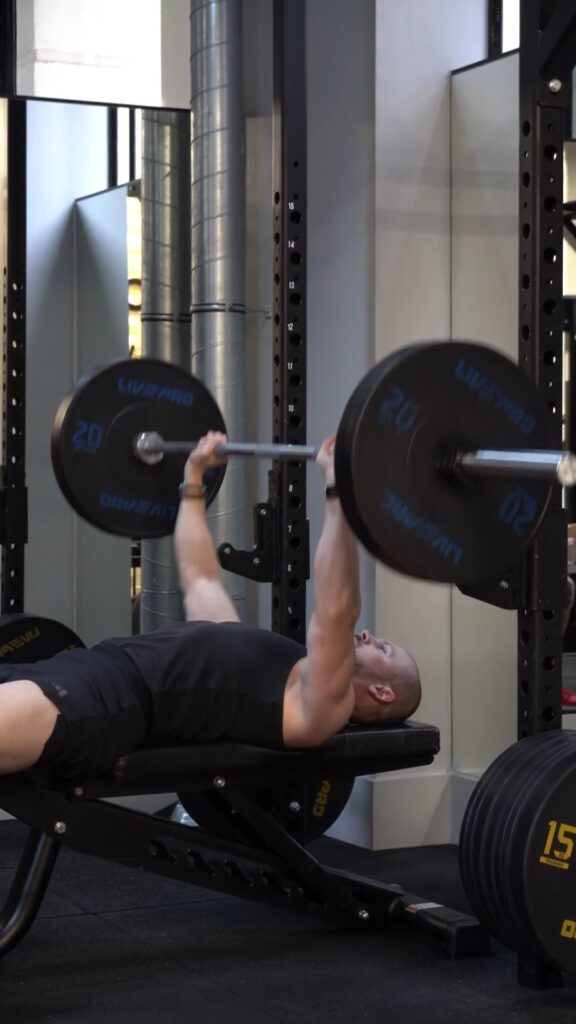
Compound Exercise Example: Bench Press
The bench press trains your chest, front shoulders and triceps in one movement.
Isolation Exercise Examples

Leg extensions target your quads, and biceps curls target your biceps. Read more in are leg extensions bad for your knees and how to build bigger arms.
When Isolation Exercises Help Most
- Small muscles that compound lifts don’t fully train, such as your biceps, side shoulders and calves. See how to do lateral raises.
- Lagging muscles you want to bring up.
- Training around an injury, when a compound lift is uncomfortable.
- Adding volume without much extra fatigue.
How to Balance Them
These are practical guidelines, not strict rules.
| Goal | Compound | Isolation |
|---|---|---|
| Strength | Most of your sets | A few, for weak points |
| Muscle size | About half to two-thirds of your sets | About one-third to half |
| Short on time | Almost all | One exercise at the end, if any |
| Beginner | Most of your sets | Light use to learn muscle control |
A simple order: big compound lifts first, when you are fresh, then isolation exercises. For more, read how many exercises per workout and the power of compound lifts.
Example Upper-Body Workout
| Exercise | Type | Sets and reps |
|---|---|---|
| Bench press | Compound | 3 to 4 sets of 6 to 10 |
| Seated cable row | Compound | 3 sets of 8 to 12 |
| Lateral raise | Isolation | 3 sets of 12 to 15 |
| Biceps curl | Isolation | 2 to 3 sets of 10 to 12 |
| Triceps pushdown | Isolation | 2 to 3 sets of 10 to 12 |
Add a rep or a little weight when you reach the top of your rep range with good form. The American College of Sports Medicine recommends progressing gradually like this.
Summary
- Compound exercises work several muscles at once and build more overall strength.
- Isolation exercises target one muscle and help with smaller or lagging muscles.
- Research suggests compound exercises are the best base, with isolation adding extra growth for some muscles.
- Do compound lifts first, then isolation exercises.
- Most people get the best results using both.
Get the Right Mix in Your Program
Not sure how many compound and isolation exercises to do? 12REPS builds a strength program around your goal, schedule and equipment, with the right balance of exercises for your level.
Every exercise has a demo and a coach tutorial from me, and your log shows what you lifted last time, so you always know when to add weight.
Download 12REPS and see what you’ll get:
Sources
- Paoli A, Gentil P, Moro T, Marcolin G, Bianco A. Resistance training with single vs. multi-joint exercises at equal total load volume: effects on body composition, cardiorespiratory fitness, and muscle strength. Front Physiol. 2017;8:1105.
- Gentil P, Soares S, Bottaro M. Single vs. multi-joint resistance exercises: effects on muscle strength and hypertrophy. Asian J Sports Med. 2015;6(2):e24057.
- Mannarino P, Matta T, Lima J, Simão R, Freitas de Salles B. Single-joint exercise results in higher hypertrophy of elbow flexors than multijoint exercise. J Strength Cond Res. 2019.
- American College of Sports Medicine. Progression models in resistance training for healthy adults. Med Sci Sports Exerc. 2009;41(3):687–708.
Related Reading
- The power of compound lifts
- Free weights vs machines
- Best exercises for each muscle group
- How to train for muscle growth
- Minimalist gym routine
I’m Will Duru, a personal trainer and the founder of 12REPS. I hold a BSc (Hons) in Sport and Exercise Science and have more than a decade of experience coaching people in strength training.
