

By Will Duru, BSc (Hons) Sport and Exercise Science, Award-winning Personal Trainer with over 10 years of experience in strength training and optimising recovery.
Strength vs hypertrophy training comes down to your main goal. Strength training aims to lift heavier weights, so it uses heavy loads, low reps and long rests. Hypertrophy training aims to build bigger muscles. Research shows it works across a wide range of loads, as long as your sets are hard.
There is plenty of overlap. Training for strength builds some muscle, and training for size makes you stronger. But changes in load, reps, rest and effort shift your results toward one goal or the other.
This guide explains the key terms, compares the two approaches side by side and covers how to eat for each goal.

What Is the Difference Between Strength and Hypertrophy?
Before you plan your training, decide what you want most. Do you want to lift heavier weights, or build bigger muscles? The two sound similar, but your body adapts in slightly different ways to each.
What is strength?
Strength is how much force your muscles can produce. In the gym, it is often measured by your one-rep max (1RM). That is the heaviest weight you can lift for one full rep with good form.
Training loads are often written as a percentage of 1RM. For example, if your squat 1RM is 100kg, 80% of 1RM is 80kg.
Getting stronger is partly about bigger muscles and partly about skill. Your nervous system gets better at using your muscles together for a given lift. That is one reason strength is specific: you get best at the lift and the load you practice.
What is hypertrophy?
Hypertrophy means an increase in muscle size. When you train hard and recover well, your muscle fibers grow larger over time. This is what most people mean by “building muscle”.
Key terms in this guide
- 1RM (one-rep max): the most weight you can lift once with good form.
- RIR (reps in reserve): how many more good reps you could have done when you stopped a set. Stopping with 2 RIR means you had about two reps left.
- RPE (rating of perceived exertion): a 1 to 10 effort scale often paired with RIR. On the RIR-based scale, RPE 10 means 0 RIR and RPE 9 means 1 RIR (Zourdos et al., 2016).
- Training to failure: continuing a set until you cannot complete another rep with good form (0 RIR).
- Volume: the amount of work you do, often counted as hard sets per muscle per week.
For more on effort scales, read RPE vs RIR for strength training.

How Strength and Hypertrophy Training Differ
Here is a side-by-side summary. The sections below explain each row.
| Factor | Strength focus | Hypertrophy focus |
|---|---|---|
| Load | Heavy, often around 80% of 1RM or more | Light to heavy: a wide range works |
| Reps per set | Usually 1 to 5 | Often 6 to 12, but higher reps also work |
| Effort (RIR) | No need to go close to failure | Closer to failure tends to help |
| Rest between sets | About 3 to 5 minutes | At least 60 to 90 seconds |
| Exercises | Mainly big compound lifts | Compound and isolation exercises |
| Frequency | Each muscle 2 to 3 times a week | Each muscle 2 to 3 times a week |
Load and reps
- For strength: use heavy weights for low reps, usually 1 to 5 per set. The ACSM recommends loads of about 80% of 1RM for strength (ACSM, 2026). A 2017 meta-analysis found that heavier loads (above 60% of 1RM) led to greater 1RM strength gains than lighter loads (Schoenfeld et al., 2017).
- For hypertrophy: the same meta-analysis found similar muscle growth with light and heavy loads when sets were taken to failure. A 2021 review concluded that muscle growth can be achieved across a much wider range of loads than the classic rep-range model suggests (Schoenfeld et al., 2021). Moderate reps, about 6 to 12 per set, are still a practical choice, because sets are neither very long nor very heavy.
Effort: how close to failure
A 2024 series of meta-regressions found that strength gains were similar across a wide range of RIR. Muscle growth, however, improved as sets ended closer to failure (Robinson et al., 2024).
- For strength: you can leave a few reps in reserve on heavy sets. This helps you keep good technique and recover for the next session.
- For hypertrophy: make your sets hard, finishing with only a few reps left. If you do take a set to failure, choose an exercise where a missed rep is safe, such as a machine or a curl.
For the average healthy adult, the ACSM notes that training to failure did not consistently change results. So hard sets matter more than all-out sets.
Rest periods
- For strength: rest longer, about 3 to 5 minutes between heavy sets, so you can lift heavy again on the next set. In one study, trained men who rested 3 minutes gained more strength than those who rested 1 minute (Schoenfeld et al., 2016).
- For hypertrophy: you don’t need very short rests. A 2024 meta-analysis found a small benefit to resting longer than 60 seconds. It found no clear extra gain beyond about 90 seconds (Singer et al., 2024). Rest at least 60 to 90 seconds, and longer on big compound lifts if you need it.
Exercise choice
- For strength: focus on the lifts you want to get stronger at. These are usually big compound lifts such as the barbell squat, deadlift, bench press and overhead press. Strength is specific, so practice the lift you want to improve.
- For hypertrophy: use a mix of compound and isolation exercises. Compound lifts train lots of muscle at once. Isolation exercises, such as biceps curls or triceps pushdowns, let you add sets for specific muscles.
Our guide to compound lifts covers the main movements and form cues.
Frequency
For both goals, training each muscle group at least twice a week is a good target. A meta-analysis found that twice a week built more muscle than once a week (Schoenfeld et al., 2016). The difference is the focus of each session: heavier sets with fewer reps for strength, more total hard sets for size.
To plan your week, see how often you should lift and the benefits of full-body workouts.
Can you train for both?
Yes. Many lifters start a session with a few heavy sets of one main lift, then move on to moderate-rep sets for muscle. Because the two goals overlap, you will improve in both, with the bigger gains in the one you prioritize.

Eating for Strength vs Hypertrophy
Training is only half the picture. What you eat supports your recovery and your progress toward either goal.
Calories
- For strength: eating around maintenance, which means enough to keep your body weight steady, is often enough. A small surplus can help if you also want to add muscle. The focus is steady energy for heavy sessions and good recovery.
- For hypertrophy: a small, steady calorie surplus means eating a little more than you burn. It gives your body the extra energy it needs to build new muscle. Keep the surplus modest to limit fat gain.
Protein, carbs and fats
- Protein: important for both goals. The International Society of Sports Nutrition (ISSN) recommends 1.4 to 2.0 g of protein per kg of body weight per day. It says this is enough for most active people to build and maintain muscle (ISSN, 2017). A 2018 meta-analysis found that extra protein stopped adding muscle gains at around 1.6 g per kg per day (Morton et al., 2018). Good sources include lean meat, fish, eggs, dairy, beans, lentils and tofu. Read more in how much protein you need to build muscle.
- Carbohydrates: your main fuel for hard training. They help you perform in heavy sessions and refill muscle glycogen (stored carbohydrate) afterward. Whole grains, fruit and vegetables are good choices.
- Fats: healthy fats support overall health and hormone production. Include foods like nuts, seeds, avocado and olive oil.
In short, both goals need enough protein and a balanced diet. Hypertrophy needs a little more food than you burn. Strength needs enough energy to train hard and recover. Consistency matters with food just as it does with training.
If you have a kidney condition or another medical condition, check with your doctor before changing your protein intake.

How 12REPS Helps You Train for Your Goal
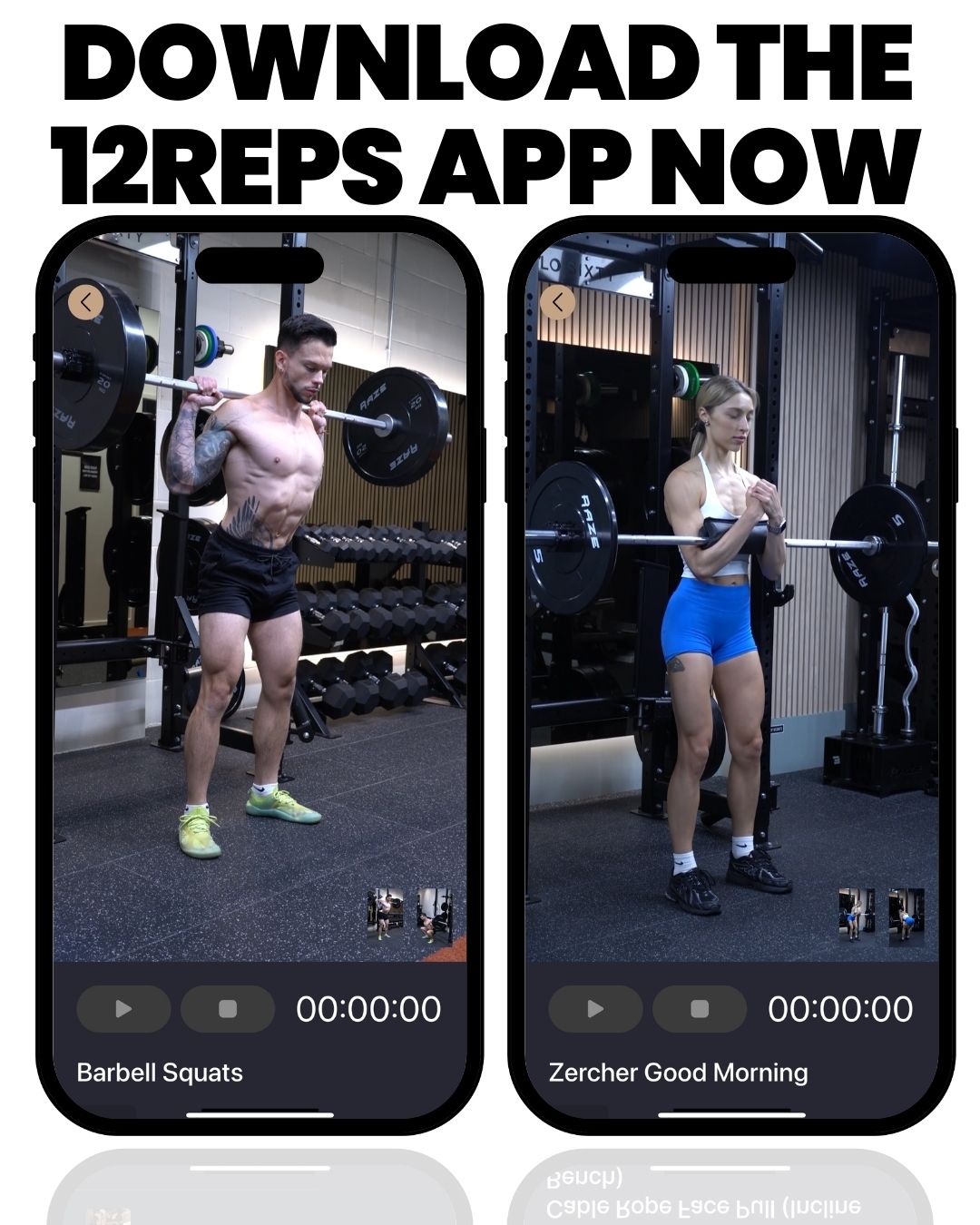
Knowing the differences is useful. Applying them every session, around work and family, is the hard part. The 12REPS app gives you direction in the gym, so you know what to do when you walk in.
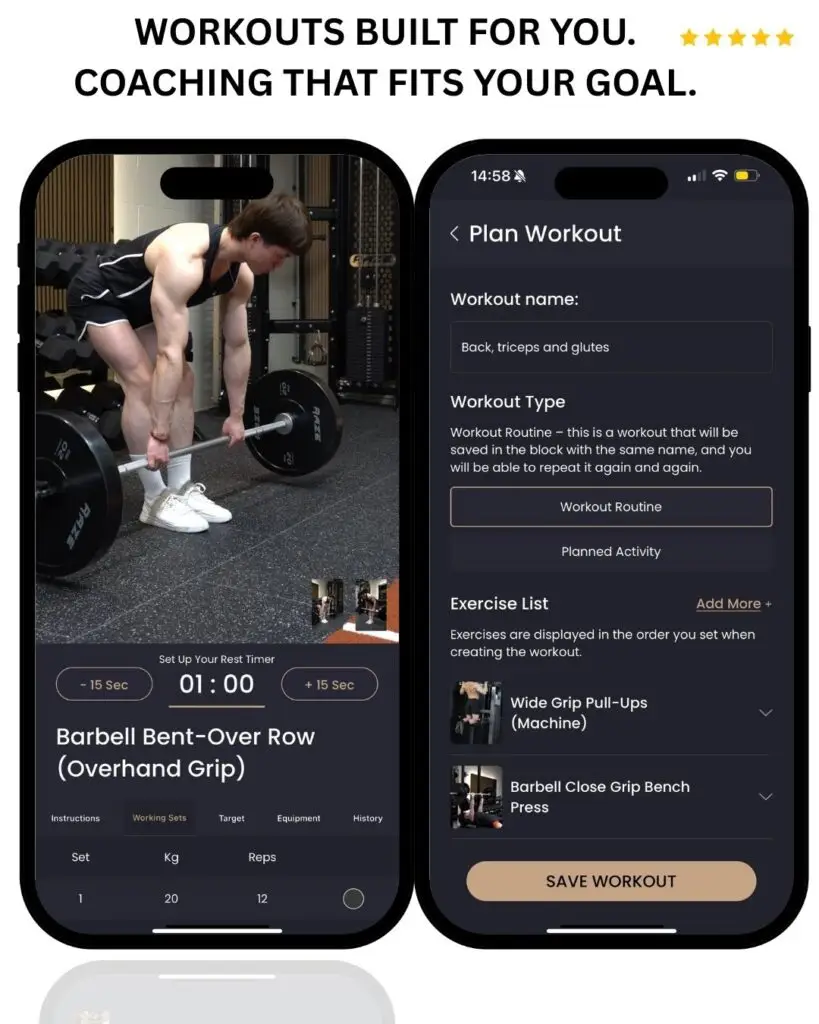
- A plan built around your goal: your training is built around your goal, your equipment and the time you have. Open the app and your workout is ready.
- Build your own: use the body map to pick a muscle, your equipment and your time, and 12REPS builds the session. Save it and train.
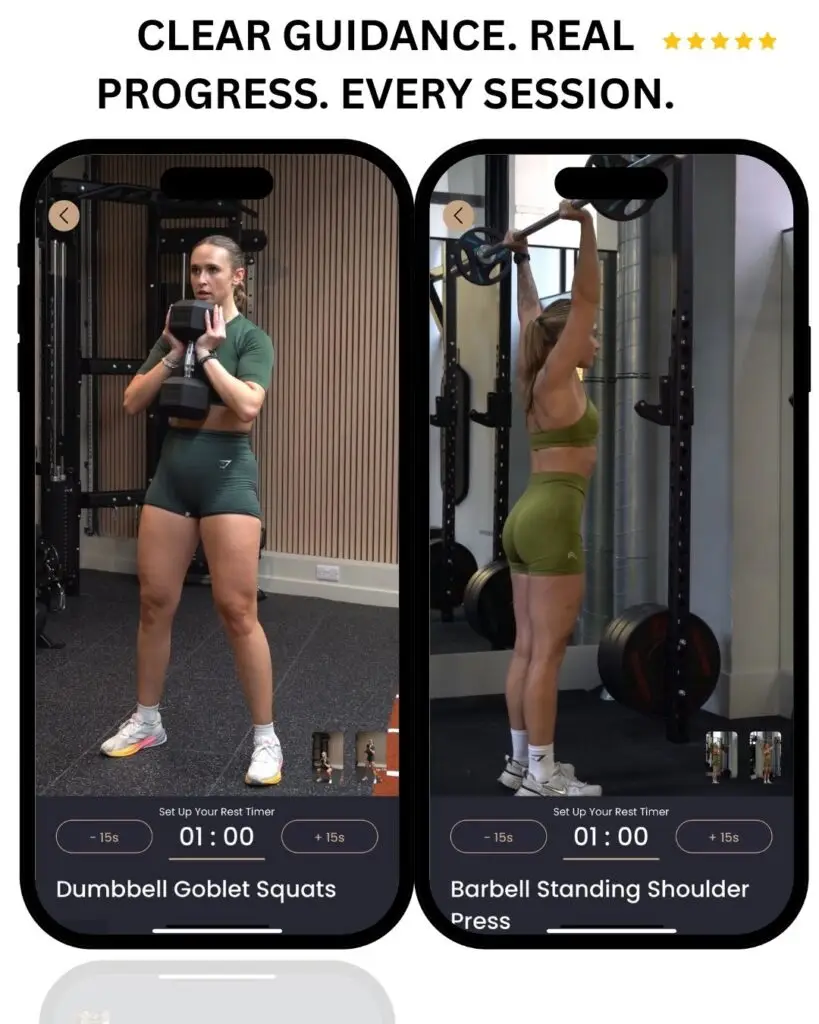
- Trainer demonstrations: every exercise has a demonstration and technique breakdown from qualified personal trainers. Good technique matters most when the weights get heavy.
- A number to beat: enter your reps and weight for each set. The app remembers what you lifted, so you can see whether you are getting stronger or doing more work over time.
- Accountability: track your workouts, sets, reps, weights and streaks, and set a weekly goal.
Conclusion: Choose Your Main Goal, Then Train for It
Strength and hypertrophy training share the same building blocks: compound lifts, enough weekly sets, good technique and progressive overload. The difference is how you set the dials.
- For strength: heavy loads, low reps, longer rests and plenty of practice on the lifts you want to improve.
- For hypertrophy: hard sets across a wide range of loads, taken fairly close to failure, with a mix of compound and isolation exercises.
Pick your main goal for the next few months, then adjust your training and eating to match. If your week is busy, our guide to choosing a workout split helps you fit your sessions in.
Want a plan built around your goal, your equipment and your time? 12REPS sets out each session and shows a trainer demonstration for every exercise.
Sources
- Strength and hypertrophy adaptations between low- vs. high-load resistance training: a systematic review and meta-analysis. Journal of Strength and Conditioning Research, 2017. https://www.pubmed.gov/28834797/
- Loading Recommendations for Muscle Strength, Hypertrophy, and Local Endurance: A Re-Examination of the Repetition Continuum. Sports (MDPI), 2021. https://doaj.org/article/6d51b905504d46f0873bb43d5d84bf21
- 5 Things to Know About Creating an Effective Resistance Training Plan (ACSM position stand infographic). American College of Sports Medicine, 2026. https://acsm.org/wp-content/uploads/2026/03/Resistance-Training-Position-Stand-infographic.pdf
- Exploring the dose-response relationship between estimated resistance training proximity to failure, strength gain, and muscle hypertrophy: a series of meta-regressions. Sports Medicine, 2024. https://rke.abertay.ac.uk/en/publications/exploring-the-dose-response-relationship-between-estimated-resist/
- Novel Resistance Training-specific Rating of Perceived Exertion Scale Measuring Repetitions in Reserve. Journal of Strength and Conditioning Research, 2016. https://openrepository.aut.ac.nz/items/efef3b25-6701-4fb5-bb82-55fcd2a26027/full
- Longer Interset Rest Periods Enhance Muscle Strength and Hypertrophy in Resistance-Trained Men. Journal of Strength and Conditioning Research, 2016. https://www.pubmed.gov/26605807/
- Give it a rest: a systematic review with Bayesian meta-analysis on the effect of inter-set rest interval duration on muscle hypertrophy. Frontiers in Sports and Active Living, 2024. https://www.frontiersin.org/articles/10.3389/fspor.2024.1429789/full
- Effects of Resistance Training Frequency on Measures of Muscle Hypertrophy: A Systematic Review and Meta-Analysis. Sports Medicine, 2016. https://pubmed.ncbi.nlm.nih.gov/27102172/
- International Society of Sports Nutrition Position Stand: Protein and Exercise. Journal of the International Society of Sports Nutrition, 2017. https://cdr.lib.unc.edu/concern/articles/gh93h184p
- A systematic review, meta-analysis and meta-regression of the effect of protein supplementation on resistance training-induced gains in muscle mass and strength in healthy adults. British Journal of Sports Medicine, 2018. https://bjsm.bmj.com/content/52/6/376.abstract