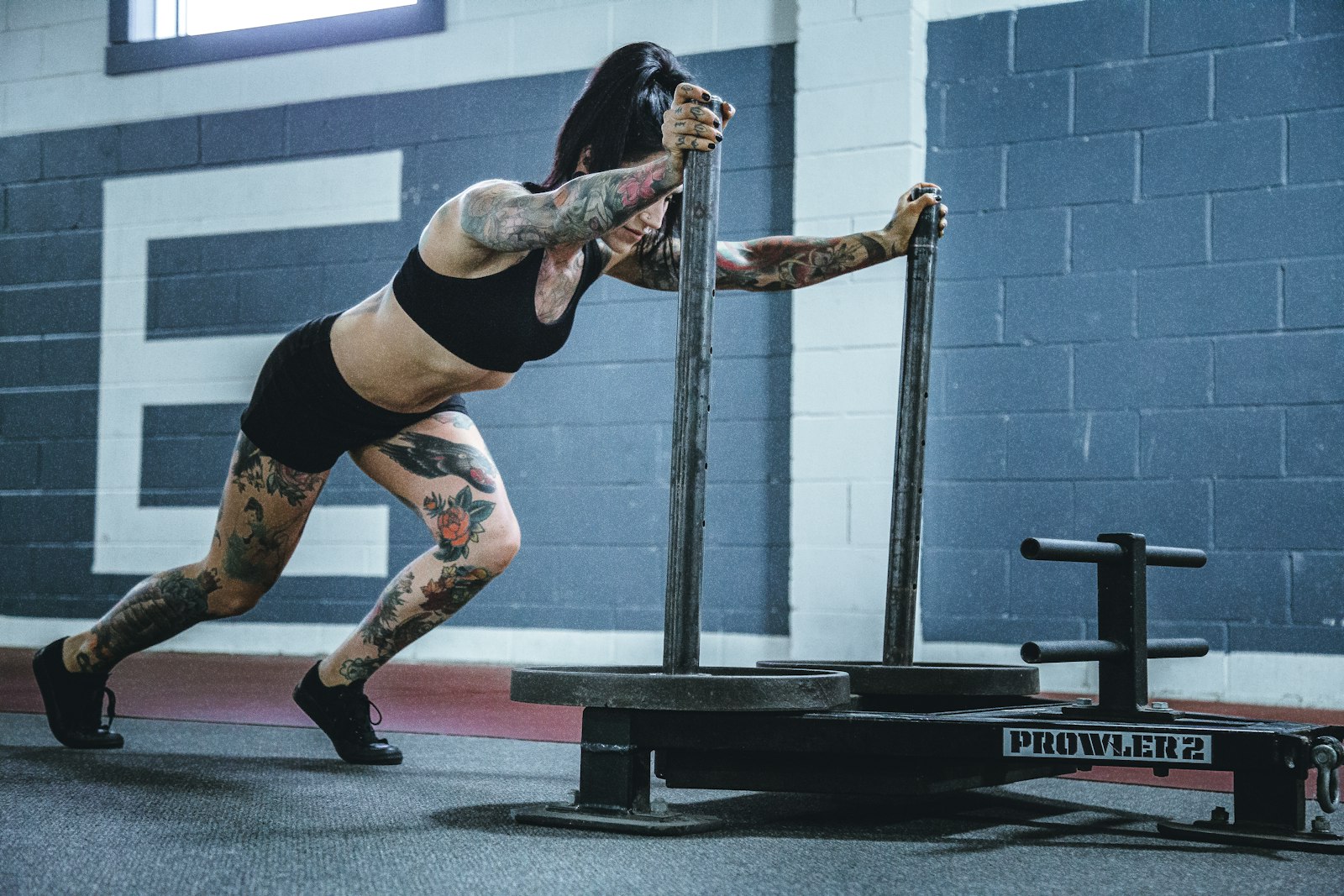


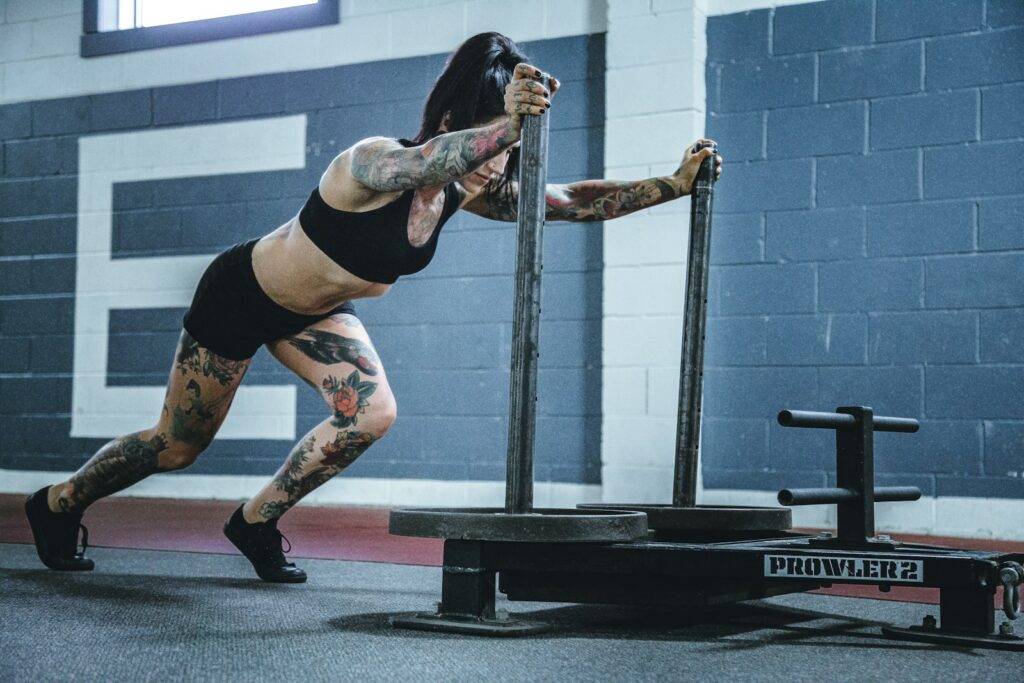
Quick answer: To push a sled, hold the handles with your arms extended, lean forward at about 45 degrees and drive the sled forward with short, powerful steps, pushing off the balls of your feet. To pull a sled, grip the rope or straps, sit your hips back and pull it toward you hand over hand, or walk backward with it. Sled pushes mainly train your quads, glutes and calves. Sled pulls train your back, arms and grip. Both build leg power and conditioning, and they’re easy to learn.
Sleds have become a staple in gyms, partly thanks to Hyrox, where the sled push and sled pull are two of the eight stations. This guide is for you if you want to know how to do them, what they train, how heavy to go and how to fit them into your week, whether you’re racing Hyrox or not.
What do sled pushes and pulls train?
| Sled push | Sled pull | |
|---|---|---|
| Main muscles | Quads, glutes, calves | Upper back, lats, biceps, forearms |
| Also works | Core, chest, shoulders and triceps to hold your body position | Legs and core to anchor you |
| Main benefits | Leg drive, acceleration, conditioning | Pulling strength, grip, conditioning |
| Skill needed | Low | Low to moderate |
What the research says
- Faster over the first few steps. In an 8-week study, 50 male high school athletes did sled pushes or regular sprints twice a week. All the sled groups improved their 5 to 20 m sprint times, and the regular sprint group didn’t. The heaviest loads produced the biggest gains (Cahill et al., 2019).
- More pushing force. In 16 amateur soccer players, 8 weeks of sled work with loads of about 80% of body weight clearly increased their ability to push horizontally, compared with normal sprinting (Morin et al., 2017).
- Probably less soreness. A sled has almost no lowering phase. Coaches use it to build strength while reducing the chance of muscle soreness. This is a proposed benefit from a review, not a measured trial result (Jenkins and Palmer, 2012).
Most sled research is in athletes and focuses on sprint speed. There’s less research on sleds for muscle building or general fitness, so those benefits rely more on coaching experience.
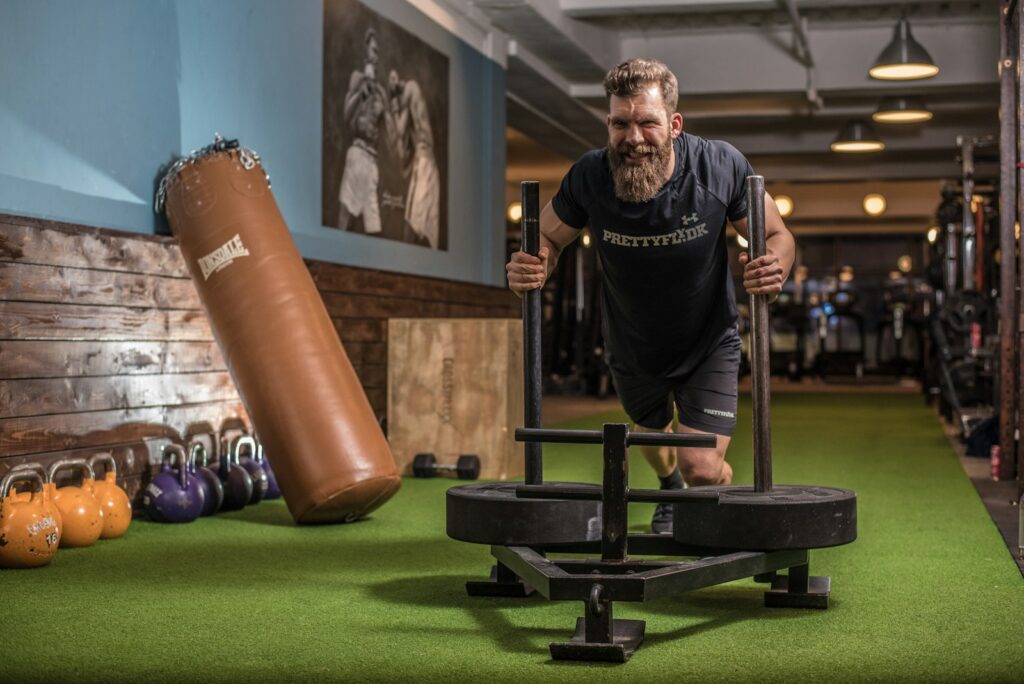
How to do a sled push
Setup
- Load the sled and stand behind it.
- Grip the handles. High handles keep you more upright. Low handles put you in a lower, harder position.
- Step back until your arms are nearly straight and your body leans forward at about 45 degrees.
- Brace your stomach and keep your head in line with your spine.
The movement
- Drive one knee forward and push the floor away with the ball of your foot.
- Take short, powerful steps, one after the other.
- Keep your hips low and your back flat. Don’t let your hips shoot up.
- Keep pushing until you reach the end of your lane, then reset.
Coaching cues: “Push the floor behind you.” “Short, fast steps.” “Arms long, body leaning in.”
How to do a sled pull
There are two common ways to pull a sled:
Rope pull (used in Hyrox)
- Stand facing the sled with the rope in front of you.
- Sit your hips back and bend your knees slightly, like a quarter squat.
- Pull the rope toward you hand over hand, using your back and arms.
- Use your legs and a slight lean back to help each pull.
- Keep the slack rope tidy behind you so you don’t trip on it.
Backward drag
- Hold the straps or handles with your arms extended.
- Sit back into a quarter squat.
- Walk backward with small steps, keeping tension on the straps.
Coaching cues: “Sit back and anchor.” “Long pulls, not short tugs.” “Keep your back flat.”
Common mistakes
- Standing too upright on the push. You lose drive. Lean in at about 45 degrees.
- Hips shooting up. Your back takes over. Keep your hips low and your stomach braced.
- Long, slow strides. Short, quick steps keep the sled moving. Stopping and starting is much harder.
- Too much weight. If the sled barely moves or your form breaks, go lighter.
- Pulling with just your arms. On the pull, sit your hips back and use your legs and back too.
- Rounding your back on the pull. Keep your chest up and your back flat.
How heavy should you go?
Sled friction changes with the floor surface, so the same weight can feel very different from gym to gym. Use how fast you move as your guide, not just the number on the plates.
| Goal | Load | Distance | Sets and rest |
|---|---|---|---|
| Conditioning | Light to moderate: you can keep moving without stopping | 20 to 40 yards | 6 to 10 rounds, rest 60 to 90 seconds |
| Leg strength and power | Heavy: slow but steady steps | 10 to 20 yards | 4 to 6 sets, rest 2 to 3 minutes |
| Acceleration | Heavy to very heavy | 10 to 20 yards | 4 to 6 sets, full rest |
| Hyrox prep | Race weight or slightly heavier | Race distance in sections | 3 to 5 sets, then practice with runs between |
Hyrox sled weights
If you’re training for Hyrox, these are the race weights, including the sled (Red Bull):
| Division | Sled push | Sled pull |
|---|---|---|
| Open, women | 102 kg (about 225 lb) | 78 kg (about 172 lb) |
| Open, men | 152 kg (about 335 lb) | 103 kg (about 227 lb) |
| Pro, women | 152 kg (about 335 lb) | 103 kg (about 227 lb) |
| Pro, men | 202 kg (about 445 lb) | 153 kg (about 337 lb) |
The sled push covers 50 m (about 55 yards), split into four 12.5 m lengths (GOWOD). Race floors can feel very different from your gym floor, so practice on the heavy side.
How to fit sleds into your training
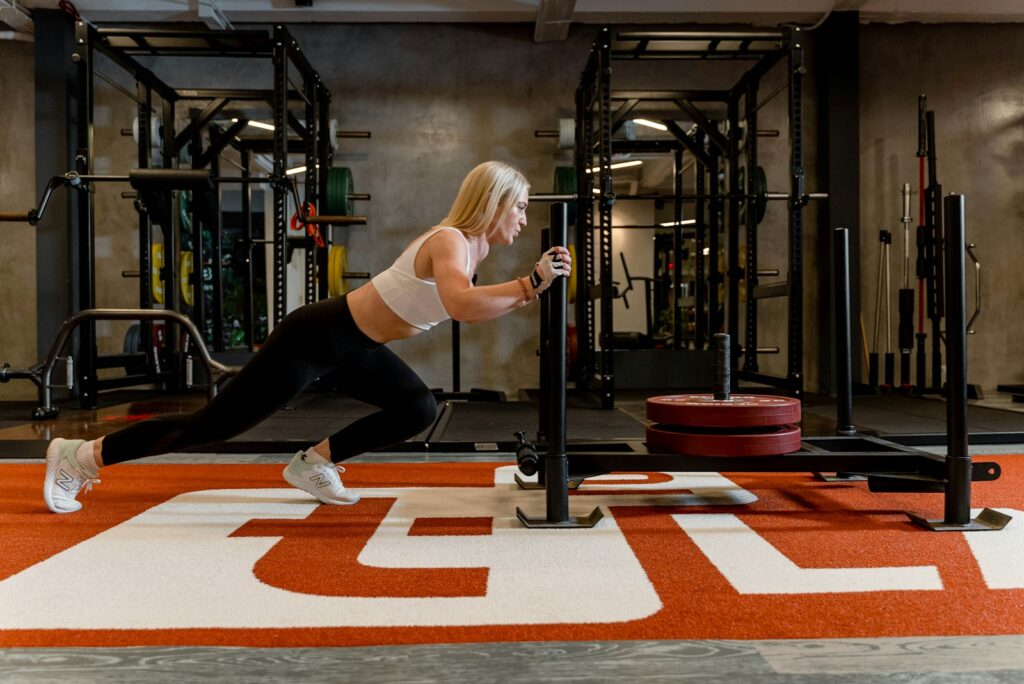
- At the end of leg day: 4 to 6 heavy pushes as a finisher.
- On a conditioning day: alternate sled pushes and pulls with rowing, running or farmer’s carries.
- For Hyrox: practice pushes and pulls with a short run before each one, so you get used to doing them on tired legs.
- For beginners: start light, focus on body position and add weight over time.
Because sleds have almost no lowering phase, many people can train them more often than heavy squats or deadlifts. Still, start with once or twice a week and build up.
Summary
- Sled pushes train your quads, glutes and calves. Sled pulls train your back, arms and grip.
- Lean in at about 45 degrees and take short, powerful steps on the push.
- Sit back and use your legs and back on the pull, not just your arms.
- Sled training improved short sprint speed and pushing force in research.
- Choose the load by your goal: lighter for conditioning, heavier for strength and power.
- Hyrox Open sled push weights are 102 kg for women and 152 kg for men.
Train for Hyrox, or just get fitter, with a plan
Sleds work best as part of a balanced plan with strength work, running and recovery. 12REPS gives you trainer-built programs, two demo videos for every exercise and a gym log that tracks your sets and times, so you can see your progress week by week. New users get a 7-day free trial.
Download 12REPS and see what you’ll get:
Sources
- Cahill MJ et al. Influence of resisted sled-push training on the sprint force-velocity profile of male high school athletes. Scand J Med Sci Sports, 2019
- Morin JB et al. Very-heavy sled training for improving horizontal-force output in soccer players. Int J Sports Physiol Perform, 2017
- Jenkins NDM, Palmer T. Implement training for concentric-based muscle actions. Strength Cond J, 2012
- Red Bull. Hyrox weights overview
- GOWOD. How far is the sled push in Hyrox?
Related reading
- Hyrox training: how to adapt from strength to hybrid fitness
- Master strength: the hidden edge in Hyrox competitions
- Hybrid athlete training
- Farmer’s carry: how to do it and why it works
- How to do a trap bar deadlift
- How to do a kettlebell swing
I’m Will Duru, a personal trainer and the founder of 12REPS. I hold a BSc (Hons) in Sport and Exercise Science and have more than a decade of experience coaching people in strength training.