


To lose belly fat, you need to lose body fat overall. The most reliable way is a steady calorie deficit, enough protein, regular strength training, more daily movement and good sleep. You can’t choose where fat comes off first, so your waist usually shrinks gradually as your total body fat goes down.
That can feel frustrating when your stomach is the area you care about most. The good news is that the habits that lower your overall body fat also reduce the fat around your middle. This guide explains what works, what doesn’t, and what to expect.
Can you spot-reduce belly fat?
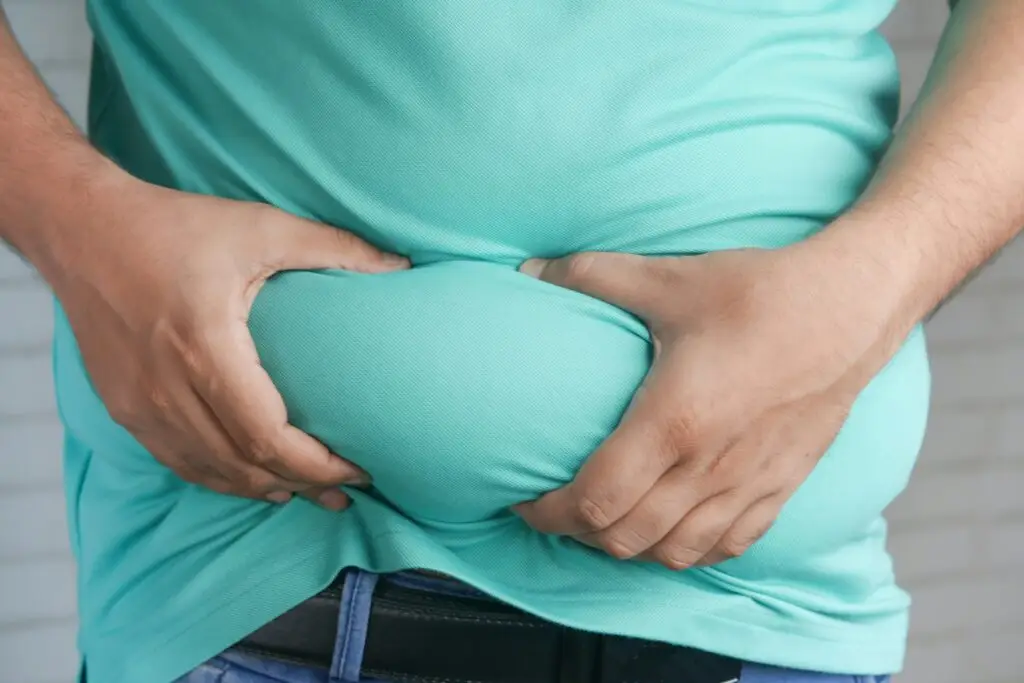
No. Spot reduction is the idea that training one body part burns the fat over that area. Doing crunches to lose stomach fat is the classic example.
A 2022 systematic review and meta-analysis pooled 13 studies with 1,158 healthy people. The studies compared a trained limb with the untrained limb on the other side. Training one area had no effect on the fat stored in that area.
Core exercises still strengthen the muscles of your trunk. They just don’t remove the fat that sits on top of them.
Two types of belly fat
- Subcutaneous fat sits just under your skin. It’s the fat you can pinch.
- Visceral fat sits deeper, around your organs. You can’t see it or pinch it.
A tape measure is a simple way to keep an eye on both. The NHS suggests keeping your waist size to less than half your height.
Step 1: Create a calorie deficit
A calorie deficit means you eat fewer calories than your body uses. Your body then draws on stored fat to make up the difference. Without a deficit, you won’t lose fat, wherever it’s stored.
That doesn’t mean starving yourself. Cutting calories too hard often leads to low energy, cravings and binge eating. The NHS weight loss plan aims for a safe and sustainable rate of 0.5 kg to 1 kg (1 to 2 lb) a week.
Small, steady changes add up. Start with the easy wins:
- Coffee drinks with cream, sugar or syrup
- Extra late-night beers or glasses of wine
- Biscuits, chocolate and snacks eaten out of habit
- Sugary soft drinks
For a step-by-step way to set your numbers, read how many calories to eat to build muscle and lose fat.
Track your food for a few weeks
It’s easy to lose track of snacks, drinks and portion sizes. Logging your food for two or three weeks shows you where the extra calories come from.
A food-tracking app such as MyFitnessPal can help you count calories and see how much protein, carbs and fat you eat. You don’t need to track forever. Once you know your usual portions, you can switch to simpler habits.
Step 2: Eat enough protein
Protein supports muscle repair and growth after strength training. A 2018 meta-analysis of 49 studies found that eating more protein improved muscle and strength gains from training. The extra benefit for muscle leveled off at about 1.6 g of protein per kg of body weight a day.
For example, if you weigh 80 kg, that’s about 128 g of protein a day. Spread it across your meals.
Good sources include chicken, fish, eggs, Greek yogurt, tofu, beans and lentils. For more detail, see how much protein you really need to build muscle.
Step 3: Strength train two to three times a week
When people want a flatter stomach, many reach for crunches and extra cardio. Whole-body strength training deserves a place in your plan too.
Here’s why. A 2025 network meta-analysis of 62 trials looked at exercise during calorie restriction. Calorie restriction on its own led to a loss of lean mass. Adding resistance training helped people keep their lean mass while they lost body fat.
Lean mass includes your muscle. Keeping it means you stay strong, and more of the weight you lose comes from fat.
The CDC recommends muscle-strengthening activity on at least 2 days a week for adults. Build your sessions around compound exercises. These are moves that work several muscles at once, such as squats, presses, rows and carries.
Sample week: three full-body sessions
Here is an example week. Warm up before each session and choose weights you can control with good form.
Session 1 (Monday)
- Dumbbell chest press: 4 sets of 12 reps
- Dumbbell single-arm row: 4 sets of 12 reps
- Dumbbell snatch: 4 sets of 16 reps (8 each arm)
- Dumbbell farmer’s carry: 4 sets of 40 meters
- Sled push: 4 sets of 40 meters
- Medicine ball slams: 4 sets of 12 reps
Session 2 (Wednesday)
- Jogging: 10 minutes
- Sled push and pull with TRX: 5 sets of 40 meters
- Kettlebell farmer’s carry: 4 sets of 40 meters
- Leg press: 5 sets of 20 reps
- Leg extension: 5 sets of 20 reps
- Assisted machine pull-ups: 4 sets of 12 reps
- Dumbbell shoulder press: 4 sets of 12 reps
Session 3 (Friday)
- Jogging: 10 minutes
- Assault bike: 10 rounds of 8 calories
- Medicine ball slams: 4 sets of 12 reps
- Walkout to press-up (or knee press-up): 4 sets of 12 reps
- Burpees: 4 sets of 12 reps
Log your weights and reps every session. Over time, aim to add a little weight or an extra rep. This is called progressive overload, and it’s how you keep getting stronger.

Step 4: Move more every day
Aerobic exercise, often called cardio, includes brisk walking, cycling and running. It has some of the strongest evidence for reducing visceral fat.
A 2012 meta-analysis of 35 trials in adults with overweight or obesity found that aerobic exercise reduced visceral fat. Resistance training alone did not show a clear effect on visceral fat in that review.
So a good plan includes both. Use strength training to keep your muscle, and regular aerobic activity to help reduce fat. The CDC suggests at least 150 minutes of moderate activity a week, such as brisk walking.
Everyday movement counts too. Taking the stairs, walking to the shops and short walks after meals all add to the calories you use.
Step 5: Sleep well and manage stress
Sleep can affect how much of the weight you lose comes from fat. In a small 2010 study, 10 adults followed a reduced-calorie diet for two weeks, twice. With 5.5 hours in bed, the share of weight they lost as fat fell by 55% compared with 8.5 hours. They also lost more lean mass and felt hungrier.
The study was small and short, so treat it as a signal rather than proof. The CDC also includes sleep and stress management in its steps for losing weight. A regular bedtime and wake time is a sensible place to start.
How long does it take to lose belly fat?
It depends on how much fat you have to lose, the size of your deficit and how consistent you are. At 0.5 to 1 kg a week, visible changes usually take weeks to months, not days.
Your body decides where you lose fat first, not you. Be patient and stick with the process.
Don’t rely on the scale alone. Track these too:
- Your waist measurement, taken at the same time each week
- Progress photos every four weeks
- Your strength in key lifts
- How your clothes fit
If the scale stalls but your waist and strength improve, you’re still making progress. Read why strength training without weight loss can still be progress.
Want more on this topic? See how to lose belly fat and build muscle (men’s guide) and how fast you can lose weight safely.
If you have a medical condition or take medication, check with your doctor or pharmacist before you change your diet or start a new exercise plan.
If you want a plan built around your goal, your equipment and the time you have, 12REPS sets out each session with a trainer demonstration for every exercise. You can also log your body weight and progress photos to see how your body changes over time.
Sources
- A proposed model to test the hypothesis of exercise-induced localized fat reduction (spot reduction), including a systematic review with meta-analysis. Human Movement (Ramirez-Campillo R, et al.), 2022. https://doi.org/10.5114/HM.2022.110373
- Calculate your waist to height ratio. NHS, 2025. https://www.nhs.uk/health-assessment-tools/calculate-your-waist-to-height-ratio
- Losing weight: Getting started, Week 1 (NHS 12-week weight loss plan). NHS, n.d.. https://assets.nhs.uk/tools/download-panels/data/weight-loss/pdf/wlp1.pdf
- A systematic review, meta-analysis and meta-regression of the effect of protein supplementation on resistance training-induced gains in muscle mass and strength in healthy adults. British Journal of Sports Medicine (Morton RW, et al.), 2018. https://bjsm.bmj.com/content/52/6/376.abstract
- Comparing exercise modalities during caloric restriction: a systematic review and network meta-analysis on body composition. Frontiers in Nutrition (Xie Y, et al.), 2025. https://www.frontiersin.org/articles/10.3389/fnut.2025.1579024/full
- Adult Activity: An Overview. Centers for Disease Control and Prevention (CDC), 2023. https://www.cdc.gov/physical-activity-basics/guidelines/adults.html
- A systematic review and meta-analysis of the effect of aerobic vs. resistance exercise training on visceral fat. Obesity Reviews (Ismail I, et al.), 2012. https://ro.ecu.edu.au/ecuworks2012/325
- Insufficient sleep undermines dietary efforts to reduce adiposity. Annals of Internal Medicine (Nedeltcheva AV, et al.), 2010. https://pubmed.ncbi.nlm.nih.gov/20921542/
- Steps for Losing Weight. Centers for Disease Control and Prevention (CDC), 2025. https://www.cdc.gov/healthy-weight-growth/losing-weight/index.html