


Written by Will Duru, BSc (Hons) Sport and Exercise Science, Award-winning Personal Trainer with over 10 years of experience in strength training and optimising recovery
A back and triceps workout trains the muscles that pull and the muscles that straighten your elbows in one session. Back exercises bend your elbows, which is your biceps’ job rather than your triceps’. That leaves your triceps fairly fresh for the second half of this six-exercise session.
After ten years of helping people get stronger, I know you don’t need fancy equipment for a strong back and triceps. You need the right exercises, good form and a plan you stick to.
This session uses three back exercises (lat pulldown, T-bar row and single-arm dumbbell row) and three triceps exercises (dips, kickbacks and bar push-downs).
Why Train Back and Triceps Together?
It’s a scheduling choice that works well for many lifters. Here’s why.
- Different jobs at the elbow. Rows and pulldowns bend the elbow, which is the biceps’ job. Triceps exercises straighten it.
- Your biceps get their work. Every back exercise here trains them, so you don’t need separate curls on this day.
- It fits a split. It pairs well with a chest and biceps workout on another day.
Your triceps have three heads: the long, lateral and medial heads. All three straighten your elbow. The long head also crosses your shoulder joint, so it’s stretched more when your arm is overhead (Maeo and colleagues, 2022).

The Back and Triceps Workout
| Exercise | Warm-up set | Working sets | Reps | Rest |
|---|---|---|---|---|
| Lat pulldown | 1 x 15 (light) | 5 | 10–12 | 90–120 seconds |
| T-bar row | 1 x 15 (light) | 5 | 10–12 | 90–120 seconds |
| Dumbbell single-arm row | 1 x 12 each arm (light) | 5 | 10–12 each arm | 90–120 seconds |
| Triceps dips | 1 x 10 (body weight) | 5 | 10–12 | 60–90 seconds |
| Dumbbell kickbacks | 1 x 12 each arm (light) | 5 | 10–12 each arm | 60–90 seconds |
| Bar triceps push-downs | 1 x 15 (light) | 5 | 10–12 | 60–90 seconds |
Start each exercise with a warm-up set at 50 to 60% of your working weight. It prepares your muscles and joints for heavier sets.
The Back Exercises
1. Lat Pulldown
The lat pulldown builds your lats and suits beginners who can’t do pull-ups yet. Advanced lifters use it for extra back volume.
- Sit at the machine with your thighs under the pads.
- Grab the bar with an overhand grip, hands wider than your shoulders.
- Lean back slightly and pull the bar to your upper chest, driving your elbows down and back.
- Squeeze at the bottom, then let the bar rise slowly.
Avoid: leaning far back, swinging the weight down, or letting it slam back up. Keep your core tight.
One study found an overhand grip produced more lat activity than an underhand grip, whatever the grip width (Lusk and colleagues, 2010).
2. T-Bar Row
The T-bar row targets your middle traps, rhomboids and rear delts, the muscles that add thickness to your upper back. It lets most lifters use heavy loads.
- Stand over the bar with your feet about shoulder-width apart.
- Bend at your hips and knees and grab the handles with both hands.
- Keep your back flat and pull the weight toward your chest.
- Squeeze your shoulder blades together at the top, then lower slowly.
Standing, bent-over rows load your lower back. In one small study, a standing bent-over row produced more lower-back load than a cable row or inverted row (Fenwick and colleagues, 2009). If your lower back tires before your upper back, try a chest-supported row instead.
3. Dumbbell Single-Arm Row
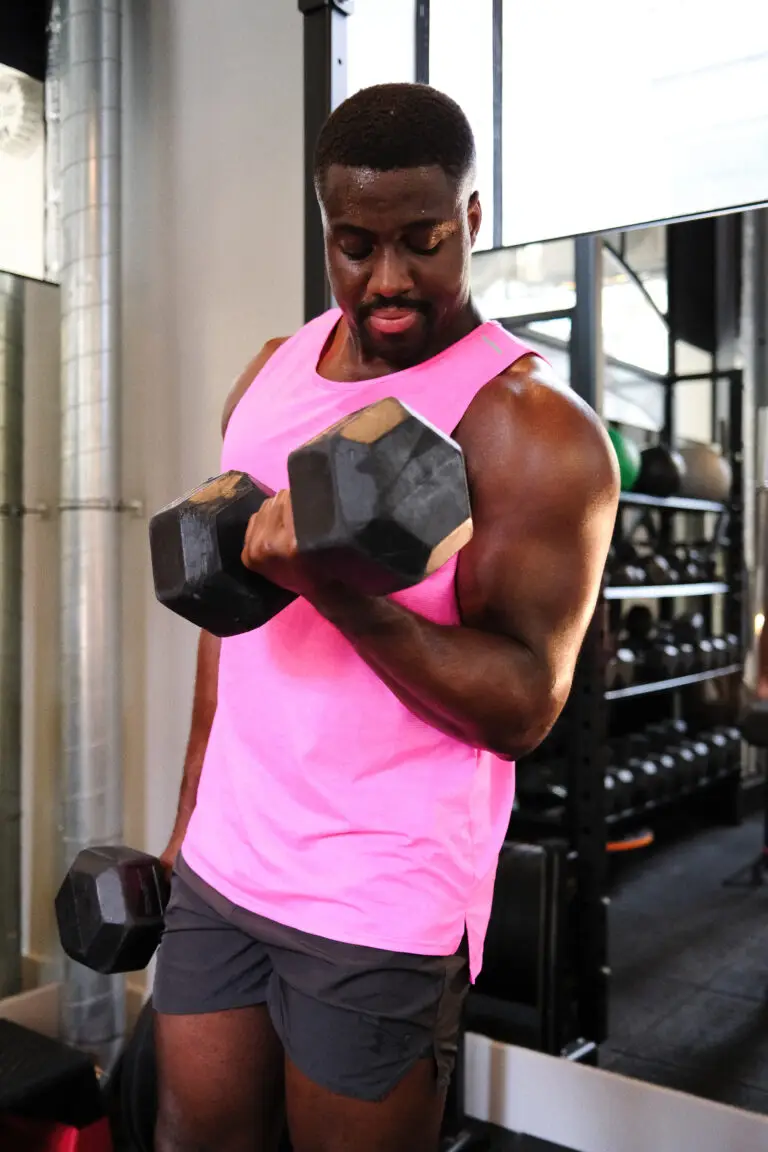
The single-arm row trains each side on its own, which helps if one side is stronger than the other. Your core also works to keep you steady.
- Put one knee and hand on a bench, and hold a dumbbell in your free hand.
- Keep your back flat and pull the dumbbell toward your hip.
- Squeeze your shoulder blade back at the top.
- Lower slowly. Do all your reps on one side before switching.
Key points: don’t twist your body as you row, and pull toward your hip, not your shoulder.
The Triceps Exercises
4. Triceps Dips
Dips are a bodyweight exercise for all three triceps heads. You can do them on a bench, a sturdy chair or a dip station.
- Sit on the edge of a bench with your hands next to your hips, fingers pointing forward.
- Slide your hips off the bench, legs straight or knees bent.
- Bend your elbows to lower your body until they reach about 90°.
- Press back up to the start.
Easier: bend your knees more. Harder: put your feet on a second bench, or add a weight plate on your lap. If dips bother your shoulders, swap them for an extra exercise you can do comfortably, such as push-downs.
More detail: triceps dip exercise guide.
Video: Triceps dips. A second dip demo from the 12REPS channel, so you can compare it with the bench version above.
5. Dumbbell Kickbacks
Kickbacks train your triceps with your upper arm held still by your side. They’re simple, but form matters.
- Put one hand and knee on a bench and hold a dumbbell in the other hand.
- Raise your upper arm until it’s parallel to the floor, elbow bent at 90°.
- Straighten your elbow to move the dumbbell back.
- Squeeze at the top, then lower slowly.
Only your forearm should move. Use a weight you can control without swinging.
Want more long-head growth? Add overhead work too. In a 12-week study, overhead cable extensions grew the long head about 1.5 times more than push-downs (Maeo and colleagues, 2022). The study used untrained adults, so results may differ for experienced lifters.
6. Bar Triceps Push-Downs
The bar push-down is a classic cable exercise that’s easy to load and progress.
- Attach a straight bar to the high pulley and grab it with an overhand grip, hands shoulder-width apart.
- Keep your elbows tucked at your sides.
- Push the bar down until your arms are straight, and squeeze your triceps.
- Let the bar rise with control.
Don’t lean over the bar or let your elbows drift forward. More detail: straight bar triceps pushdown guide.
Variation: Rope Attachment
Many gyms also have a rope handle for the same cable station. See the rope triceps extension if you want to swap the bar.
Video: Rope triceps extension. Watch this if you use the rope instead of the straight bar for your last exercise.
How to Progress This Workout
Progressive overload is the main principle in strength training. It means gradually making your workouts harder, so your muscles keep adapting.
- Aim to add weight when you can. Triceps exercises need smaller jumps than back exercises.
- If you can’t add weight, add reps. Go from 10 toward 12.
- Once you can do 12 good reps on every set, add weight and drop back to 10.
This matches ACSM guidance to raise the load by 2 to 10% once you beat your target by one or two reps (ACSM, 2009).
Better form counts as progress too. Lower each rep with control, though you don’t need very slow reps. A review found similar growth with rep durations from 0.5 to 8 seconds (Schoenfeld and colleagues, 2015).
Keep a training log with your weights, sets and reps, so you know what to beat next time.
Rest Times
Rest 90 to 120 seconds between back sets and 60 to 90 seconds between triceps sets. A timer helps you stay on track.
Resting longer than 60 seconds gave a small growth benefit in a 2024 meta-analysis, with no clear extra benefit beyond 90 seconds (Singer and colleagues, 2024). Cutting rest can make sessions shorter, but very short rests can reduce your reps.
Eating to Support Muscle Growth
Training gives your muscles a reason to grow. Your diet provides the materials.
Protein matters most here. A large meta-analysis found no further average gain in lean mass from protein above about 1.6 g per kg of body weight a day (Morton and colleagues, 2018). For a 70 kg (154 lb) person, that’s about 112 g a day.
Good sources include chicken, fish, eggs, dairy, beans and protein powder. Include some protein with each meal. Carbs fuel your training, and fats are part of a balanced diet. Drink water through the day.
If you have kidney disease or another medical condition, check with your doctor before increasing your protein.
Run This Session in 12REPS
If you want a plan built around your goal, your equipment and the time you have, 12REPS sets out each session for you. You can watch a trainer demo of every exercise, enter your reps and weight per set, and see your last numbers so you know what to beat.
Back and Triceps Workout FAQs
How often should I do this workout?
Training each muscle group at least twice a week tended to produce more growth than once a week in a meta-analysis (Schoenfeld and colleagues, 2016). Once or twice a week works for this session, alongside your other training days.
Can I swap the back exercises?
Yes. Our pull workout explains how to order rows and overhead pulls, and our back workout to build muscle covers weekly sets.
Should I add biceps curls?
You can, but the back exercises already train your biceps. For a full arm plan, see how to build bigger arms.
Sources
- Triceps brachii hypertrophy is substantially greater after elbow extension training performed in the overhead versus neutral arm position. Maeo S, Wu Y, Huang M, et al. European Journal of Sport Science, 2022. https://doi.org/10.1080/17461391.2022.2100279
- Grip width and forearm orientation effects on muscle activity during the lat pull-down. Lusk SJ, Hale BD, Russell DM. Journal of Strength and Conditioning Research, 2010. https://doi.org/10.1519/JSC.0b013e3181ddb0ab
- Comparison of different rowing exercises: trunk muscle activation and lumbar spine motion, load, and stiffness. Fenwick CMJ, Brown SHM, McGill SM. Journal of Strength and Conditioning Research, 2009. https://pubmed.ncbi.nlm.nih.gov/19197209/
- American College of Sports Medicine position stand. Progression models in resistance training for healthy adults. American College of Sports Medicine. Medicine & Science in Sports & Exercise, 2009. https://pubmed.ncbi.nlm.nih.gov/19204579/
- Give it a rest: a systematic review with Bayesian meta-analysis on the effect of inter-set rest interval duration on muscle hypertrophy. Singer A, Wolf M, Generoso L, et al. Frontiers in Sports and Active Living, 2024. https://doi.org/10.3389/fspor.2024.1429789
- Effect of Repetition Duration During Resistance Training on Muscle Hypertrophy: A Systematic Review and Meta-Analysis. Schoenfeld BJ, Ogborn DI, Krieger JW. Sports Medicine, 2015. https://doi.org/10.1007/s40279-015-0304-0
- A systematic review, meta-analysis and meta-regression of the effect of protein supplementation on resistance training-induced gains in muscle mass and strength in healthy adults. Morton RW, Murphy KT, McKellar SR, et al. British Journal of Sports Medicine, 2018. https://doi.org/10.1136/bjsports-2017-097608
- Effects of Resistance Training Frequency on Measures of Muscle Hypertrophy: A Systematic Review and Meta-Analysis. Schoenfeld BJ, Ogborn D, Krieger JW. Sports Medicine, 2016. https://doi.org/10.1007/s40279-016-0543-8