




You walk into the gym, head straight to the squat rack, load up the bar, and start squatting with your working weight. Or you lie down on the bench and immediately press heavy. No warm-up, just straight into the workout.
Here’s what usually happens: it feels uncomfortable, the weight feels heavier than it should, your range of motion is limited, and you’re risking injury with every rep.
The frustrating truth: a proper 5-10 minute warm-up significantly reduces injury risk and improves performance—but most people skip it entirely or do it completely wrong.
I’m Will Duru, a personal trainer with over 10 years’ experience in London. I’ve watched hundreds of women (and men) wander into the gym and immediately start lifting heavy weights without any warm-up. Then they wonder why they get injured or can’t lift as much as they should.
My observation from 10+ years: The women who consistently warm up properly have fewer injuries, lift heavier weights with better form, and progress faster than those who skip it. A proper warm-up isn’t “wasted time”—it’s the foundation for a safe, effective session.
This guide explains why warming up matters (backed by research), the three phases of an effective warm-up, exactly how to warm up before strength training with complete routines, common warm-up mistakes I see constantly, and how 12REPS builds warm-ups into every programme.

Why Warming Up Actually Matters
Benefit 1: Significantly Reduces Injury Risk
Research published in the International Journal of Environmental Research and Public Health found that proper warm-up programmes reduced injury risk by up to 30%.
What happens: Cold muscles and connective tissues are stiffer, less elastic, and more prone to strains and tears.
How warm-up helps: Increased blood flow raises muscle temperature, making tissues more pliable and resistant to injury.
Will’s real-world confirmation: “In 10+ years, I’ve seen countless injuries occur because someone skipped the warm-up. They load up heavy weight on cold muscles, something gives—strained hamstring, pulled shoulder, tweaked lower back. A 5-minute warm-up would have prevented it.”
Benefit 2: Improves Performance and Strength Output
A 2010 meta-analysis of 32 studies found warm-ups improved performance in 79% of scenarios across various types of exercise.
What happens: Your nervous system needs to “wake up” and prepare to recruit muscle fibres efficiently.
How warm-up helps: Activates neural pathways, improves mind-muscle connection, primes muscles for maximum force production.
Will’s typical experience: “Client squats 60kg without warm-up—struggles, form breaks down, feels heavy. Same client properly warms up—squats 65kg with better form, feels easier. The warm-up unlocked 5-8% more performance from better neuromuscular activation.”
Benefit 3: Increases Range of Motion
Research in SAGE Open Medicine shows warm-ups promote greater joint range of motion and decrease muscle stiffness.
What happens: Cold joints are stiffer, limiting how deeply you can squat or how far you can lower a weight.
How warm-up helps: Dynamic movements through full range of motion prepare joints and muscles for deep positions.
Will’s observation: “Without warm-up, client quarter-squats the weight—can’t achieve full depth. With proper warm-up, same client hits full depth squats comfortably. The difference is dramatic—warm-up literally unlocks 30-40% more range of motion.”
Benefit 4: Enhances Mind-Muscle Connection
What happens: You need mental focus to lift heavy weights safely and effectively.
How warm-up helps: Transition time from daily life to training mode, improving concentration and movement quality.
Will’s insight: “The warm-up is psychological as much as physical. It’s the mental shift from ‘just finished work, brain scattered’ to ‘focused, present, ready to train hard.’ Clients who rush this transition have poor sessions.”
Benefit 5: Reduces Post-Workout Soreness
Research indicates warming up properly can help reduce muscle soreness (DOMS) after training.
What happens: Gradual preparation of muscles reduces microtrauma from sudden intense demands.
Will’s experience: “Clients who warm up consistently report less severe soreness than those who don’t. It’s not that soreness disappears—but it’s more manageable, doesn’t impact daily life as much.”

The Three Phases of an Effective Warm-Up
Phase 1: General Warm-Up (3-5 Minutes)
Goal: Elevate heart rate, increase core temperature, increase blood flow to muscles.
What to do: Light cardiovascular activity that gets you moving and breathing slightly harder.
Options:
- Brisk walking or light jogging (treadmill or outdoors)
- Cycling (stationary bike)
- Rowing machine
- Elliptical
- Skipping/jump rope
- Incline walking
Intensity: Easy to moderate—you should be able to hold a conversation.
Will’s approach: “I have clients do 3-5 minutes on whatever cardio machine they prefer. Not hard, not breathless—just enough to get warm, heart rate slightly elevated, light sweat potentially starting. This prepares the body for what comes next.”
Why this matters: Cold muscles don’t respond well to dynamic stretching or loading. You need to raise tissue temperature first.
Phase 2: Dynamic Mobility Work (3-5 Minutes)
Goal: Take joints through full range of motion, activate muscles, prepare movement patterns.
What to do: Dynamic stretches and mobility drills specific to the workout you’re about to do.
Key principles:
- Dynamic, not static: Keep moving, don’t hold stretches
- Focus on workout-specific joints: If squatting—hips, ankles, thoracic spine; if benching—shoulders, thoracic spine
- Gradually increase range: Start controlled, progressively move through fuller range
Will’s philosophy: “This phase is where you ‘rehearse’ the movements you’re about to load. You’re teaching your nervous system ‘we’re about to squat deep, about to press overhead’—preparing the exact patterns you need.”
Sample lower body dynamic warm-up:
- Leg swings (front-to-back): 10-15 per leg
- Leg swings (side-to-side): 10-15 per leg
- Walking lunges: 10 total (5 per leg)
- Bodyweight squats: 10-15 reps, focus on depth
- Glute bridges: 10-15 reps
- Hip CARs (controlled articular rotations): 5 per side
Sample upper body dynamic warm-up:
- Arm circles: 10 forward, 10 backward
- Shoulder dislocates (with band or broomstick): 10-15 reps
- Cat-cow (thoracic mobility): 10 reps
- Band pull-aparts: 15 reps
- Scapular push-ups: 10 reps
- Wall slides: 10 reps
Sample full body dynamic warm-up:
- Inchworms: 5 reps
- World’s greatest stretch: 5 per side
- Bodyweight squats: 10 reps
- Walking lunges with rotation: 10 total
- Arm circles: 10 each direction
- Glute bridges: 10 reps
Will’s timing: “5 minutes maximum. Pick 5-6 exercises, 10-15 reps each, keep moving. Don’t overthink this—your goal is movement preparation, not exhaustion.”
Phase 3: Specific Warm-Up Sets (2-4 Sets Per Exercise)
Goal: Prepare your nervous system and muscles for the exact heavy weights you’re about to lift.
What to do: Perform the actual exercise you’re about to do, using progressively heavier weights leading up to your working sets.
This is THE most important phase—and the one most people skip.
Will’s biggest frustration: “I see women complete Phase 1 and 2, then immediately load up their working weight and start training. They’ve warmed up generally, but not specifically for the heavy load. This is where injuries happen.”
Example: Squats with 60kg working weight (3 sets of 8 reps)
Warm-up sets:
- Set 1: Empty bar (20kg) × 10 reps—focus on technique, depth, bracing
- Set 2: 35kg (58% working weight) × 6-8 reps—still light, practice form
- Set 3: 47.5kg (79% working weight) × 3-4 reps—approaching working weight, heavier feel
- Set 4: 55kg (92% working weight) × 1-2 reps—almost at working weight
- Working sets: 60kg × 8 reps × 3 sets
Example: Deadlifts with 80kg working weight (3 sets of 6 reps)
Warm-up sets:
- Set 1: 40kg (50%) × 8 reps
- Set 2: 55kg (69%) × 5 reps
- Set 3: 67.5kg (84%) × 2-3 reps
- Working sets: 80kg × 6 reps × 3 sets
Example: Bench Press with 40kg working weight (3 sets of 8 reps)
Warm-up sets:
- Set 1: 20kg (50%) × 10 reps
- Set 2: 27.5kg (69%) × 6 reps
- Set 3: 35kg (88%) × 2-3 reps
- Working sets: 40kg × 8 reps × 3 sets
Will’s warm-up set guidelines:
- Heavy compound lifts (squats, deadlifts, bench, rows): 3-4 warm-up sets
- Lighter compound lifts (lunges, hip thrusts, overhead press): 2-3 warm-up sets
- Isolation exercises (bicep curls, tricep extensions, leg curls): 1-2 warm-up sets or none if you’ve already warmed up the muscle group
Rest between warm-up sets: 30-60 seconds (shorter than working sets)
Will’s critical point: “The warm-up sets aren’t wasted reps—they’re essential preparation. They let you practice technique with lighter weights, build confidence, prepare your nervous system. Clients who warm up properly lift heavier working weights with better form than those who don’t.”

Complete Warm-Up Routines by Session Type
Lower Body Day Warm-Up (Total: 10-12 minutes before first exercise)
Phase 1: General (4 minutes)
- 4 minutes cycling or incline walking
Phase 2: Dynamic Mobility (5 minutes)
- Leg swings front-to-back: 12 per leg
- Leg swings side-to-side: 12 per leg
- Walking lunges: 10 total
- Bodyweight squats: 15 reps (focus on depth)
- Glute bridges: 15 reps
- Hip openers: 10 per side
Phase 3: Specific (for first exercise—squats)
- Empty bar × 10 reps
- 50% working weight × 6 reps
- 75% working weight × 3 reps
- 90% working weight × 1-2 reps
- Begin working sets
For subsequent exercises: 1-2 warm-up sets only (muscles already warm)
Will’s note: “After squats, you don’t need full warm-up protocol again. One or two lighter sets for deadlifts or hip thrusts is sufficient—your lower body is already thoroughly prepared.”

Upper Body Day Warm-Up (Total: 10-12 minutes before first exercise)
Phase 1: General (4 minutes)
- 4 minutes rowing machine or light jogging
Phase 2: Dynamic Mobility (5 minutes)
- Arm circles: 10 forward, 10 backward
- Band pull-aparts: 15 reps
- Shoulder dislocates: 12 reps
- Cat-cow: 10 reps
- Scapular push-ups: 10 reps
- Wall slides: 10 reps
Phase 3: Specific (for first exercise—bench press)
- Empty bar × 10 reps
- 50% working weight × 8 reps
- 75% working weight × 4 reps
- 90% working weight × 2 reps
- Begin working sets
For subsequent exercises: 1-2 warm-up sets
Full Body Day Warm-Up (Total: 10-12 minutes)
Phase 1: General (4 minutes)
- 4 minutes any cardio machine
Phase 2: Dynamic Mobility (6 minutes)
- Inchworms: 6 reps
- World’s greatest stretch: 6 per side
- Bodyweight squats: 12 reps
- Walking lunges: 10 total
- Arm circles: 10 each direction
- Band pull-aparts: 15 reps
- Glute bridges: 12 reps
Phase 3: Specific
- Follow warm-up set protocol for each major compound lift
Will’s full body approach: “Full body days include both lower and upper movements, so the dynamic mobility phase covers everything. Then warm up specifically for each major lift.”

Common Warm-Up Mistakes (That I See Constantly)
Mistake 1: Skipping the Warm-Up Entirely
The problem: Going straight into heavy working sets on cold muscles and joints.
Why people do it: “I don’t have time” or “I’ll warm up with my first working set.”
Why it’s dangerous: Dramatically increased injury risk—cold muscles are inflexible and vulnerable.
Will’s reality check: “You ‘don’t have time’ for a 5-minute warm-up, but you’ll have time for 6-8 weeks of rehab from a pulled hamstring or strained shoulder? The warm-up saves time by preventing injuries.”
The fix: Non-negotiable 5-10 minute warm-up before every session.
Mistake 2: Static Stretching Before Lifting
The problem: Holding stretches for 30-60 seconds before strength training.
Why it’s problematic: Research shows static stretching can reduce strength and power output.
What happens: Excessive static stretching temporarily reduces muscle’s ability to produce force.
Will’s observation: “Client static stretches her hamstrings for 2 minutes before deadlifts—then wonders why her deadlift feels weak. Static stretching belongs post-workout or on rest days, not pre-strength training.”
The fix: Dynamic mobility only before lifting. Save static stretching for after your session.
Mistake 3: Too Much Warm-Up (Overdoing It)
The problem: 20-30 minute warm-ups that fatigue you before your actual workout starts.
Why people do it: Excessive foam rolling, too many activation drills, too many warm-up sets.
What happens: You’re tired before your working sets begin, reducing performance.
Will’s example: “Client does 10 minutes foam rolling, 10 minutes mobility, 10 minutes activation exercises, then 8 warm-up sets for squats. She’s exhausted before her first working set. The warm-up should prepare you, not tire you out.”
The fix: 10-12 minutes maximum for entire warm-up including all phases.
Mistake 4: Not Warming Up Specifically for Heavy Lifts
The problem: General cardio and mobility only, then immediately loading working weight.
Why it’s dangerous: Your nervous system isn’t prepared for the specific heavy load.
Will’s most common observation: “This is THE mistake I see most often. Women do 5 minutes on bike, some arm circles, then immediately bench press 40kg for working sets. No empty bar practice, no progressive loading. Their first set is terrible—poor form, struggle, feels heavier than it should.”
The fix: Always do 2-4 warm-up sets with progressively heavier weights for major compound lifts.
Mistake 5: Identical Warm-Up Regardless of Workout
The problem: Same general warm-up for every session without specific preparation.
Example: Same 5-minute bike ride and arm circles whether training legs, upper body, or full body.
Why it’s suboptimal: Different workouts require different joint preparation and muscle activation.
The fix: Phase 1 can be identical, but Phase 2 (mobility) should be specific to the session (lower/upper/full body).
Will’s approach: “Lower body day? I want to see hip openers, leg swings, bodyweight squats. Upper body day? Shoulder mobility, scapular work, arm circles. The warm-up should reflect what you’re about to do.”
Mistake 6: Warming Up in the Wrong Order
The problem: Doing specific warm-up sets before general warm-up and mobility.
Example: Immediately doing warm-up sets for squats without any cardio or dynamic mobility first.
Why it’s problematic: Muscles aren’t warm enough to benefit from the specific warm-up sets.
The fix: Always follow the three phases in order: General → Dynamic Mobility → Specific Warm-Up Sets.
How 12REPS Handles Warm-Ups
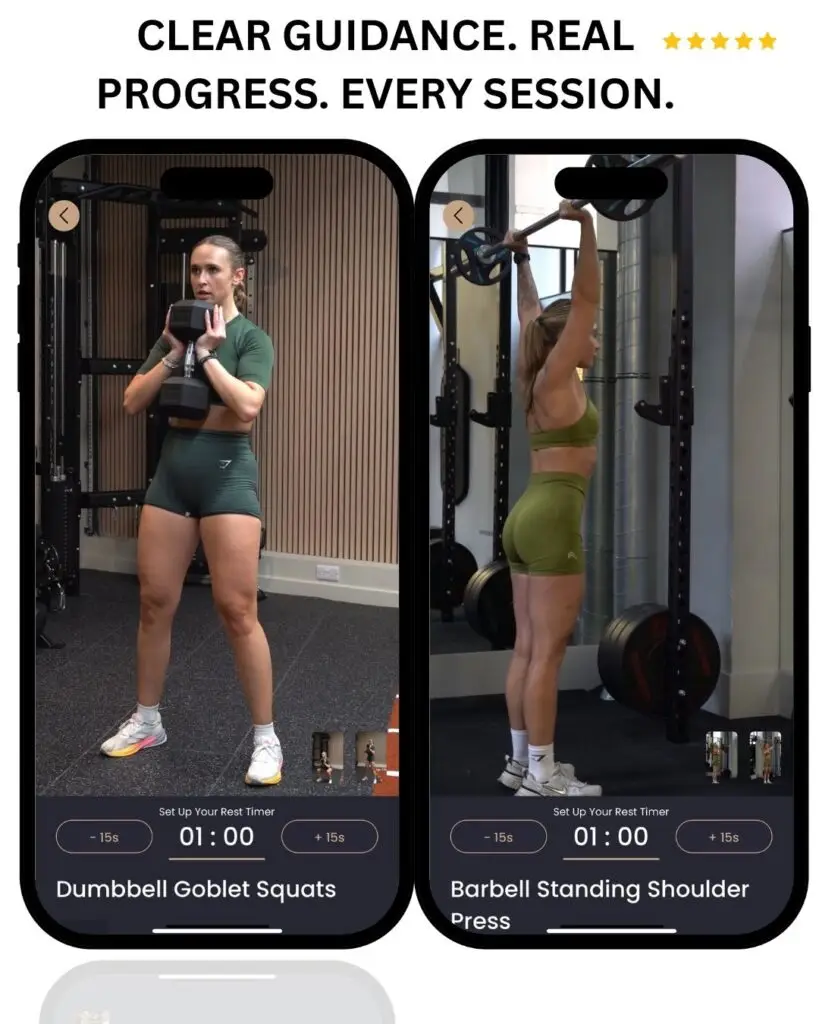
Built-In Warm-Up Guidance
Every 12REPS session includes:
- Recommended general warm-up duration (3-5 minutes)
- Specific dynamic mobility exercises for that session type
- Clear notation for warm-up sets before major lifts
Will’s integration: “I designed 12REPS programmes with warm-ups built in because I know most people skip them otherwise. The app reminds you exactly what to do and why it matters.”
Progressive Warm-Up Sets Clearly Indicated
12REPS shows:
- How many warm-up sets to complete
- Suggested weights for each warm-up set (% of working weight)
- Rest periods between warm-up sets
Example in 12REPS:
- Squats: 60kg × 8 reps × 3 sets (working sets)
- Warm-up: Bar × 10, 35kg × 6, 50kg × 3
- Then begin working sets
Session-Specific Warm-Ups
Lower body sessions: Hip and ankle mobility emphasis Upper body sessions: Shoulder and thoracic mobility emphasis Full body sessions: Complete mobility routine
Will’s philosophy: “The warm-up isn’t one-size-fits-all. What you need before squats is different from what you need before bench press. 12REPS customises warm-up recommendations based on the specific session.”
The Bottom Line
How should you warm up before strength training? The honest answer: a proper warm-up takes 10-12 minutes and includes three essential phases—but it’s the difference between safe, effective training and unnecessary injury risk.
The three phases (10-12 minutes total):
Phase 1: General Warm-Up (3-5 minutes)
✅ Light cardio to elevate heart rate and core temperature
✅ Options: walking, cycling, rowing, elliptical, skipping
✅ Intensity: Easy to moderate, conversational pace
✅ Result: Blood flow increased, muscles warm and pliable
Phase 2: Dynamic Mobility (3-5 minutes)
✅ Dynamic stretches and mobility drills
✅ Specific to your workout (lower/upper/full body)
✅ 5-6 exercises, 10-15 reps each
✅ Result: Joints through full range of motion, movement patterns activated
Phase 3: Specific Warm-Up Sets (2-4 sets per major lift)
✅ Perform the actual exercise with progressively heavier weights
✅ Heavy compounds (squat, deadlift, bench): 3-4 warm-up sets
✅ Lighter compounds: 2-3 warm-up sets
✅ Isolation exercises: 1-2 warm-up sets or none
✅ Example progression: Empty bar → 50% → 75% → 90% → working weight
✅ Result: Nervous system prepared, technique practiced, confidence built
Why this matters (research-backed benefits):
✅ 30% injury risk reduction with proper warm-up
✅ 79% performance improvement in meta-analysis of 32 studies
✅ Increased range of motion and decreased muscle stiffness
✅ Enhanced mind-muscle connection and focus
✅ Reduced post-workout soreness
Will’s decade of experience summarized:
✅ “Women who warm up consistently have fewer injuries and progress faster”
✅ “Client squats 65kg with warm-up vs struggles with 60kg without—the warm-up unlocks 5-8% more performance”
✅ “Without warm-up, quarter-squats the weight. With warm-up, full depth squats comfortably—30-40% more range”
✅ “The warm-up sets aren’t wasted reps—they let you practice technique, build confidence, prepare your nervous system”
✅ “You ‘don’t have time’ for 5-minute warm-up but you’ll have time for 6-8 weeks rehab from injury? The warm-up saves time by preventing injuries”
Common mistakes to avoid:
❌ Skipping warm-up entirely (dramatically increased injury risk)
❌ Static stretching before lifting (reduces strength output)
❌ Too much warm-up (20-30 minutes fatigues you before working sets)
❌ Not warming up specifically for heavy lifts (general only, then immediately loading working weight)
❌ Identical warm-up regardless of workout (same routine for legs and upper body)
❌ Wrong order (specific warm-up before general warm-up and mobility)
12REPS approach:
✅ Built-in warm-up guidance for every session
✅ Session-specific dynamic mobility recommendations
✅ Progressive warm-up sets clearly indicated with suggested weights
✅ Reminders so you don’t skip this critical phase
The most important insight: A 10-minute warm-up isn’t “wasted time”—it’s the foundation for safe, effective strength training. It reduces injury risk by 30%, improves performance, increases range of motion, and lets you lift heavier with better form.
Try 12REPS free for 7 days. Get structured programmes with proper warm-ups built into every session—so you never skip this critical injury-prevention phase again.
Stop risking injury by training on cold muscles. Start warming up properly. Your body will thank you with better performance, fewer injuries, and faster progress.
The 10 minutes you invest in warming up properly saves weeks of recovery from preventable injuries. Make it non-negotiable.
References
- Herman, K., Barton, C., Malliaras, P., Morrissey, D. (2012). The Effectiveness of Neuromuscular Warm-Up Strategies, That Require No Additional Equipment, for Preventing Lower Limb Injuries During Sports Participation: A Systematic Review. BMC Medicine, 10, 75. https://doi.org/10.1186/1741-7015-10-75
- Fradkin, A.J., Zazryn, T.R., Smoliga, J.M. (2010). Effects of Warming-up on Physical Performance: A Systematic Review With Meta-analysis. Journal of Strength and Conditioning Research, 24(1), 140-148. https://doi.org/10.1519/JSC.0b013e3181c643a0
- Behm, D.G., Blazevich, A.J., Kay, A.D., McHugh, M. (2016). Acute Effects of Muscle Stretching on Physical Performance, Range of Motion, and Injury Incidence in Healthy Active Individuals: A Systematic Review. Applied Physiology, Nutrition, and Metabolism, 41(1), 1-11. https://doi.org/10.1139/apnm-2015-0235
- McGowan, C.J., Pyne, D.B., Thompson, K.G., Rattray, B. (2015). Warm-Up Strategies for Sport and Exercise: Mechanisms and Applications. Sports Medicine, 45(11), 1523-1546. https://doi.org/10.1007/s40279-015-0376-x
- Woods, K., Bishop, P., Jones, E. (2007). Warm-Up and Stretching in the Prevention of Muscular Injury. Sports Medicine, 37(12), 1089-1099. https://doi.org/10.2165/00007256-200737120-00006