


By Will Duru | Certified Personal Trainer | BSc Sport Science
How many sets should you do? How many reps? How long should you rest?
Ask five people, and you will get five different answers. One says 3 sets of 10. Another says 5 sets of 5. Someone else tells you rest does not matter. The internet is full of conflicting advice, and most of it is either outdated or taken out of context.
Most people do not lack effort. They lack clarity.
This guide cuts through the noise. I am going to explain exactly how many sets, reps, and rest you need for muscle growth. No complicated science. Just clear numbers you can use in your next session.

What Are You Training For?
Before you pick your sets and reps, you need to know your goal. Training looks different depending on what you are trying to achieve.
- Strength: heavy weight, low reps, long rest. You are training your nervous system to lift more.
- Muscle growth (hypertrophy): moderate weight, moderate reps, controlled rest. You are maximising time under tension and muscle damage.
- Endurance: light weight, high reps, short rest. You are training your muscles to last longer.
This article focuses on muscle growth. That is what most people in the gym are actually after, even if they have not said it out loud. If you want to look bigger, feel stronger, and fill out your clothes, hypertrophy training is the way to go.
How Many Sets for Muscle Growth
The research is clear on this. For muscle growth, you need 10 to 20 sets per muscle group per week. Not per session. Per week. That total volume is what drives adaptation.
Where you land in that range depends on your experience.
- Beginners (under 1 year): 10 to 12 sets per muscle per week. You grow quickly. You do not need much.
- Intermediate (1 to 3 years): 12 to 16 sets per muscle per week. You need more stimulus now.
- Advanced (3+ years): 16 to 20 sets per muscle per week. Gains come slower. Volume needs to be higher.
Spread those sets across 2 sessions per week. If you need 12 sets for the chest per week, that is 6 sets on Monday and 6 sets on Thursday. Not 12 sets crammed into one session. Splitting it up leads to better recovery and performance in each session.
More is not always better. If you are doing 25 sets for a muscle group without adequate recovery, you are doing too much. The goal is the minimum effective dose that drives growth while allowing recovery.
If your sets are not going up in quality over 4 to 6 weeks, you are either doing too many or not recovering enough.
How Many Reps to Build Muscle
The 6 to 12 rep range is the primary zone for hypertrophy. That is the range where you can use enough weight to create tension while keeping the set long enough to accumulate volume.
But here is what most people get wrong. The rep range is not magic. Muscle grows across a wide range of reps as long as you are training close to failure.
- 1-5 reps: primarily build strength. Good for compound lifts. Muscle growth happens here, too, but it is harder to accumulate volume.
- 6 to 12 reps: the sweet spot for hypertrophy. Best balance of load and volume.
- 12 to 20 reps: still builds muscle if you push close to failure. Useful for isolation work and accessories.
A practical approach is to use different ranges for different exercises within the same session. Heavy compound lifts in the 6 to 8 range. Accessories in the 10-12 range. Isolation work in the 12-15 range. You cover all bases.
The number on the bar matters less than how hard the set is. A set of 15 taken to near failure will build more muscle than a set of 8, where you stopped because the number felt right.
How Hard Should You Train?
This is where most people lose gains without realising it. They finish a set and could have done 4 or 5 more reps. That is not hard enough to trigger growth.
Use Reps in Reserve, or RIR. After every set, ask yourself: how many more clean reps could I have done?
- RIR 3 to 4: too easy. Warm-up territory.
- RIR 1 to 2: the target. Hard but controlled. This is where growth lives.
- RIR 0: failure. Useful on the last set of an exercise. Not every set.
Most of your working sets should finish at RIR 1 to 2. The last rep or two should feel genuinely hard. Your form stays clean but the effort is real.
If the set did not challenge you, it did not count.
For a full breakdown of training intensity and why effort matters, read Why You’re Not Seeing Results in the Gym.

Rest Time Between Sets
Rest is not downtime. It is recovery time. How long you rest determines how well you perform on the next set. Get it wrong and you either fatigue too quickly or waste time.
Exercise Type | Rest Time | Why |
Heavy compounds | 2 to 3 minutes | Full recovery for max strength output |
Hypertrophy work | 60 to 90 seconds | Enough recovery, keeps metabolic stress high |
Isolation/conditioning | 30 to 60 seconds | Keeps intensity high, builds work capacity |
If you are benching heavy for 6 reps, rest 2 to 3 minutes. You need your nervous system and muscles ready for the next set. If you are doing lateral raises for 15 reps, 60 seconds is plenty.
The mistake most people make is resting too little on heavy lifts and too long on light ones. Match the rest to the exercise.
Pro tip: If you are scrolling your phone between sets and losing track of time, your rest periods are random. Random rest means random results. Time it or track it.
Example Workout: Push Day for Hypertrophy
Here is what all of this looks like in a real session. This is a push day built for muscle growth.
Exercise | Sets | Reps | Rest |
Bench Press | 4 | 6–8 | 2–3 min |
Incline DB Press | 3 | 8–10 | 90 sec |
Overhead Press | 3 | 8–10 | 90 sec |
Lateral Raises | 3 | 12–15 | 60 sec |
Tricep Pushdowns | 3 | 10–12 | 60 sec |
Total: 16 working sets. Chest gets 7 sets. Shoulders get 6. Triceps get 3 direct sets plus work from pressing. That is a solid push session.
Start with the heaviest compound. Work down to lighter isolation. Heavier exercises get more rest. Lighter exercises get less. Every set should finish at RIR 1 to 2.
This is one session. Repeat it every week. Beat last week’s numbers. That is how you grow.
The Biggest Mistakes People Make
You now know the numbers. Here is where people still get it wrong.
Too Many Sets
More volume is not always better. If you are doing 25 to 30 sets for one muscle group per week and you are not an advanced lifter, you are outrunning your recovery. You end up fatigued, not bigger. Start with the lower end of the range and add sets only when progress stalls.
Not Enough Intensity
If you never feel challenged during a set, you are not training hard enough. Every working set should finish with genuine effort. If you could do 5 more reps, it was a warm-up.
Resting Too Little on Heavy Lifts
Rushing through squats and bench press with 60-second rests is killing your performance. You need 2-3 minutes on heavy compounds. Take the rest. Your muscles will thank you.
Not Tracking Any of It
You can understand all of this perfectly. But if you don’t write down your sets, reps, weights, and rest times, you will forget. And if you forget, you cannot progress. Knowledge without tracking is just information. Tracking turns it into results.
Why Tracking Changes Everything
Think about your last push session.
- How many sets did you do for the chest?
- What weight did you use on the bench press?
- How many reps did you get on each set?
- How long did you rest between sets?
If you cannot answer all four, you are guessing. And guessing does not build muscle.
Hypertrophy training is precise. The numbers matter. The difference between 10 sets and 16 sets per week matters. The difference between RIR 1 and RIR 4 matters. The difference between 60 seconds and 3 minutes rest matters. You cannot manage what you do not measure.
If you do not know what you did, you cannot improve it.
Pro tip: The moment you start logging your sessions, you stop guessing and start progressing. Tracking does not just measure your training. It improves it.
This is the gap between knowing what to do and actually doing it consistently. Tracking closes that gap.
How 12REPS Makes This Simple
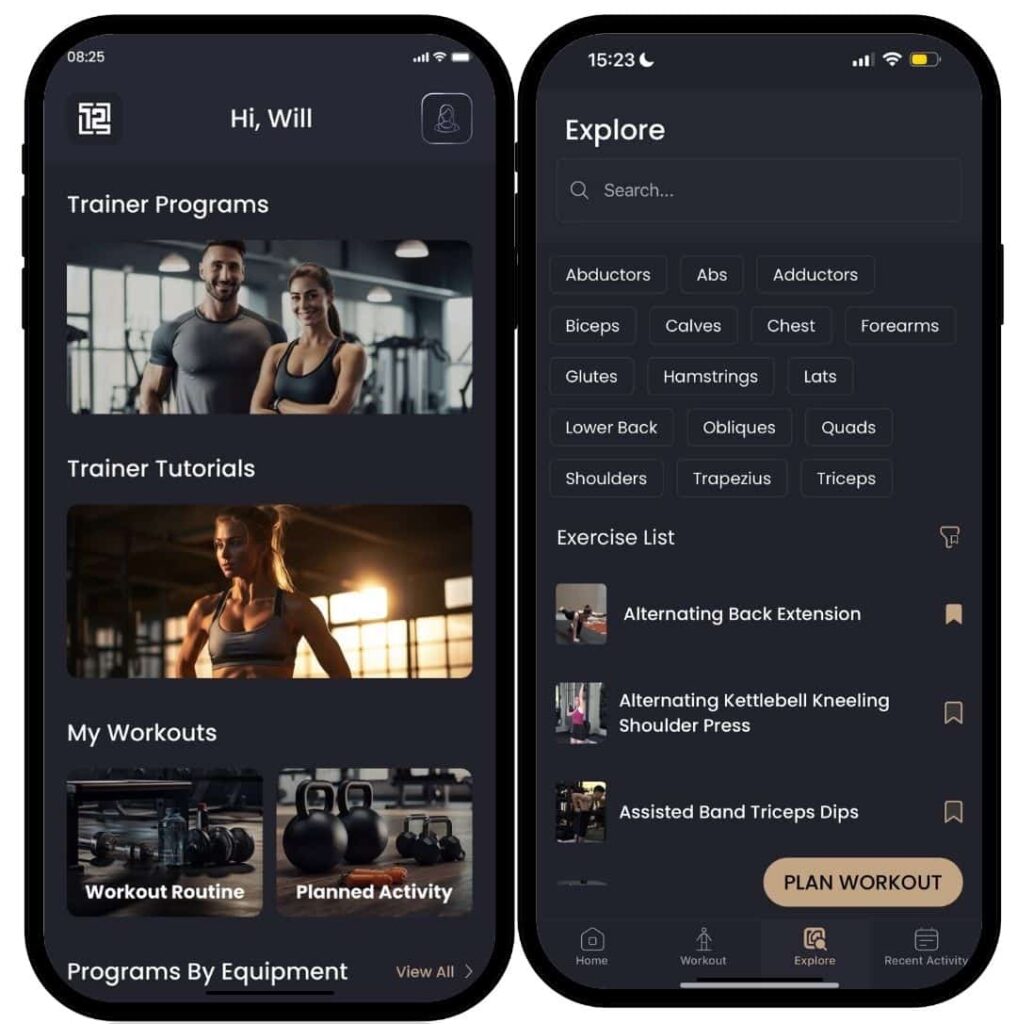
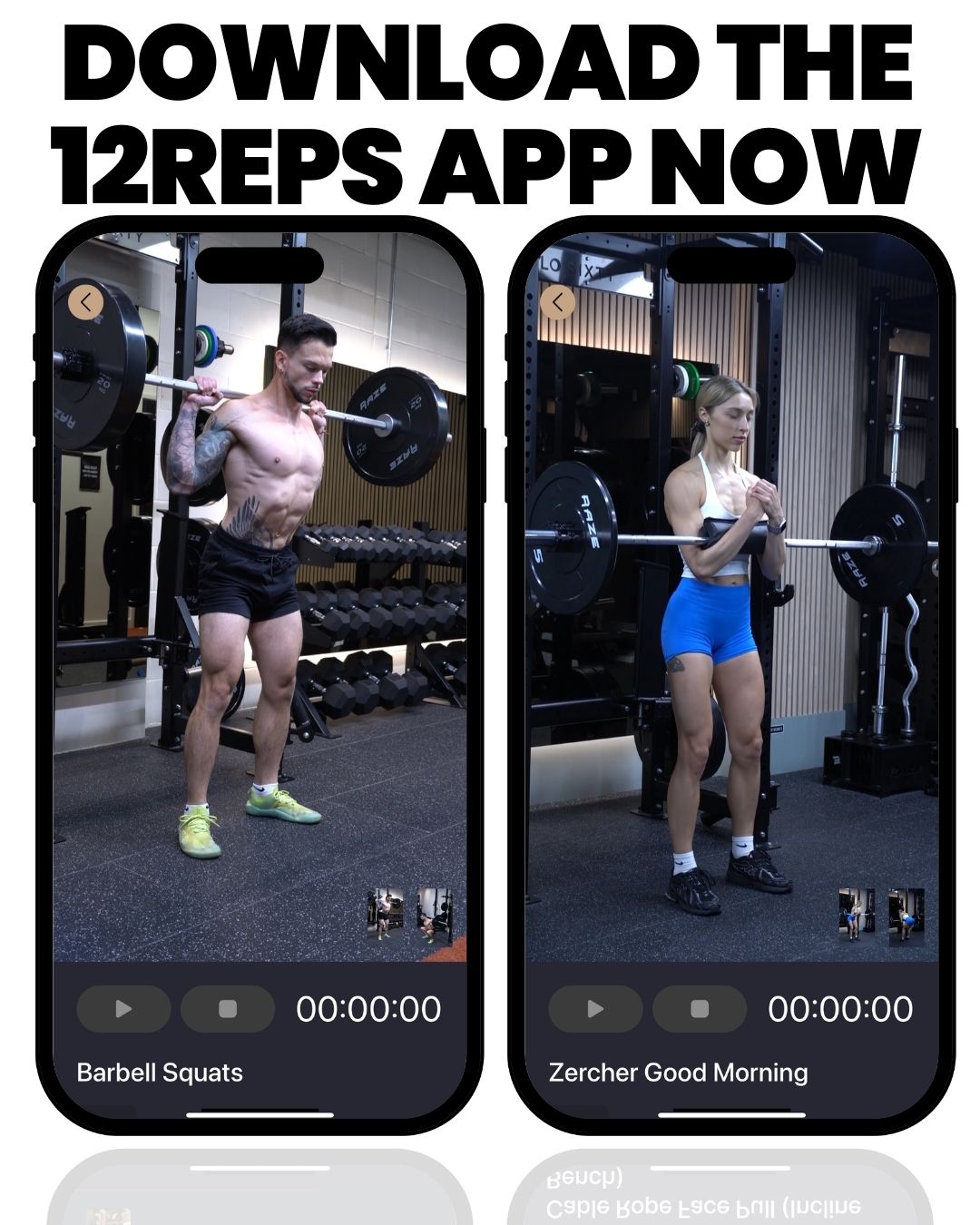
Everything in this article comes down to numbers. Sets. Reps. Weight. Rest. Progression. You need a way to capture all of it quickly and see it clearly.
That is what 12REPS does.
- Build structured workouts with the right sets and rep ranges for your goals.
- Log every set in seconds. Weight, reps, and how the set felt.
- See your previous session so you know exactly what to beat.
- Track weekly volume per muscle group so you stay in the growth range.
Built from over 10 years of real coaching experience. Designed to be fast and simple. Focused entirely on helping you progress session to session.
You do not need to memorise any of the numbers in this article. You just need a system that tracks them for you. Then all you have to do is show up and beat last week.
For a complete training and nutrition framework, read The Complete Guide to Building Muscle.
If you want structure without complexity, this is what the app was built for.
Your Action Plan
You now know the numbers. Here is how to use them starting this week.
- Pick your rep range. 6 to 8 for heavy compounds. 8 to 12 for accessories. 12 to 15 for isolation.
- Set your weekly volume. 10 to 20 sets per muscle group per week. Start at the lower end.
- Time your rest. 2 to 3 minutes on heavy lifts. 60 to 90 seconds on everything else.
- Train at the right intensity. Every working set should finish at RIR 1 to 2. If it was easy, it did not count.
- Track every session. Reps. Weight. Rest. No more guessing.
- Progress weekly. Add weight or reps. Small jumps. Consistent gains.
That is the system. Clear numbers. Consistent execution. A record that proves you are moving forward.
The difference between someone who understands training and someone who actually grows is execution. You have the knowledge now. The only question is whether you will use it.
Pro tip: Most people spend months searching for the perfect programme. The truth is, a good programme followed with intensity and tracked consistently will outperform a perfect programme done randomly every single time.
Your next session is your first chance to train with structure. Make it count.
Download 12REPS. Structure your training. Start progressing from session one →