




Written by Will Duru, BSc (Hons) Sport and Exercise Science, Level 3 Personal Trainer
The science of progressive overload comes down to one idea: to keep getting stronger or building muscle, you must gradually increase the challenge on your body over time. You can add weight, reps or sets, or change how you perform each rep. Your muscles and nervous system then adapt to the new demand.
This guide explains how progressive overload works, the main ways to apply it, and what research says about each one. It also covers the most common mistakes, and how tracking your training in 12REPS makes progress easier to plan.

What Is Progressive Overload?
Progressive overload is the training principle that your workouts need to get gradually harder for your body to keep adapting. If you lift the same weight for the same number of reps every week, your body gets used to it. Progress then tends to stall. This is called a plateau.
A widely cited 2010 review in the Journal of Strength and Conditioning Research named three factors that drive muscle growth: mechanical tension, muscle damage and metabolic stress. Mechanical tension is the force your muscles produce against a load. Asking your muscles to do a little more over time keeps that stimulus strong.
Progressive overload is built into major training guidelines. ACSM’s 2009 position stand on progression recommends adding load in small steps as you get stronger. Its 2026 update lists progressive effort over time as part of a well-designed program.
New to the idea? Our beginner’s guide to progressive overload covers the basics step by step.
The Main Ways to Apply Progressive Overload
There’s no single way to apply progressive overload. There are several “levers” you can pull to make a workout more challenging. Below is each one, what the research says, and how to use it.
Increase the Load (Weight)
This is the most common method: lift heavier over time. For example, if you bench pressed 50 kg for 5 reps last week, try 52.5 kg next time.
Keep the jumps small. ACSM recommends adding 2 to 10% to the load once you can do one or two reps more than your target on two sessions in a row. Use smaller jumps for small-muscle exercises, such as biceps curls, and larger jumps for big lifts, such as squats.
In 12REPS, you log the weight and reps for every set. The app remembers what you lifted, so you know exactly what to beat next session.
Increase the Reps
If you’re not ready to add weight, do more reps with the same weight. For example, progress from 3 sets of 8 reps to 3 sets of 10 reps.
Research supports this. In an 8-week study of trained adults, adding reps and adding load produced similar muscle growth in most of the leg muscles measured. Adding load gave slightly more strength, but the difference was small.
A simple way to combine both is called double progression. Pick a rep range, such as 8 to 12. When you reach the top of the range on all sets with good form, add a little weight and work back up the range.
Increase the Sets (Volume)
Training volume is the total amount of work you do. It’s often counted as hard sets per muscle group per week. Going from 3 sets to 4 sets of an exercise raises your volume.
More volume tends to bring more muscle growth, as long as you can recover from it. ACSM’s 2026 position stand links hypertrophy (muscle growth) with about 10 or more sets per muscle group per week, with higher volumes giving more benefit.
For maximal strength, the same position stand highlights 2 to 3 sets per exercise with heavier loads. That means around 80% or more of your one-rep max (1RM), which is the most weight you can lift for a single rep.
12REPS records the sets you complete for each exercise. That makes it simple to see your volume and add a set when you’re ready.
Change Your Rest Time
Shorter rest between sets makes a session harder, because you start each set more tired. It can be useful when you’re short on time. But it’s not the best lever for building strength or size.
A 2024 meta-analysis found a small benefit for muscle growth when people rested more than 60 seconds between sets. It found no clear difference beyond about 90 seconds. For heavy compound lifts, ACSM recommends resting at least 2 to 3 minutes.
So rest long enough to perform your next set well. Cut rest mainly to save time, not as your main way to progress.

Improve Range of Motion and Form
Range of motion (ROM) is how far you move through an exercise. Squatting a little deeper, or pausing at the bottom of a rep, can make the same weight more challenging.
A 2020 systematic review found that training through a full range of motion helped lower-body muscle growth more than partial reps. Evidence for the upper body was limited and mixed.
Strict form, with no cheating or momentum, also keeps tension on the target muscles. Each 12REPS exercise has a trainer demonstration and technique breakdown, so you can check your form. Always master the technique before you add more weight.
Train More Often
Training frequency is how often you train a muscle each week. Moving from training legs once a week to twice a week, while managing your total volume, is another way to progress.
A 2016 meta-analysis found that training each muscle group twice a week led to more muscle growth than once a week, when total volume was matched. Whether three times a week beats twice is still unclear.
Keep recovery in your plan. Give each muscle time to recover between hard sessions, and avoid training the same muscles hard on back-to-back days.
Slow Down Your Tempo
Tempo is the speed of each rep. A 3-second lowering phase on a bench press, or a 2-second pause at the bottom of a squat, makes a weight feel harder without adding load. Time under tension is how long a muscle works during a set, and slower reps increase it.
Slower is not always better for growth, though. In a small 2021 study of untrained men, 2-second and 6-second reps produced similar muscle growth and similar gains in one-rep max. Use tempo as a tool to add challenge and control, not as a goal in itself.
Progressive Overload Methods at a Glance
| Method | Example | What the evidence suggests |
|---|---|---|
| Load | 50 kg to 52.5 kg | Add 2 to 10% once you beat your target reps on two sessions in a row |
| Reps | 3 x 8 to 3 x 10 | Similar muscle growth to adding load in one 8-week study |
| Sets | 3 to 4 sets | About 10 or more weekly sets per muscle is linked with growth |
| Rest | 2 minutes to 90 seconds | Makes sessions harder; longer rest suits strength and size |
| Range of motion | Deeper squat | Full range helped lower-body growth |
| Frequency | Legs once to twice a week | Twice weekly beat once weekly for growth |
| Tempo | 3-second lowering | Makes a weight harder; not shown to build more muscle |
As you can see, progressive overload has many faces. It’s not just about adding weight. A good program uses several of these methods over time. What they all need is a record of what you did last time.

How 12REPS Helps You Apply Progressive Overload
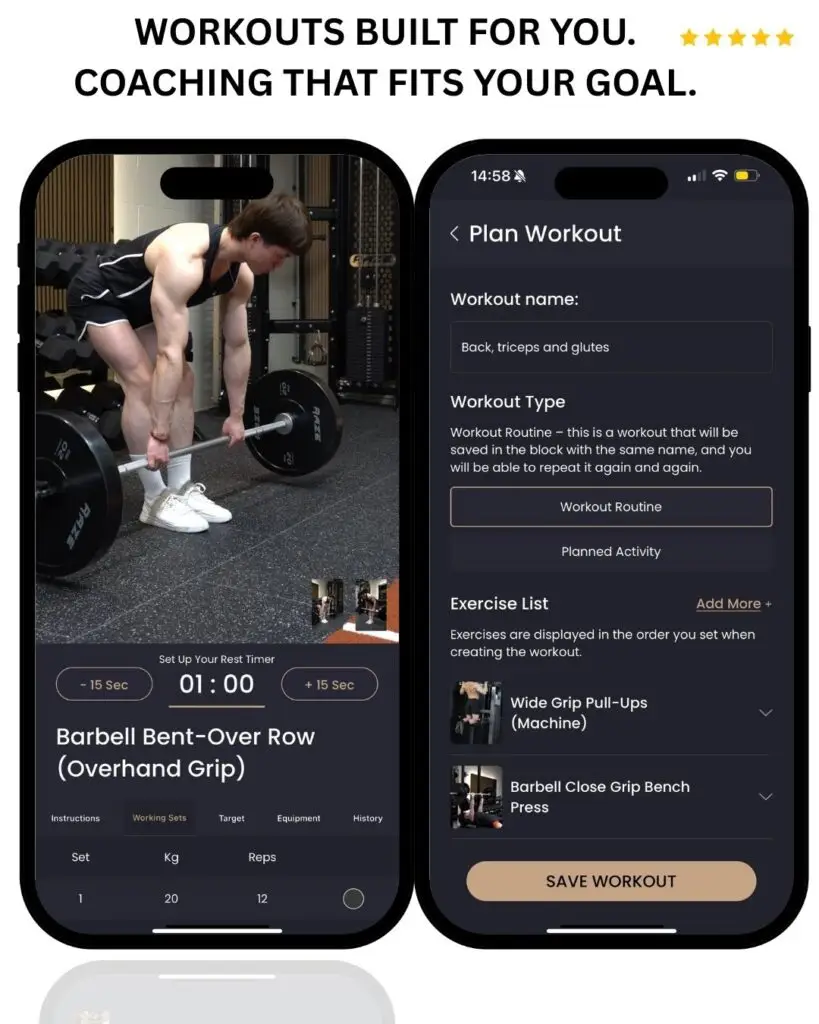
Progressive overload depends on knowing what you did last time. 12REPS keeps that record for you, so each session gives you a clear target.
- A plan built around you: Your training is built around your goal, your equipment and the time you have. Open the app and your workout is ready.
- Every set logged: Tap Start Workout, watch the demo, then enter your reps and weight for each set. The app remembers what you lifted, so you have a number to beat next time.
- A clear workout history: 12REPS tracks your workouts, sets, reps, weights and streaks. You can look back and see which lifts are moving up and which have stalled.
- Trainer demonstrations: Every exercise includes a demonstration and technique breakdown from a qualified personal trainer. They help you keep your form as the weights go up.
- Build your own sessions: Use the body map to choose a muscle, your equipment and your time, and 12REPS builds the session. That makes it simple to add an extra session for a muscle you want to train more often.
- Accountability: A weekly goal, challenges, awards and a community help you stay consistent. Consistency is what lets small increases add up.
You stay in charge of when to add weight or reps. Use a simple rule like double progression, and let your logged numbers guide the next step. For more on logging, read how to track your workouts.

Common Progressive Overload Mistakes
Too Much, Too Soon
The biggest mistake is increasing the weight or intensity too fast. Jumping from 50 kg to 60 kg in one go is a 20% increase. That’s well beyond ACSM’s suggested 2 to 10%.
Muscles and connective tissues need time to adapt. Small, steady increases, such as one extra rep at a time or a few percent more weight, work better than big leaps followed by a setback. Avoid the urge to load the bar with a weight you can’t handle: progress, don’t ego-lift.
Neglecting Form
Progressive overload should never come at the expense of good form. If adding weight turns your squats into half reps or rounds your back on a deadlift, the weight is too heavy. Poor form makes the exercise less effective and can raise your risk of getting hurt.
Master an exercise with good form before increasing the load. Better technique, such as a fuller range of motion, is a form of progress in itself.
Not Tracking Your Workouts
If you don’t track your workouts, it’s hard to apply progressive overload. Without a record, it’s easy to repeat the same weights and reps for months without noticing.
The key to steady progress is knowing exactly what you lifted and how many reps you did. Then you have a target to beat. Whether you use an app or a notebook, log your workouts. 12REPS records your sets, reps and weights for you.
Pushing Every Set to Failure
You don’t need to push every set until you can’t do another rep. ACSM’s 2026 position stand found that training to failure did not consistently change results for healthy adults.
You can stop a rep or two short instead. One way to measure this is RIR (reps in reserve), which is how many more reps you could have done. Learn more in our guide to RPE vs RIR.
Still stuck? Read what to do when you stop seeing progress at the gym, or watch this short 12REPS video on common reasons people don’t gain muscle.
In short: increase gradually, never sacrifice technique, and track everything.
Conclusion: Make Progressive Overload a Habit
Understanding and applying progressive overload is the foundation of long-term strength and muscle gains. It’s a principle supported by research and by major training guidelines.
By gradually challenging your body in different ways, through weight, reps, sets, range of motion, frequency and tempo, you give it a reason to adapt. It takes patience and consistency. Results vary from person to person, but steady, tracked progress is how you keep improving.
Want a plan built around your goal, your equipment and the time you’ve got? 12REPS sets out each session and shows a trainer demonstration for every exercise. It also remembers what you lifted, so you always have a number to beat.
Every session where you do a little more than before is a step forward. Over weeks and months, those steps add up.
For a step-by-step walkthrough of each method, see our complete guide to progressive overload. If you’re just starting out, read our strength training for beginners guide.
Sources
- American College of Sports Medicine position stand: Progression models in resistance training for healthy adults. Medicine & Science in Sports & Exercise, 2009. https://pubmed.ncbi.nlm.nih.gov/19204579/
- Resistance Training Prescription for Muscle Function, Hypertrophy, and Physical Performance in Healthy Adults (position stand summary slides). American College of Sports Medicine, 2026. https://acsm.org/wp-content/uploads/2026/03/Pronouncement-ppt-deck_resistance-training-ps.pdf
- Schoenfeld BJ. The mechanisms of muscle hypertrophy and their application to resistance training. Journal of Strength and Conditioning Research, 2010. https://pubmed.ncbi.nlm.nih.gov/20847704/
- Plotkin et al. Progressive overload without progressing load? The effects of load or repetition progression on muscular adaptations. PeerJ, 2022. https://peerj.com/articles/14142
- Schoenfeld BJ, Ogborn D, Krieger JW. Effects of Resistance Training Frequency on Measures of Muscle Hypertrophy: A Systematic Review and Meta-Analysis. Sports Medicine, 2016. https://link.springer.com/10.1007/s40279-016-0543-8
- Singer A, et al. Give it a rest: a systematic review with Bayesian meta-analysis on the effect of inter-set rest interval duration on muscle hypertrophy. Frontiers in Sports and Active Living, 2024. https://public-pages-files-2025.frontiersin.org/journals/sports-and-active-living/articles/10.3389/fspor.2024.1429789/text
- Schoenfeld BJ, Grgic J. Effects of range of motion on muscle development during resistance training interventions: A systematic review. SAGE Open Medicine, 2020. https://vuir.vu.edu.au/42523/
- Lacerda et al. Resistance training with different repetition duration to failure: effect on hypertrophy, strength and muscle activation. PeerJ, 2021. https://peerj.com/articles/10909
