




You’ve been training consistently for 6 weeks. Your lifts are progressing well. Then suddenly, this week’s squat feels unusually heavy. Your bench press has stalled. You’re fatigued. Everything feels harder than it should.
Here’s what usually happens: you assume you’re not trying hard enough, so you push harder. You add more volume. You increase intensity. You’re determined to break through.
Two weeks later, you’re exhausted, your lifts have gone backwards, and you’re questioning whether strength training even works.
The problem isn’t lack of effort—it’s lack of strategic recovery. You needed a deload week.
I’m Will Duru, a personal trainer with over 10 years’ experience in London. I’ve coached hundreds of women through proper periodisation, and the most common mistake I see is grinding through fatigue rather than taking planned recovery weeks.
This guide explains exactly what deload weeks are, why they accelerate rather than hinder progress, how often you need them, three methods for deloading properly, and signs that you’ve waited too long to deload.

What Is a Deload Week?
A deload week is a planned reduction in training intensity, volume, or both, designed to allow your body and nervous system to recover from accumulated fatigue whilst maintaining fitness.
What a deload week is NOT:
❌ A complete week off from training
❌ Randomly skipping workouts due to lack of motivation
❌ Detraining or “losing your gains”
❌ A sign of weakness or lack of commitment
What a deload week IS:
✅ Strategic reduction in training stress for 5-7 days
✅ Planned recovery period that enhances long-term progress
✅ Opportunity to dissipate fatigue whilst preserving strength and muscle
✅ Professional programming strategy used by all advanced athletes
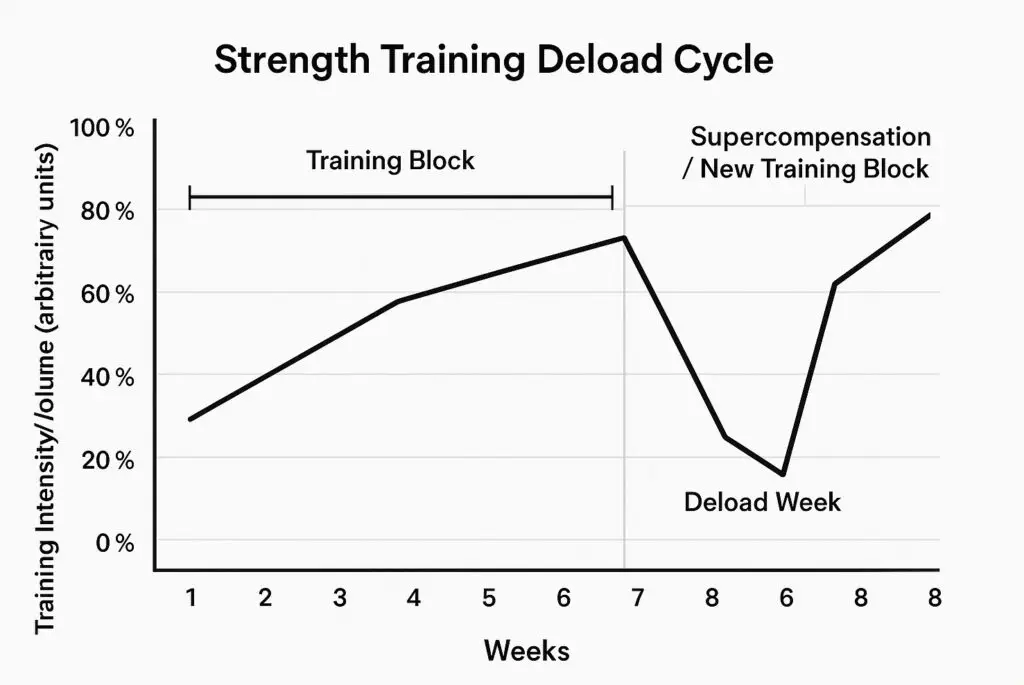
Think of it this way: Training creates both fitness (muscle, strength) and fatigue (metabolic waste, nervous system strain, microtrauma). When fatigue is high, it masks your fitness improvements. Performance suffers not because you’ve lost strength, but because fatigue is temporarily suppressing it.
A deload reduces fatigue, allowing your actual fitness level to express itself. Many women hit new personal records immediately after a proper deload.

Why Deload Weeks Work: The Science
Accumulated Fatigue vs Acute Fatigue
Acute fatigue: What you feel immediately after a hard workout. Recovered within 24-48 hours with proper rest and nutrition.
Accumulated fatigue: Builds over weeks of consistent hard training. Takes longer to dissipate—typically 5-7 days of reduced training stress.
The problem: You can recover from individual workouts (acute fatigue) whilst simultaneously accumulating fatigue across weeks. After 4-8 weeks of hard training, accumulated fatigue becomes significant enough to impair performance.
Signs of accumulated fatigue:
- Weights that felt manageable last week now feel heavy
- Difficulty completing sets/reps you previously handled
- Decreased motivation to train
- Poor sleep quality
- Increased soreness lasting longer than usual
- Lack of workout “pump” or muscle congestion
- Feeling flat or drained rather than energised
What Research Shows
Study on planned vs spontaneous deload weeks: Participants who took scheduled deload weeks every 6 weeks gained equal muscle and strength to those who trained continuously—whilst completing 25% fewer total training sessions. Scheduled deloads also improved recovery speed.
Study on heart rate variability (HRV): Taking a deload week every 5 weeks of training maintained healthy HRV levels, indicating proper recovery from training stress. Continuous training without deloads progressively decreased HRV, suggesting overtraining.
Study comparing deload approaches: Research comparing different deload methods found all approaches (reducing volume, reducing intensity, or combined) were effective at dissipating fatigue whilst preserving strength and muscle mass.
Takeaway: Deload weeks don’t interrupt progress—they enhance it. You achieve the same or better results in less total training time when you deload systematically.
Who Needs Deload Weeks?
Beginners (0-12 Months Training)
Frequency needed: Every 8-10 weeks
Why less frequent: Beginners don’t generate as much fatigue because they’re lifting lighter relative loads and their nervous systems haven’t adapted to tolerating high training stress yet.
Exception: Beginners following very high volume programmes may need deloads every 6-8 weeks.
Most beginners: Actually experience natural deloads from life circumstances (holidays, work commitments, occasional missed sessions) that provide adequate recovery without planned deloads.
Intermediate Trainees (12-36 Months Training)
Frequency needed: Every 5-8 weeks
Why more frequent: You’re now lifting heavier loads relative to your bodyweight, training with higher volume, and your body has adapted to tolerate more training stress—meaning you can accumulate more fatigue before breaking down.
This is when planned deloads become important. You’re consistent enough that life doesn’t naturally provide recovery weeks, but you’re lifting heavy enough to accumulate significant fatigue.
Advanced Trainees (36+ Months Training)
Frequency needed: Every 4-6 weeks
Why most frequent: Very heavy loads, high training volumes, and well-developed work capacity mean you can push extremely hard—but this also means you accumulate fatigue rapidly.
Elite powerlifters and bodybuilders often deload every 3-4 weeks because their training intensity is so high.
Special Circumstances Requiring More Frequent Deloads
1. Cutting (eating in calorie deficit): Reduce deload frequency to every 5-6 weeks (from usual 6-8). Recovery capacity is reduced when calories are restricted.
2. High life stress: Demanding job, relationship issues, family responsibilities, poor sleep—external stressors reduce recovery capacity. Consider deloading every 5-6 weeks.
3. Age 40+: Recovery typically slows with age. Consider deloading every 5-7 weeks rather than 8-10.
4. Training 5-6 days weekly: Higher training frequency accumulates more fatigue. Deload every 5-6 weeks.
5. Very high training volume: If you’re performing 20+ sets per muscle group weekly, consider more frequent deloads (every 5-6 weeks).

Three Methods for Deloading
You have three primary approaches to deloading. Choose based on personal preference and what your body responds to best.
Method 1: Reduce Volume (Keep Intensity)
How: Cut sets by 40-50%, maintain weight on the bar
Example:
- Normal week: Squats 4 sets × 8 reps @ 60kg
- Deload week: Squats 2 sets × 8 reps @ 60kg
Advantages:
- Maintains neural adaptations to heavy loads
- Preserves technical skill with challenging weights
- Psychological benefit of still lifting “heavy”
- Works well for strength-focused training
Disadvantages:
- Some people find reduced volume unsatisfying
- Still generating some fatigue from heavy loads
Who this suits: Powerlifters, strength-focused trainees, people who derive satisfaction from lifting heavy weights.
Method 2: Reduce Intensity (Keep Volume)
How: Cut weight by 40-50%, maintain sets and reps
Example:
- Normal week: Squats 4 sets × 8 reps @ 60kg
- Deload week: Squats 4 sets × 8 reps @ 30-35kg
Advantages:
- Significantly reduces joint and nervous system stress
- Maintains training volume (total work performed)
- Allows focus on perfect technique with lighter loads
- Good for addressing any technical flaws
Disadvantages:
- Psychologically difficult for some (feels “too easy”)
- Less maintenance of heavy load adaptations
Who this suits: Women with joint issues, those prioritising technique refinement, hypertrophy-focused trainees.
Method 3: Combined Reduction (Volume + Intensity)
How: Cut both weight (20-30%) and volume (20-30%)
Example:
- Normal week: Squats 4 sets × 8 reps @ 60kg
- Deload week: Squats 3 sets × 6 reps @ 45kg
Advantages:
- Maximum fatigue dissipation
- Shortest session durations
- Most recovery for nervous system
- Good when life stress is high
Disadvantages:
- Requires careful planning to avoid excessive deload
- Can feel unsatisfying (not enough challenge)
Who this suits: Very fatigued trainees, those with high external stress, preparation for max effort competitions.

My Recommendation
For most women: Start with Method 1 (reduce volume, keep intensity).
This maintains the neural adaptations to heavy loads, preserves skill with challenging weights, and provides adequate recovery. It’s also psychologically easier—you’re still lifting your normal weights.
If Method 1 doesn’t feel sufficient after trying it once, switch to Method 2 or 3 for future deloads.
How to Structure a Deload Week
Option A: Reduce All Exercises Equally
Apply your chosen reduction method to every exercise in your programme.
Example using Method 1 (50% volume reduction):
Normal Week:
- Squats: 4 sets × 8 reps @ 60kg
- Romanian Deadlifts: 3 sets × 10 reps @ 50kg
- Bulgarian Split Squats: 3 sets × 10 reps @ 12kg dumbbells
- Leg Press: 3 sets × 12 reps @ 100kg
- Leg Curls: 3 sets × 12 reps @ 30kg
- Total: 16 sets
Deload Week:
- Squats: 2 sets × 8 reps @ 60kg
- Romanian Deadlifts: 2 sets × 10 reps @ 50kg
- Bulgarian Split Squats: 2 sets × 10 reps @ 12kg dumbbells
- Leg Press: 2 sets × 12 reps @ 100kg
- Leg Curls: 1 set × 12 reps @ 30kg
- Total: 9 sets (44% reduction)
Advantages: Simple, applies consistent reduction across all movements.
Option B: Reduce Main Lifts, Eliminate Accessories
Maintain your main compound lifts (reduced volume/intensity), eliminate accessory work entirely.
Normal Week:
- Squats: 4 sets × 8 reps
- Romanian Deadlifts: 3 sets × 10 reps
- Bulgarian Split Squats: 3 sets × 10 reps (accessory)
- Leg Press: 3 sets × 12 reps (accessory)
- Leg Curls: 3 sets × 12 reps (accessory)
Deload Week:
- Squats: 2 sets × 8 reps
- Romanian Deadlifts: 2 sets × 10 reps
- Bulgarian Split Squats (eliminated)
- Leg Press (eliminated)
- Leg Curls (eliminated)
Advantages: Very short sessions, maximum recovery, maintains skill in primary lifts.
Option C: Selective Deload (Stalling Exercises Only)
Only deload exercises where you’ve plateaued. Continue normal progression on exercises still improving.
Example:
- Squats (stalled 3 weeks): Deload (2 sets instead of 4)
- Romanian Deadlifts (progressing): Continue normal (3 sets)
- Hip Thrusts (progressing): Continue normal (4 sets)
Advantages: Targeted recovery for specific movements, maintains momentum on progressing lifts.
Disadvantages: Less total recovery, may not address systemic fatigue adequately.
When to use: If only 1-2 exercises have plateaued but you feel generally good.
Sample Deload Week Programmes
Full Body Programme (3 Days Weekly)
Normal Training Week:
Day 1:
- Squats: 4×8
- Bench Press: 3×10
- Bent Over Rows: 3×10
- Overhead Press: 3×12
- Bicep Curls: 2×15
Day 2:
- Deadlifts: 4×6
- Lat Pulldowns: 3×12
- Leg Press: 3×15
- Dumbbell Rows: 3×12
- Tricep Extensions: 2×15
Day 3:
- Romanian Deadlifts: 3×10
- Incline Press: 3×10
- Lunges: 3×10 each
- Face Pulls: 3×15
- Plank: 3×45 seconds
Deload Week (Method 1: 50% volume reduction):
Day 1:
- Squats: 2×8
- Bench Press: 2×10
- Bent Over Rows: 2×10
- Overhead Press (eliminated)
- Bicep Curls (eliminated)
Day 2:
- Deadlifts: 2×6
- Lat Pulldowns: 2×12
- Leg Press (eliminated)
- Dumbbell Rows: 2×12
- Tricep Extensions (eliminated)
Day 3:
- Romanian Deadlifts: 2×10
- Incline Press: 2×10
- Lunges: 2×10 each
- Face Pulls (eliminated)
- Plank (eliminated)
Upper/Lower Split (4 Days Weekly)
Normal Training Week:
- Upper A: 16 sets total
- Lower A: 14 sets total
- Upper B: 15 sets total
- Lower B: 14 sets total
- Total: 59 sets weekly
Deload Week (Method 1: 50% reduction):
- Upper A: 8 sets total
- Lower A: 7 sets total
- Upper B: 8 sets total
- Lower B: 7 sets total
- Total: 30 sets weekly (49% reduction)
Or reduce to 3 training days instead of 4 (Upper A, Lower A, Upper

Signs You Need a Deload Week NOW
Sometimes you can’t wait for your scheduled deload. These signs indicate you’ve pushed too long and need immediate recovery:
1. Strength regression: Weights you lifted 2-3 weeks ago now feel impossible. You’ve lost 5-10% strength across multiple lifts.
2. Persistent soreness: You’re still sore 72+ hours after training. New sessions start before previous soreness has resolved.
3. Sleep disturbances: Difficulty falling asleep despite being exhausted, or waking frequently during the night. Elevated resting heart rate.
4. Loss of motivation: Dreading training sessions. Finding excuses to skip gym. Training feels like a chore rather than enjoyable.
5. Increased injuries/aches: New joint pain, persistent tendon discomfort, small injuries accumulating.
6. Mood changes: Irritability, anxiety, emotional flatness, reduced stress tolerance.
7. Training sessions feel unusually difficult: Everything requires more effort. Your “easy” warm-up sets feel heavy.
If you experience 3+ of these signs: Implement an immediate deload week regardless of your schedule.
Common Concerns About Deloading
“Will I lose muscle or strength during a deload week?”
No. Research shows muscle and strength don’t begin declining until 2-3 weeks of complete inactivity (and even longer if you’ve been training for years).
During a deload week, you’re still training—just with reduced volume or intensity. This is sufficient stimulus to maintain muscle and strength whilst allowing recovery.
Many women actually set PRs (personal records) immediately after deloads because dissipated fatigue allows their true strength to express itself.
“A deload week feels like I’m wasting time.”
This is the most common psychological barrier.
Reframe: You’re not wasting time—you’re investing in 4-8 weeks of productive training that follows. Without deloads, you’ll grind yourself into plateaus or injury, actually wasting time.
Analogy: You don’t view sleep as “wasting 8 hours.” It’s essential recovery that makes your waking hours productive. Deloads are the same principle applied to training.
“I feel guilty taking it easier when I could push harder.”
More is not always better. Your body doesn’t improve during training—it improves during recovery from training.
Evidence: Studies show equal or better results with scheduled deloads despite 25% fewer total sessions. You achieve more by strategically doing less.
“My programme doesn’t include deload weeks.”
Add them yourself. After every 5-8 weeks of the programme, insert a deload week before continuing.
Most programmes assume you’ll either programme deloads yourself or experience natural deloads from life circumstances.

What to Do During Deload Week Besides Training
Prioritise Recovery Practices
Sleep: Aim for 8-9 hours nightly during deload week. Extra sleep accelerates recovery.
Nutrition: Maintain normal protein intake (1.8-2.2g/kg). Calories can remain at maintenance or slight surplus—don’t cut calories during deload.
Stress management: This is an excellent time to address life stressors that impair recovery. Practice meditation, spend time in nature, engage in enjoyable activities.
Mobility work: Extra time for stretching, foam rolling, yoga. Address any tight areas or mobility restrictions.
Light Activity
Walking: 30-60 minutes daily. Low-intensity movement aids recovery without adding fatigue.
Swimming or cycling: Light cardio (heart rate <120 bpm) for 20-30 minutes promotes blood flow.
Yoga or Pilates: Gentle movement, stretching, breathwork.
Avoid: High-intensity cardio, HIIT, sports, or anything that generates significant fatigue
How to Return to Normal Training Post-Deload
Don’t ease back in gradually. After a proper deload, return immediately to your normal training intensity and volume.
Week after deload: Resume regular programme where you left off. Don’t arbitrarily reduce weight or volume—trust that the deload has prepared you to handle your normal training loads.
Many women feel nervous about jumping back to full intensity, but this is precisely when you should see your best performance. The deload dissipated fatigue—now express your fitness.

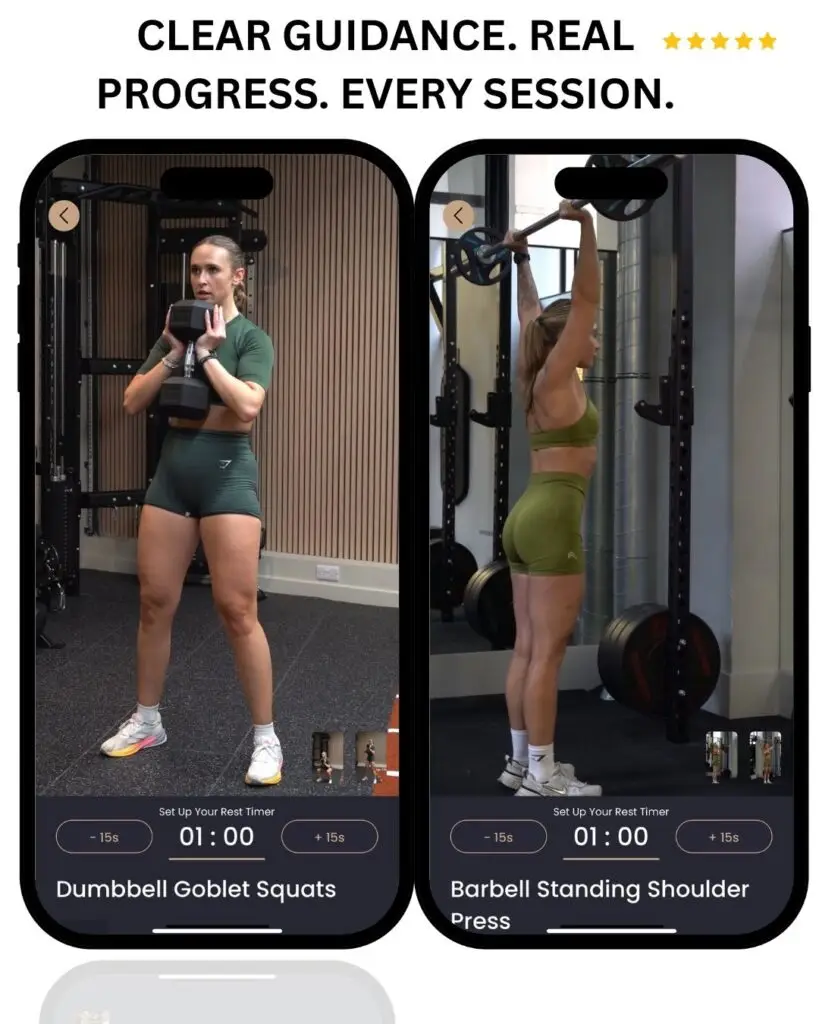
How 12REPS Handles Deload Weeks
Understanding the concept of deload weeks is one thing. Actually implementing them systematically within a structured programme is another.
12REPS includes automatic deload weeks:
1. Scheduled deloads: The app programmes deload weeks every 5-8 weeks depending on your experience level and training frequency.
2. Automatic adjustments: During deload weeks, the app automatically reduces volume by 40-50% whilst maintaining exercise selection and rep ranges.
3. No manual calculations: You don’t need to figure out how to reduce your training—the app handles it for you.
4. Maintains momentum: Deloads are built into your programme progression, so you never question whether you should take one.
5. Progressive periodisation: The app uses periodisation principles (progressive overload with planned recovery) proven to maximise long-term strength and muscle gains.
Try 12REPS free for 7 days. Stop guessing when to deload or how to structure recovery weeks—follow a programme with proper periodisation built in by qualified trainers.
The Bottom Line
Deload weeks are not optional luxuries; they’re essential components of intelligent training.
When to deload:
✅ Beginners: Every 8-10 weeks
✅ Intermediates: Every 5-8 weeks
✅ Advanced: Every 4-6 weeks
✅ When cutting: Every 5-6 weeks
✅ Immediately if experiencing 3+ fatigue symptoms
How to deload (choose one):
✅ Reduce volume 40-50% (maintain weight)
✅ Reduce intensity 40-50% (maintain sets/reps)
✅ Reduce both volume and intensity 20-30%
What happens during deload:
✅ Accumulated fatigue dissipates
✅ Muscle and strength are maintained (not lost)
✅ Nervous system recovers
✅ True fitness level can express itself
✅ Often hit PRs immediately after deload
What to avoid:
❌ Training through accumulated fatigue
❌ Viewing deloads as “wasted” time
❌ Skipping scheduled deloads because you “feel fine”
❌ Completely stopping training for a week
❌ Adding extra intensity during deload “since I’m not doing as much”
The women who build the most strength and muscle over 12-24 months aren’t those who train hardest every single week—they’re those who train hard for 5-8 weeks, take a strategic deload, and repeat this cycle consistently.
Periodisation isn’t a secret advanced technique; it’s how all successful training works. Build fatigue intentionally, dissipate it systematically, repeat.
Your body doesn’t grow in the gym; it grows during recovery from the gym. Deload weeks are organised, strategic recovery that accelerates rather than interrupts your progress.
References
- Ogasawara, R., Yasuda, T., Ishii, N. and Abe, T. (2013). Comparison of Muscle Hypertrophy Following 6-Month of Continuous and Periodic Strength Training. European Journal of Applied Physiology, 113(4), pp.975-985. https://doi.org/10.1007/s00421-012-2511-9
- Pritchard, H., Keogh, J., Barnes, M. and McGuigan, M. (2015). Effects and Mechanisms of Tapering in Maximizing Muscular Strength. Strength and Conditioning Journal, 37(2), pp.72-83. https://doi.org/10.1519/SSC.0000000000000125
- Plews, D.J., Laursen, P.B., Stanley, J., Kilding, A.E. and Buchheit, M. (2013). Training Adaptation and Heart Rate Variability in Elite Endurance Athletes. Medicine & Science in Sports & Exercise, 45(8), pp.1 503-1509. https://doi.org/10.1249/MSS.0b013e31828942b1
- Schoenfeld, B.J., Grgic, J. and Krieger, J. (2019). How Many Times Per Week Should a Muscle Be Trained to Maximize Muscle Hypertrophy? A Systematic Review and Meta-Analysis of Studies Examining the Effects of Resistance Training Frequency. Journal of Sports Sciences, 37(11), pp.1286-1295. https://doi.org/10.1080/02640414.2018.1555906
- Travis, S.K., Mujika, I., Gentles, J.A., Stone, M.H. and Bazyler, C.D. (2020). Tapering and Peaking Maximal Strength for Powerlifting Performance. Sports, 8(9), 125. https://doi.org/10.3390/sports8090125