

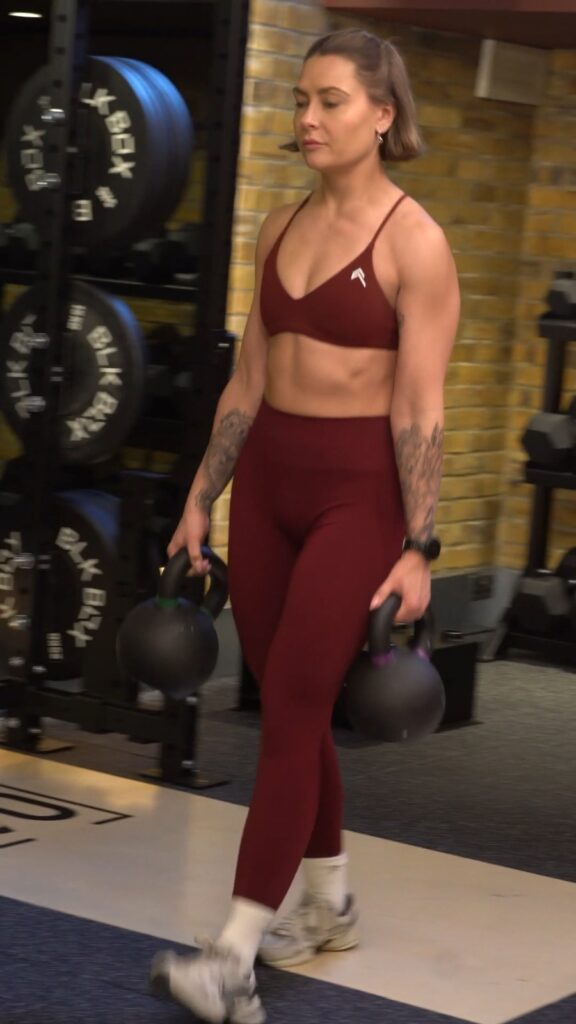
To do a farmer’s carry, pick up a heavy dumbbell or kettlebell in each hand, stand tall with your shoulders back and walk with short, controlled steps. Don’t let the weights pull you out of position. Start with 3 carries of 20 to 40 meters (about 20 to 45 yards).
That’s it. Pick up, stand tall, walk.
The farmer’s carry is one of the most underrated strength exercises. It builds your grip, core, posture and shoulder strength all at once. It looks basic, but it builds strength you can feel outside the gym, every time you carry shopping bags up the stairs.
This guide is for you if:
- You want a simple exercise that trains your whole body.
- Your grip gives out before your back or legs on pulling exercises.
- You want a strength move that carries straight over to everyday life.
I’m Will Duru, a personal trainer and the founder of 12REPS. Below, I’ll cover what the research shows, how to pick up and carry safely, what weight and distance to use, a few variations and the mistakes I see most.
Why do farmer’s carries?
Most gym exercises happen in one spot. Carries make you move while holding weight, the way you do every day with bags, boxes and children.
What the research says
- Carries work your trunk in a way lifts don’t. A study of strongman events, including the farmer’s walk and suitcase carry, found the carrying events challenged the body differently than the lifting events. The researchers suggested loaded carries could add to a traditional lifting program. (McGill et al., 2009)
- Strongman-style training builds strength too. In 30 trained rugby players, 7 weeks of strongman training improved strength and performance about as much as traditional gym training. (Winwood et al., 2015)
- Grip strength is linked to health. In a study of almost 140,000 adults in 17 countries, each 5 kg (11 lb) drop in grip strength was linked to a 16% higher risk of death from any cause over about four years. (Leong et al., 2015)
What the research doesn’t say
- The grip strength study shows a link, not cause and effect. It doesn’t prove that training your grip will help you live longer. The authors said that still needs testing.
- The strongman studies used experienced, strong athletes. Results may differ for beginners.
If you have a back, shoulder or hand injury, check with a doctor or physical therapist before carrying heavy weights.
Why I use them
Carries build grip strength, core strength, posture, shoulder stability and full-body control in one move. I put them in programs for everyone from new moms to older beginners, because carrying is something we all do every day.
They’re also tough. Twenty meters with a heavy kettlebell will test your grip, your core and your mental toughness.
How to do a farmer’s carry
Pick up the weights safely
Take your time here. Picking up heavy weights with a rounded back is a bigger risk than the walk itself.
- Stand between the weights. Place a dumbbell or kettlebell on each side of your feet, handles pointing forward.
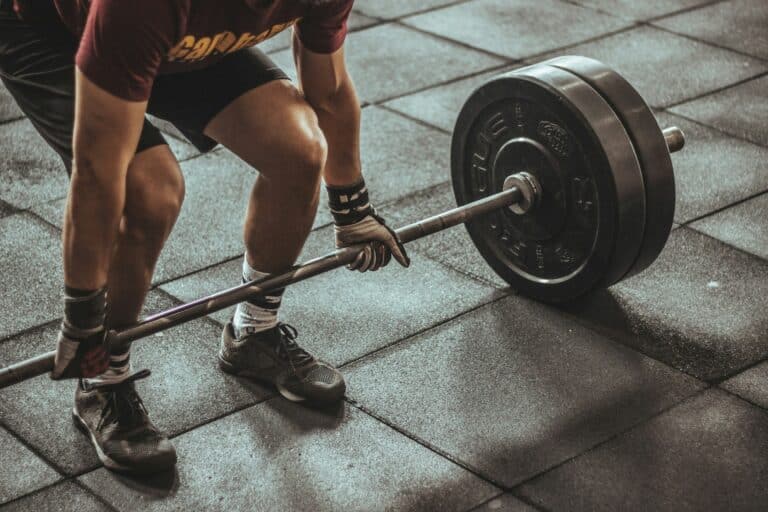
- Hinge down. Push your hips back, keep your back flat and bend your knees to reach the handles. Don’t round over to grab them.
- Grip hard. Wrap your hands around the middle of each handle and squeeze.
- Stand up. Drive through your feet, the same way you’d finish a deadlift. Stand tall before you take a step.
The walk
- Stand tall. Chest up, shoulders back and down, eyes forward.
- Brace. Tighten your stomach as if you’re preparing to be pushed.
- Keep your arms straight. Let the weights hang at your sides. Don’t curl them or let them swing.
- Walk with short, controlled steps. Heel to toe, at a steady pace. Don’t rush.
- Turn carefully. At the end of your distance, take small steps to turn around. Don’t twist on one foot.
Set the weights down
Stop walking, stand still, then hinge back down to put the weights on the floor. Keep your back flat on the way down, just like the pick-up.
Breathing
Take short, steady breaths while staying braced. Don’t hold your breath for the whole walk.
My coaching cues
- “Tall posture, steady steps.” Walk like you’re proud, not rushed.
- “Don’t let the weights move you.” You control the weights. They don’t pull you out of position.
- “Shoulders level.” No leaning or dropping to one side.
- “Squeeze the handles.” A tight grip keeps your shoulders strong too.
What weight should you use?
Use the heaviest weight you can carry with perfect posture for your whole distance. Your grip should feel challenged by the last few steps, but your shoulders should stay level and your body upright.
- First time? Start light. Pick a pair you could easily hold for 30 seconds, learn the pick-up and walk, then go heavier next session.
- Too heavy: you lean, your shoulders drop, your steps get short and shuffly, or you drop the weights early.
- Too light: you could keep walking for another 20 meters without your grip feeling it.
Distance, time and sets
You can carry for distance or for time. Use whichever suits your gym.
| Goal | Sets | Distance or time | Rest |
|---|---|---|---|
| Learning the move | 2 to 3 | 20 meters (about 22 yards) or 20 to 30 steps | 60 to 90 sec |
| General strength | 3 | 20 to 40 meters (about 22 to 44 yards) | 60 sec |
| No space to walk | 3 | 30 to 45 seconds, walking in a small loop | 60 sec |
If you train in a small space, walk 10 meters, turn carefully and walk back.
How to progress
- Go further. Add 5 to 10 meters per carry, up to about 40 meters.
- Go heavier. Then drop back to 20 meters with the heavier weights and build up again.
- Try a harder version. The suitcase carry (one weight only) is a big step up for your core. See below.
Log your weights and distances, so you always know what to beat next session.
Farmer’s carry variations
Dumbbell vs kettlebell
Both work. Dumbbells come in small jumps, so they’re easier to progress in most gyms. Kettlebells hang lower and can bump your legs, so keep them slightly away from your body. Use whichever your gym has.
Trap bar carry
If your gym has a trap bar (a hexagon-shaped bar you stand inside), you can load it heavier than most dumbbells. Deadlift it up, then walk. It’s a good option once you outgrow the heaviest dumbbells.
Suitcase carry
Carry one weight in one hand only, like a suitcase. Your core has to work hard to stop you leaning toward the weight. Use a lighter weight than for the farmer’s carry, walk your distance, then switch hands.
Start with 3 carries of 30 meters (about 33 yards) on each side.
Rack carry and overhead carry
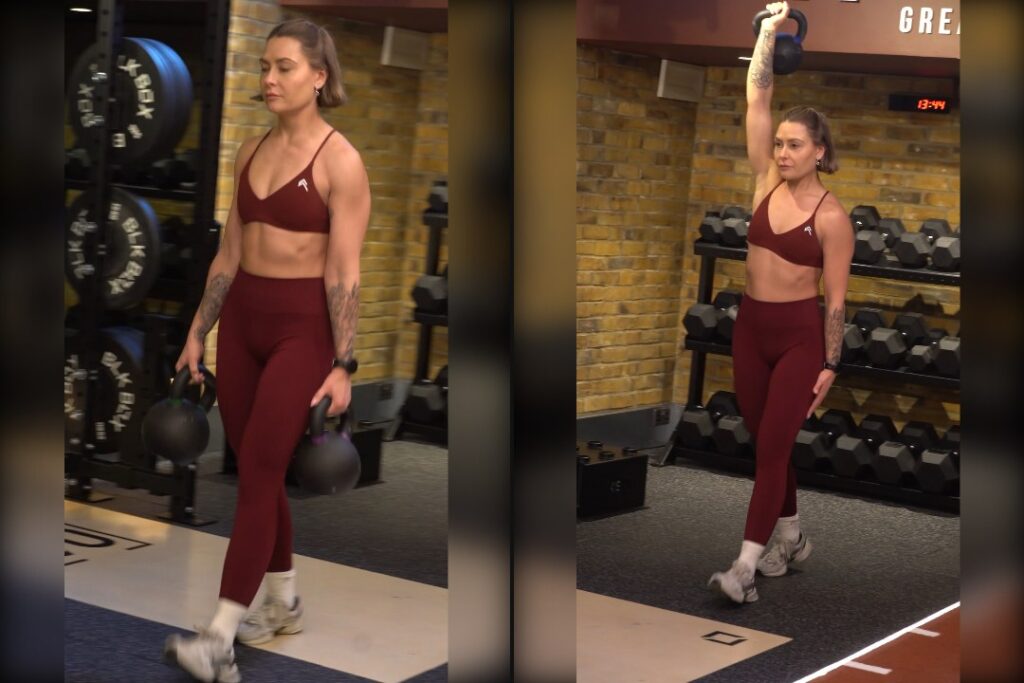
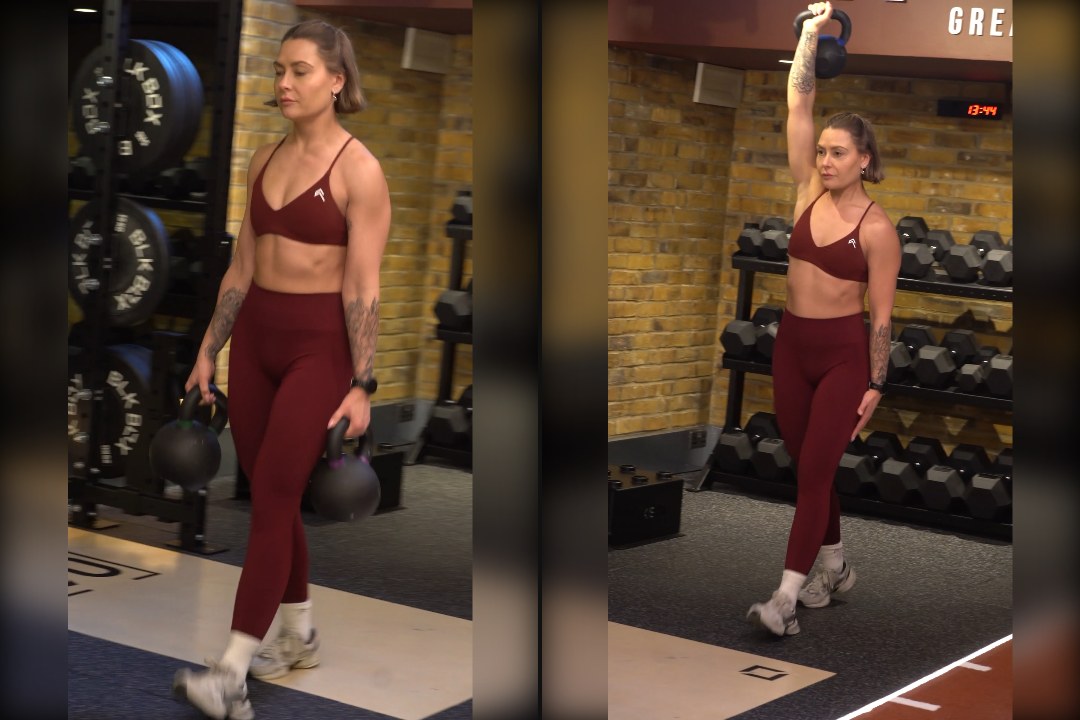
For more of a challenge, hold a kettlebell at your shoulder (the “rack” position) or straight overhead and walk. These test your shoulders and upper back as well as your core. In my kettlebell program, I combine all three into one loaded carry complex: 20 meters farmer’s carry, 20 meters rack carry on each side, then 20 meters overhead carry on each side.
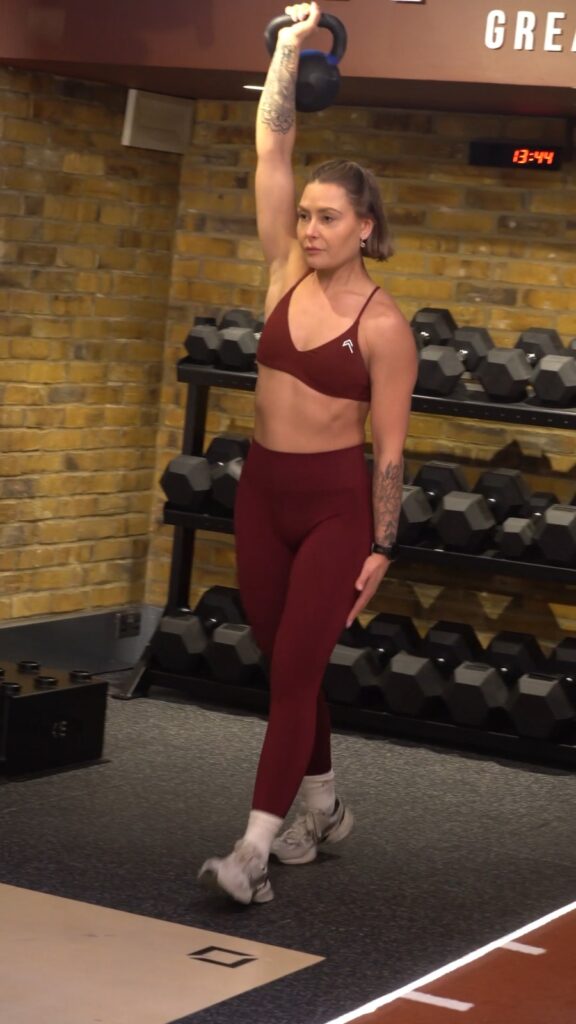
Only try the overhead carry if you can press the weight overhead comfortably and your shoulders feel healthy.
Build a stronger grip
If your grip is the first thing to go on deadlifts, rows or pull-ups, carries are one of the best fixes. You can add other grip work too, like dead hangs from a pull-up bar, plate pinches and wrist curls.
Common farmer’s carry mistakes
The biggest one: letting the weights pull you out of position. If you can’t stand tall, the weights are too heavy for now.
| Mistake | What it looks like | The fix |
|---|---|---|
| Rounding to pick up | Back curves as you grab the weights from the floor | Hinge with a flat back, like a deadlift. Or pick the weights up from a rack or bench |
| Leaning to one side | One shoulder drops, body tilts | Keep your shoulders level. Use a lighter weight |
| Shoulders rolling forward | Upper back rounds, chest drops | Chest up, shoulders back and down |
| Shrugging | Shoulders creep up toward your ears | Let your arms hang long and pull your shoulders down |
| Rushing | Fast, big steps, weights swinging | Short, steady steps. Control every one |
| Holding your breath | Face goes red, you gasp at the end | Short, steady breaths while staying braced |
| Dropping the weights | Letting them crash to the floor at the end | Stop, stand still, then hinge back down to set them down |
If you feel pain in your lower back, shoulders or hands, stop and go lighter.
Where to put carries in your week
Add farmer’s carries once or twice a week. They work best near the end of a session, after your main lifts, so your grip is fresh for deadlifts and rows.
I often pair them with a core exercise. Here’s a pairing I use in my core-focused programs:
| Exercise | Sets | Distance or time | Rest |
|---|---|---|---|
| A. Kettlebell farmer’s carry | 3 | 30 meters (about 33 yards) | None, go straight to B |
| B. Side plank | 3 | 20 seconds each side | 60 sec, then repeat |
Summary
- Hinge down with a flat back to pick up the weights, then stand tall.
- Walk with short, steady steps, shoulders level and core braced.
- Don’t let the weights pull you out of position.
- Start with 3 carries of 20 to 40 meters (about 22 to 44 yards), resting 60 seconds.
- Go further first, then heavier.
- Try the suitcase carry when the farmer’s carry feels easy.
Get stronger for real life
You carry things every day. Bags, boxes, kids, luggage. The farmer’s carry trains you for exactly that.
The hard part is knowing where it fits in your week, and how much to carry. That’s why I built 12REPS. Every program is written by a real personal trainer. Before every exercise, you get a demo video and a coach’s guide. Every set you log is saved, so you always know what to beat next time.
Download 12REPS and see what you’ll get:
Sources
- McGill SM, McDermott A, Fenwick CM. Comparison of different strongman events: trunk muscle activation and lumbar spine motion, load, and stiffness. Journal of Strength and Conditioning Research. 2009;23(4):1148–1161.
- Winwood PW, Cronin JB, Posthumus LR, Finlayson SJ, Gill ND, Keogh JW. Strongman vs. traditional resistance training effects on muscular function and performance. Journal of Strength and Conditioning Research. 2015;29(2):429–439.
- Leong DP, Teo KK, Rangarajan S, et al. Prognostic value of grip strength: findings from the Prospective Urban Rural Epidemiology (PURE) study. The Lancet. 2015;386(9990):266–273.
Related reading
- A 3-Day Plan for Your Core, Your Back, and Your Confidence
- Functional Strength: Kettlebell and Dumbbell Workouts
- 8-Week Kettlebell Program for Athletic Women
- Strength Training for Women Over 40
- Master Strength: The Hidden Edge in Hyrox Competitions
About the author: I’m Will Duru, a personal trainer and the founder of 12REPS. I hold a BSc (Hons) in Sport and Exercise Science and have more than a decade of experience coaching people in strength training.