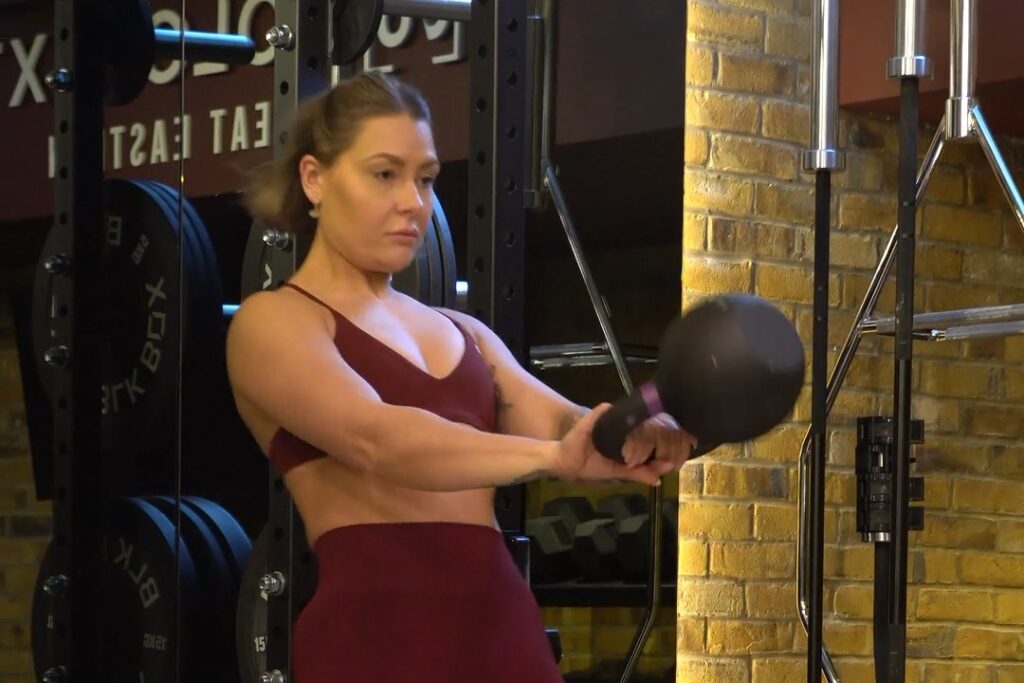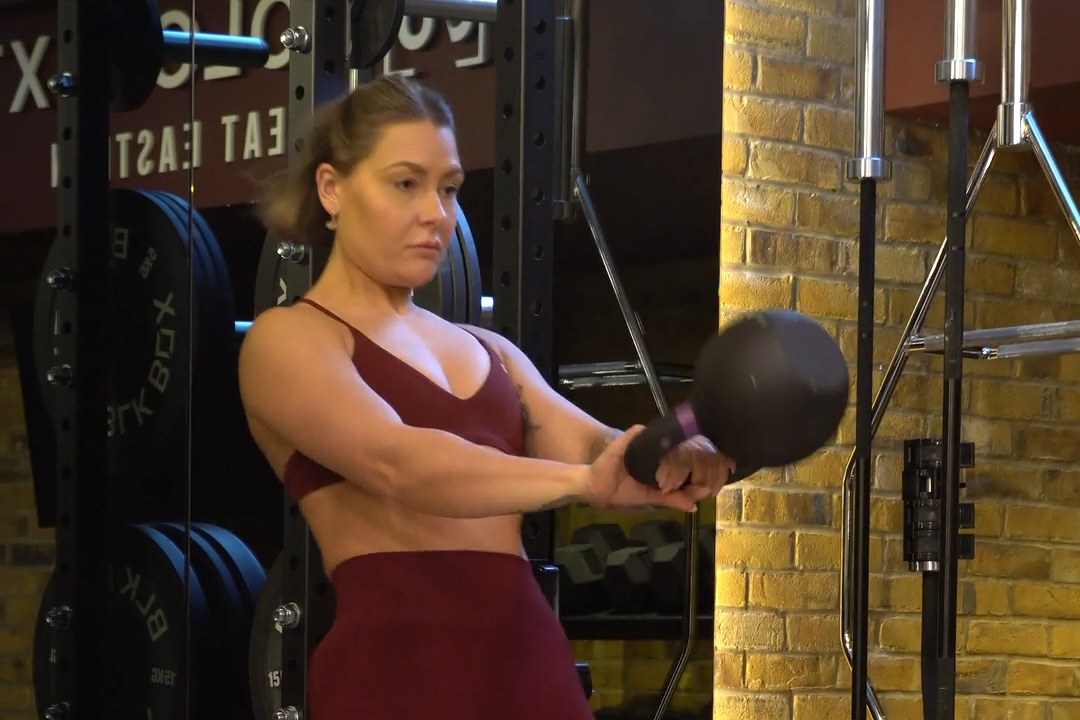


To do a kettlebell swing, hinge at your hips, hike the bell back between your legs, then snap your hips forward to float it up to chest height. Let it fall back into the next hinge and repeat. Your hips do the work, not your arms.
That’s the whole movement in three lines.
The swing is a hip hinge, not a squat. Your knees bend a little, but most of the movement comes from pushing your hips back and driving them forward. Get that right and the swing builds your glutes, hamstrings and grip, and gets your heart rate up fast.
This guide is for you if:
- You’ve never swung a kettlebell and want to learn it safely.
- You already swing, but feel it in your lower back or arms.
- You want a simple, short workout you can do with one kettlebell.
I’m Will Duru, a personal trainer and the founder of 12REPS. I use swings with my clients, often as the last exercise of a session. Below, I’ll show you how to learn the hinge first, then the swing itself, the mistakes I see most and how to choose your weight.
Why do kettlebell swings?
The swing trains strength, power and conditioning in one movement, with one piece of equipment. Here’s what the research shows, and where my coaching view comes in.
What the research says
- It builds strength and power. In a 6-week study, men who did kettlebell swings twice a week improved their half-squat strength and vertical jump. The gains were similar to those from jump squat training. (Lake and Lauder, 2012)
- It works your glutes and back hard. A lab study of the swing with a 16 kg (35 lb) bell found glute activity around 80% of a maximal contraction, and low back muscle activity around 50%. (McGill and Marshall, 2012)
- It may help some people with back and neck pain. In an 8-week trial, adults in jobs with high rates of neck and back pain did kettlebell training three times a week. Their neck, shoulder and low back pain dropped compared with a control group, and their back strength improved. (Jay et al., 2011)
What the research doesn’t say
- These were small studies: 21 young men, 7 men in the lab study and 40 workers in the pain trial.
- The same lab study noted that while many people credit swings with helping their back, a few find they irritate it.
- The pain trial found no improvement in aerobic fitness, even though swings feel like cardio.
If you already have back pain, check with a doctor or physical therapist before you start.
Why I use them
The swing is powered by your hips, not your arms. That’s why I like it so much. It teaches you to drive with your glutes, the same skill you need for deadlifts, jumps and sprints.
It’s also one of the best ways I know to finish a session. A few hard sets get your heart rate up fast, with very little equipment.
Learn the hip hinge first
Most swing problems start with a poor hinge. Before you swing, practice the movement slowly.
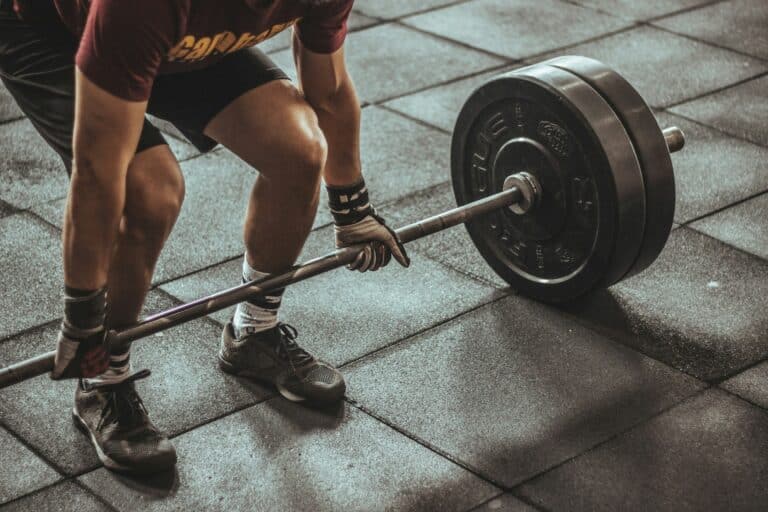
A hinge means you push your hips back while your back stays flat and your knees bend only a little. It’s the opposite of a squat, where your hips drop straight down.
Step 1: The kettlebell deadlift
- Stand with your feet about shoulder-width apart, the kettlebell on the floor between your feet.
- Push your hips back until you can reach the handle. Keep your back flat and your chest up.
- Grip the handle with both hands and squeeze your shoulder blades down.
- Drive through your feet and stand up tall, squeezing your glutes at the top.
- Push your hips back again to lower it.
Step 2: The kettlebell Romanian deadlift (RDL)
The RDL starts from standing, which is closer to how the swing feels. Hold the bell in front of your thighs, push your hips back until you feel a stretch in your hamstrings, then drive your hips forward to stand.
See the Kettlebell RDL with Loop Band demo for another version.
What you should feel: your hamstrings and glutes. If you feel it mostly in your lower back, your hips aren’t going back far enough. When you can do 10 smooth RDLs with a flat back, you’re ready to swing.
How to do a kettlebell swing
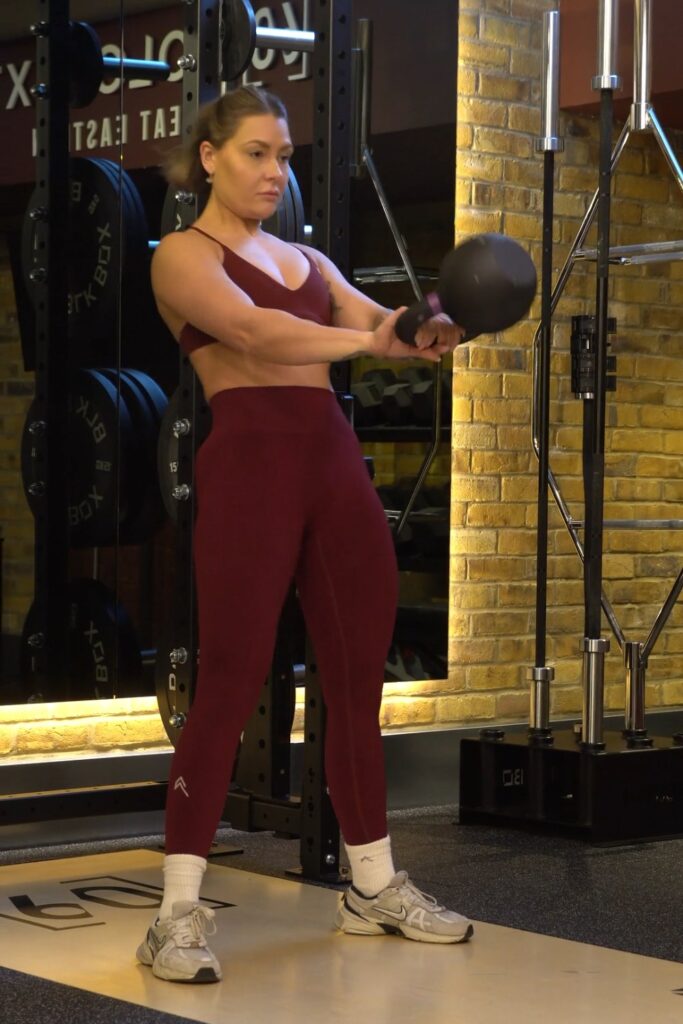
This is the two-handed swing, sometimes called the Russian swing. The bell rises to about chest height.
Setup
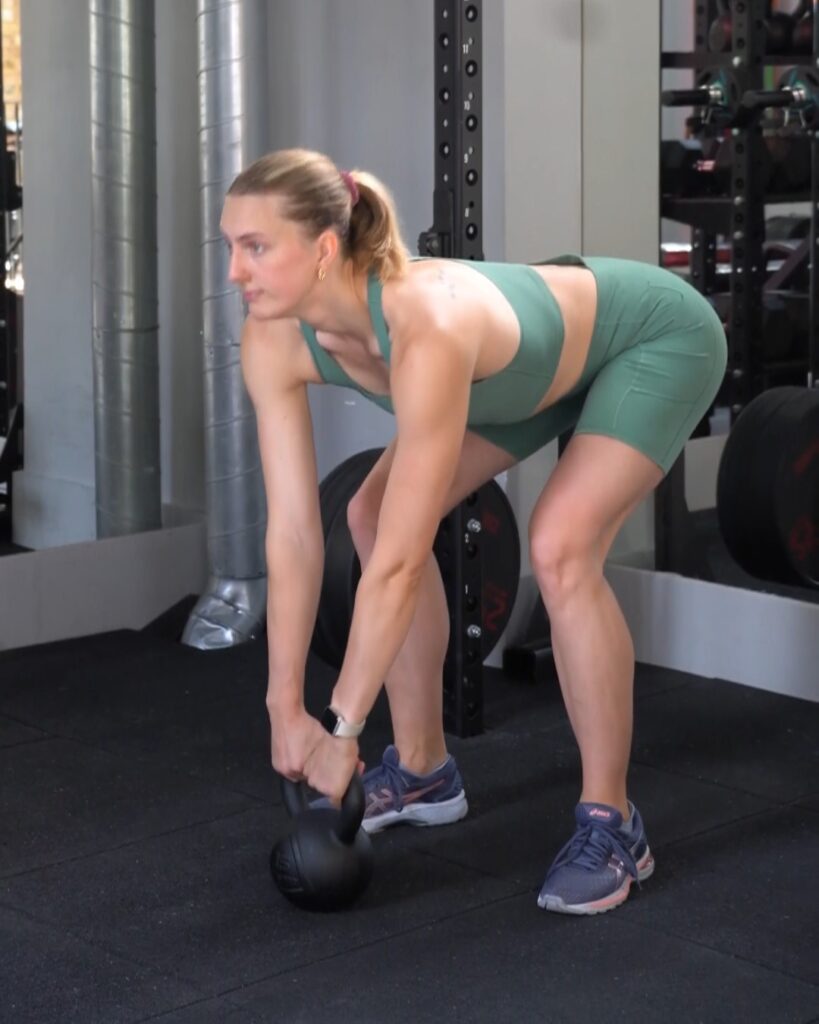
- Place the kettlebell on the floor about a foot in front of your toes.
- Stand with your feet a little wider than shoulder-width.
- Hinge at your hips and grip the handle with both hands. Tilt the bell toward you.
- Flatten your back, pull your shoulders down and brace your core.
The movement
- Hike it back. Pull the bell back between your legs, like a football snap. Your forearms should touch your inner thighs.
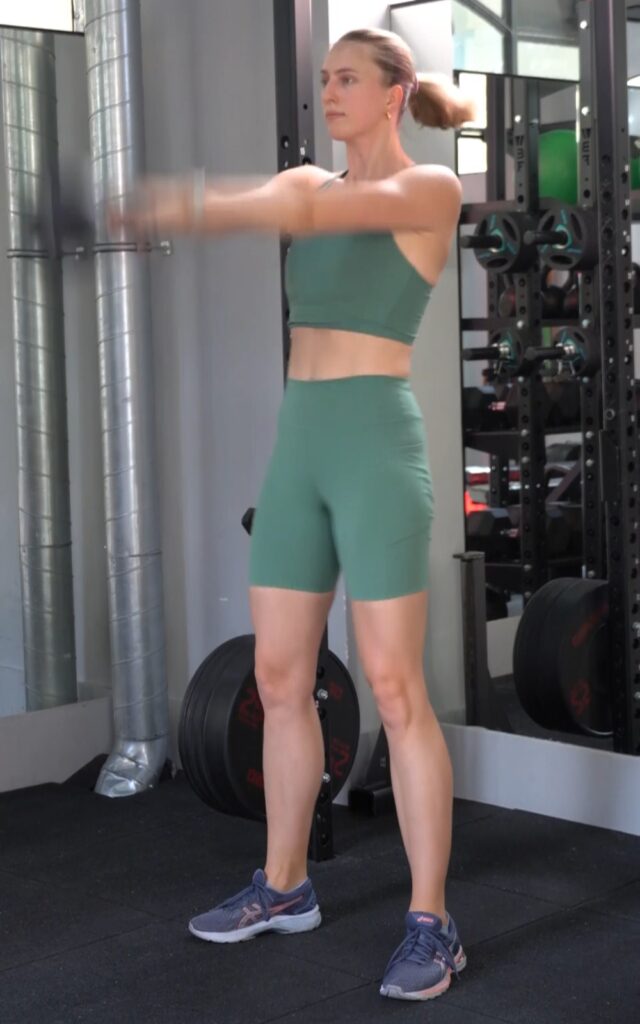
- Snap your hips. Drive your hips forward hard and stand up tall. Squeeze your glutes and tighten your stomach at the top.
- Let it float. The bell rises to about chest height from the power of your hips. Your arms just guide it.
- Hinge again. As the bell falls, wait until it’s close to your hips, then push your hips back and let it swing between your legs.
- Repeat for your set, then hike the bell back one last time and park it on the floor in front of you.
Breathing
Breathe in as the bell swings back. Breathe out sharply as you snap your hips forward. A short, hard breath out helps you brace at the top.
My coaching cues
- “Hips, not arms.” If your shoulders are doing the lifting, you’re turning it into a front raise.
- “Hinge, don’t squat.” Your hips go back, not down.
- “Stand tall at the top.” Finish in a straight line from head to heels, like a standing plank. Don’t lean back.
- “Let it fall, then hinge.” Don’t chase the bell down. Wait for it, then hinge.
Common kettlebell swing mistakes
The biggest one is simple: turning the swing into a squat. If your hips drop instead of going back, your thighs take over and the power is gone.
| Mistake | What it looks like | The fix |
|---|---|---|
| Squatting the swing | Knees bend a lot, hips drop toward the floor | Practice RDLs. Push your hips back, not down |
| Lifting with your arms | Shoulders burn, bell feels heavy at the top | Relax your arms and snap your hips harder |
| Rounding your back | Back curves as the bell swings between your legs | Hinge less deep, keep your chest up and go lighter |
| Leaning back at the top | Hips push past your shoulders, back arches | Finish standing tall, glutes and stomach tight |
| Swinging too high | Bell goes overhead with a two-hand grip | Stop at chest height for this version |
| Bell swings too low | Bell drops toward your knees on the way back | Keep it high between your thighs. Forearms touch your legs |
| Feeling it in your lower back | Ache or pain in the low back after sets | Stop, go back to RDLs, then retry with a lighter bell |
If you feel pain in your lower back, it’s a sign you’re likely using the wrong muscles. Focus on hinging at your hips and snapping them forward.
What weight kettlebell should you use?
Start lighter than you think while you learn, then move up once your form is solid. These are the ranges I give most people:
| While learning | Once your technique is solid | |
|---|---|---|
| Women | 8 to 12 kg (18 to 26 lb) | 12 to 16 kg (26 to 35 lb) |
| Men | 12 to 16 kg (26 to 35 lb) | 16 to 24 kg (35 to 53 lb) |
These are starting points, not rules. If the bell pulls you forward or your back rounds, it’s too heavy. If you can swing it to chest height for 20 reps without breathing hard, it’s probably too light.
Sets, reps and a simple swing workout
Swings work best in short, sharp sets. Stop each set while your form still looks good.
Option 1: Swing finisher
Add this to the end of a strength session. It’s how I often use swings with my clients.
- 4 sets of 15 to 20 swings, resting 45 seconds between sets.
Option 2: 10-minute swing session
For a short stand-alone workout:
- Set a timer for 10 minutes.
- At the start of every minute, do 10 swings, then rest for the remainder of the minute.
- That’s 100 swings in 10 minutes.
Do either option two or three times a week, on days apart.
How to progress
- Add reps: build from 10 to 15 to 20 per set.
- Shorten your rest.
- Move up one bell size and drop back to 10 reps.
Next step: the single-arm swing
Once the two-handed swing feels smooth, try swinging with one hand. It’s the same hip snap, but your core works harder to stop your body twisting. Use a lighter bell at first and do equal reps on each side.
Summary
- The kettlebell swing is a hip hinge, not a squat. Your hips do the work, not your arms.
- Learn the hinge first with kettlebell deadlifts and Romanian deadlifts.
- Hike the bell back, snap your hips forward and let it float to chest height.
- Stand tall at the top. Don’t lean back or lift with your arms.
- If you feel it in your lower back, stop and check your form.
- Start lighter than you think and build reps before you add weight.
Train swings with a plan
Knowing how to swing is one thing. Knowing where it fits in your week is another.
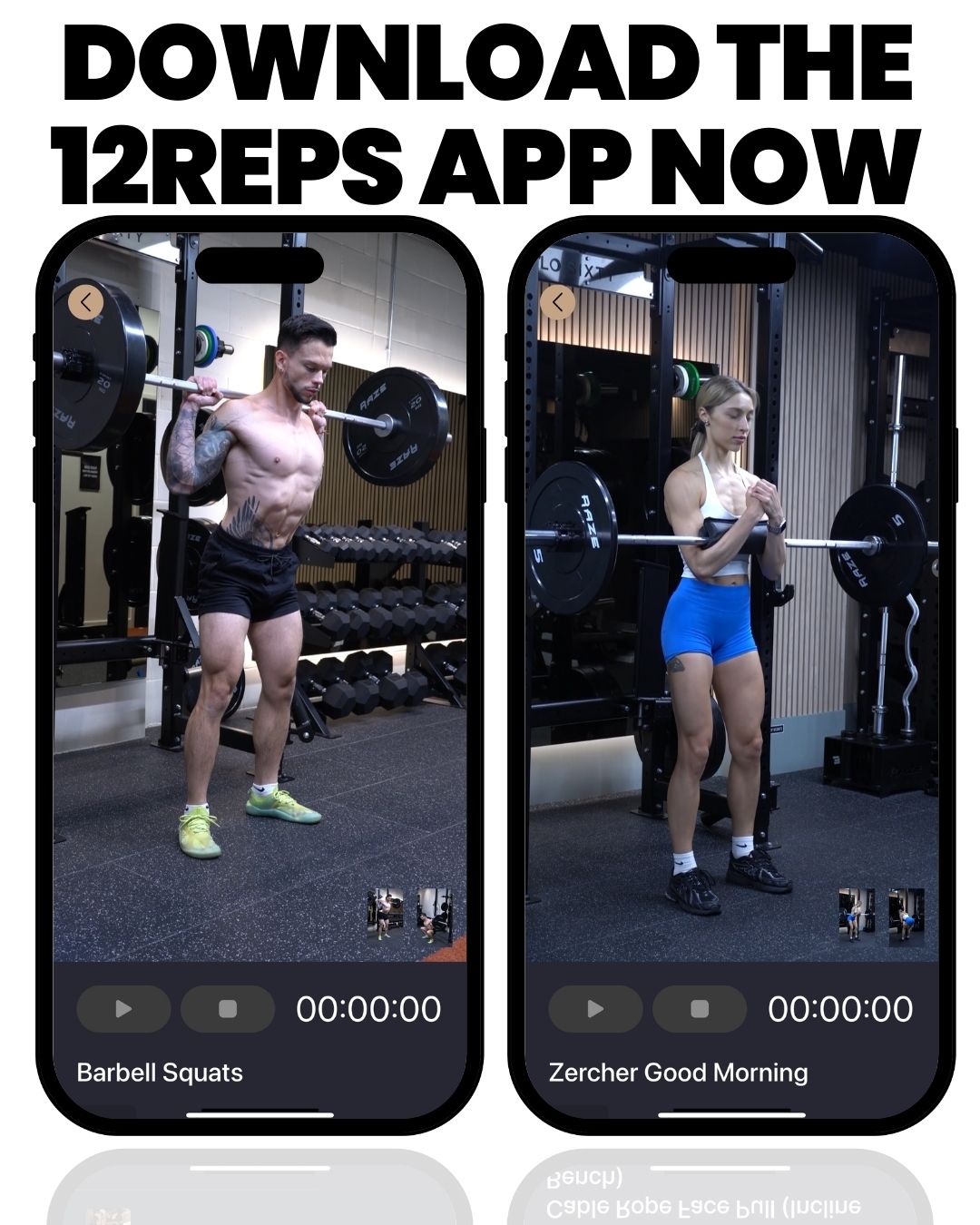
That’s why I built 12REPS. Every program is written by a real personal trainer. Before every lift, you get a demo video and a coach’s guide, so you know exactly what good form looks like. Tap the muscles you want to train, hit generate, and you get a workout built around them. Every set you log is saved, so you can see your history and know when it’s time to move up a bell.
Download 12REPS and see what you’ll get:
Sources
- Lake JP, Lauder MA. Kettlebell swing training improves maximal and explosive strength. Journal of Strength and Conditioning Research. 2012;26(8):2228–2233.
- McGill SM, Marshall LW. Kettlebell swing, snatch, and bottoms-up carry: back and hip muscle activation, motion, and low back loads. Journal of Strength and Conditioning Research. 2012;26(1):16–27.
- Jay K, Frisch D, Hansen K, et al. Kettlebell training for musculoskeletal and cardiovascular health: a randomized controlled trial. Scandinavian Journal of Work, Environment & Health. 2011;37(3):196–203.
Related reading
- Full Body Kettlebell Workout: 5 Moves for a Quick, Effective Gym Session
- Kettlebell Workout for Runners: The Minimal Equipment Programme
- The Ultimate Kettlebell Workout: Your Full-Body Transformation in One Tool
- Kettlebell RDL with Loop Band exercise demo
- How to Do Face Pulls: Cable, Rope and Band Versions
About the author: I’m Will Duru, a personal trainer, strength and conditioning coach and the founder of 12REPS.