

You want your arms to look defined when you wear a sleeveless top. Not necessarily “bodybuilder” arms, just visible muscle tone, some shape, a bit of definition. But your arms remain frustratingly soft and undefined despite months of training.
Here’s what usually happens: you do a few bicep curls at the end of each workout, maybe some tricep dips. You use light weights (afraid of “getting bulky”). You do 20+ reps because you heard “high reps tone.” Months pass. Your arms look the same.
The problem isn’t genetics or age, it’s undertraining your arms with insufficient volume, inadequate intensity, and no progressive overload.
I’m Will Duru, a personal trainer with over 10 years’ experience in London. I’ve coached hundreds of women through proper arm training, and the transformation that occurs when they actually train arms properly—with appropriate weight, volume, and intensity, is remarkable.
This guide explains arm anatomy (biceps, triceps, and why they matter), why the “light weights, high reps” approach doesn’t work, what actually builds defined arms (progressive overload with moderate-heavy weights), the best exercises for biceps and triceps, how to programme arm training effectively, and how 12REPS structures arm work for optimal results.

Understanding Arm Anatomy
The Biceps (Front of Upper Arm)
According to Healthline’s comprehensive guide on building bigger arms, the biceps brachii consists of two heads:
Long head:
- Originates from top of shoulder blade
- Runs along outer edge of arm
- Creates the “peak” when you flex
Short head:
- Originates closer to shoulder joint
- Runs along inner edge of arm
- Creates width when viewed from front
Brachialis:
- Sits beneath biceps
- Often overlooked but crucial
- When developed, pushes biceps up creating greater arm circumference
- Trained with hammer grips (palms facing each other)
Primary functions:
- Elbow flexion (bending arm)
- Forearm supination (rotating palm upward)
The Triceps (Back of Upper Arm)
The triceps brachii consists of three heads—hence “tri” ceps:
Long head:
- Largest of three heads
- Runs down back of arm closest to body
- Creates the “horseshoe” shape when developed
- Only head that crosses shoulder joint
Lateral head:
- Runs down outer edge of arm
- Most visible from the side
- Creates arm width
Medial head:
- Lies beneath the other two heads
- Least visible but provides foundational strength
Primary function:
- Elbow extension (straightening arm)
- Long head also assists with shoulder extension
Why Triceps Matter More Than You Think
Surprising fact: Your triceps make up approximately 60-65% of your upper arm mass. Your biceps only account for 30-35%.
Implication: If you want bigger, more defined arms, tricep development is actually more important than bicep development.
Yet most women: Focus almost exclusively on biceps (curls, curls, curls) whilst neglecting triceps. This creates imbalanced, less defined arms.
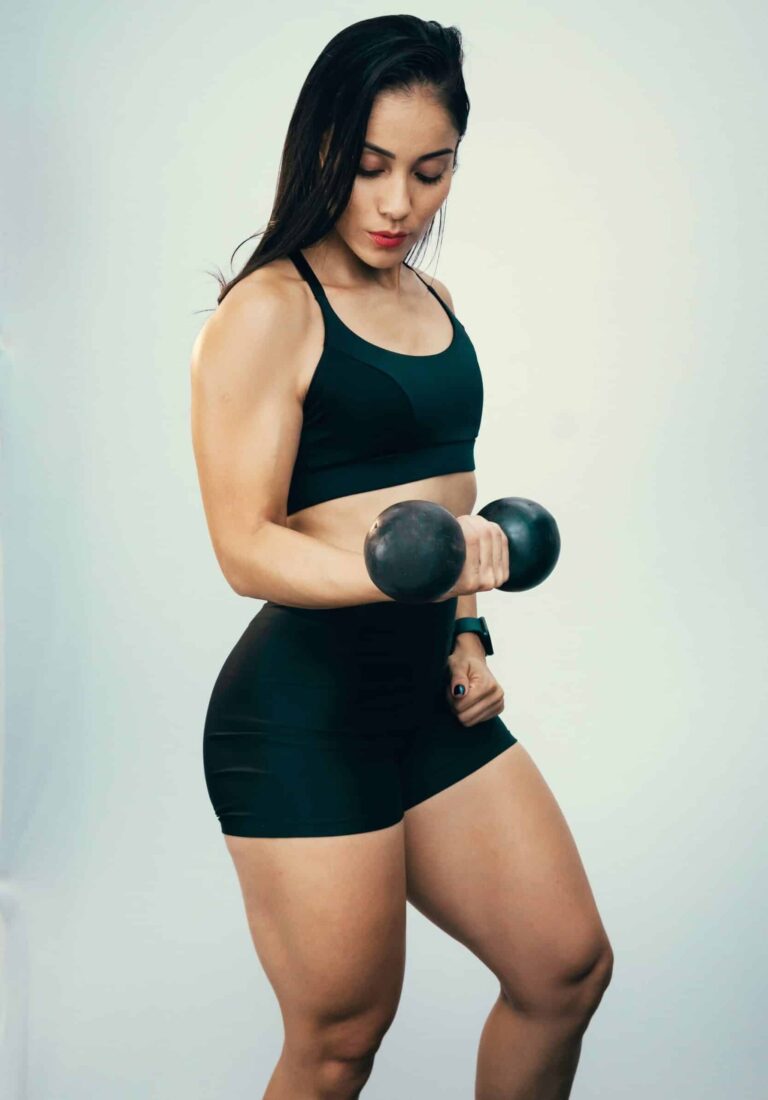
Why Triceps Matter More Than You Think
Surprising fact: Your triceps make up approximately 60-65% of your upper arm mass. Your biceps only account for 30-35%.
Implication: If you want bigger, more defined arms, tricep development is actually more important than bicep development.
Yet most women: Focus almost exclusively on biceps (curls, curls, curls) whilst neglecting triceps. This creates imbalanced, less defined arms.
Why "Light Weights, High Reps" Doesn't Work
The Myth
Common advice: “Women should use light weights (2-4kg) and do 20-30 reps to ‘tone’ without getting bulky.”
Where this comes from: Misunderstanding of muscle physiology + fear of building “too much” muscle.
The Reality
According to research reviewed by the American Council on Exercise (ACE), muscle doesn’t “tone”—it either grows or shrinks. There’s no special “toning” rep range.
What actually happens with different rep ranges:
1-5 reps (very heavy weight):
- Primarily builds maximum strength
- Some muscle growth
- Very demanding on nervous system
6-12 reps (moderate-heavy weight):
- Optimal for muscle growth (hypertrophy)
- Still builds significant strength
- Sweet spot for most people
15-20 reps (light-moderate weight):
- Builds muscular endurance
- Minimal muscle growth
- Limited strength development
20+ reps (light weight):
- Primarily cardiovascular benefit
- Minimal muscle growth
- Very limited strength gains
For building defined, shapely arms: The 6-12 rep range with weights that feel challenging is optimal.
Why You Won’t “Get Bulky”
Biological reality: Women have 10-30x less testosterone than men. Testosterone is the primary hormone driving significant muscle growth.
What this means: Even training with heavy weights, high volume, and perfect nutrition, women build muscle much more slowly than men.
To actually achieve “bulky” arms requires:
- Years of dedicated arm-focused training
- Very high training volume (15-20+ sets weekly per muscle group)
- Calorie surplus for extended periods
- Often performance-enhancing drugs (among competitive bodybuilders)
What happens when you train arms properly:
- Defined muscle becomes visible
- Arms look shapely and athletic
- “Toned” appearance everyone actually wants
You will not accidentally build massive arms. It doesn’t happen.
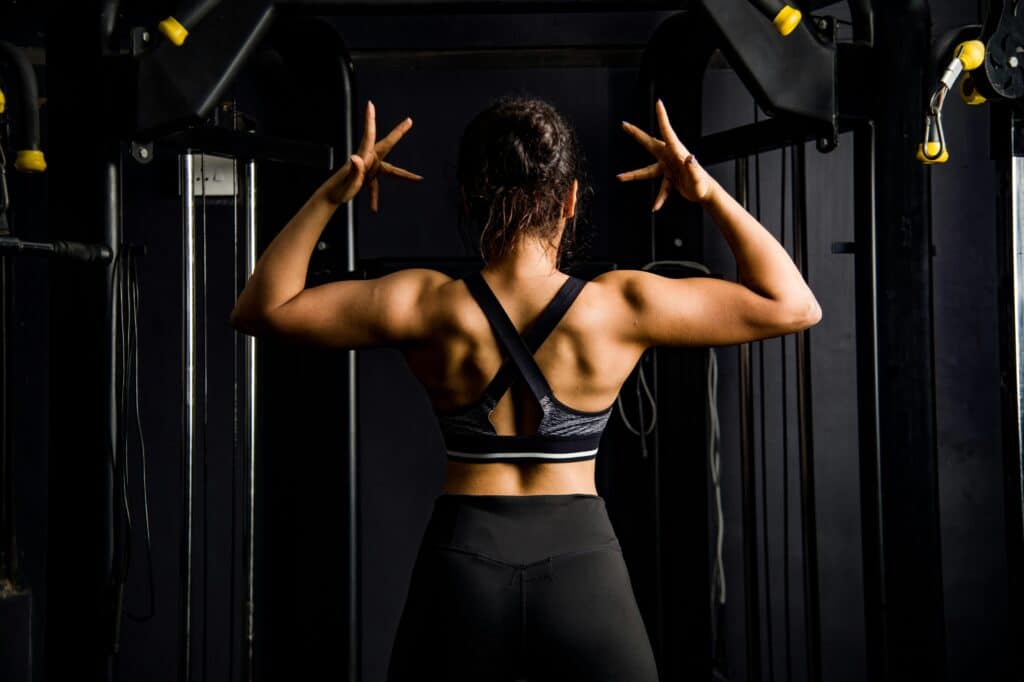
The Best Bicep Exercises for Women
Research by the American Council on Exercise identified the most effective bicep exercises through EMG (electromyography) analysis.
1. Barbell Curl
Why it’s effective: Allows heaviest loading, both bicep heads worked equally, simple movement pattern.
How to perform:
- Stand with feet hip-width apart
- Grip barbell with underhand grip (palms up), hands shoulder-width apart
- Arms extended, bar at thigh level
- Curl bar upward by bending elbows
- Bring bar to shoulder height (don’t let elbows drift forward)
- Squeeze biceps at top
- Lower with control to starting position
Common mistakes:
- Swinging body to lift weight (use lighter weight, control the movement)
- Letting elbows drift forward (keep elbows by sides throughout)
- Only curling halfway up (full range of motion required)
Starting weight: Empty bar (20kg) for most women, or 10-15kg fixed barbell if learning.
Progression: 12kg → 15kg → 20kg (empty bar) → 22.5kg → 25kg over 12-24 weeks.
2. Dumbbell Hammer Curl
Why it’s effective: Targets brachialis significantly (adds arm thickness), reduces wrist strain, can alternate arms for better focus.
How to perform:
- Stand with dumbbells at sides
- Neutral grip (palms facing each other, thumbs pointing forward)
- Curl one dumbbell upward toward shoulder
- Keep neutral grip throughout (don’t rotate palm)
- Lower with control, repeat other side

Common mistakes:
- Rotating wrist during curl (defeats the purpose—keep neutral grip)
- Using momentum by swinging torso
- Incomplete range of motion
Starting weight: 4-6kg dumbbells
Progression: 4kg → 6kg → 8kg → 10kg → 12kg over 12-24 weeks
3. Cable Curl
Why it’s effective: Constant tension throughout movement (unlike free weights where tension varies), easy to adjust weight, smoother resistance curve.
How to perform:
- Stand facing cable machine, handle at lowest position
- Grab handle with underhand grip
- Step back slightly so cable has tension even with arms extended
- Curl handle upward to shoulder height
- Squeeze, then lower with control
Common mistakes:
- Standing too close to machine (reduces tension at bottom)
- Leaning back to lift weight (stand upright, use lighter weight)
Starting weight: 10-15kg
Progression: 10kg → 15kg → 20kg → 25kg → 30kg
4. Concentration Curl
Why it’s effective: Isolates bicep by eliminating momentum, excellent mind-muscle connection, great for fixing left-right imbalances.
How to perform:
- Sit on bench, legs spread
- Hold dumbbell in right hand
- Rest right elbow against inside of right thigh
- Let arm hang extended
- Curl dumbbell upward, focusing on bicep contraction
- Lower with control
- Complete all reps, switch arms
Common mistakes:
- Rushing through reps (this is about slow, controlled contraction)
- Using too much weight (compromises isolation)
Starting weight: 4-6kg
Progression: 4kg → 6kg → 8kg → 10kg
5. Incline Dumbbell Curl
Why it’s effective: Stretches long head of biceps more than standing curls, unique stimulus, great for variety.
How to perform:
- Set bench to 45-60 degree incline
- Sit with back against bench
- Hold dumbbells at sides, arms hanging (stretch at bottom)
- Curl both dumbbells upward simultaneously
- Keep elbows back (don’t let them drift forward)
- Lower to full stretc
Common mistakes:
- Setting bench too upright (reduces stretch—45-60 degrees optimal)
- Not lowering to full stretch position
Starting weight: 4-6kg (lighter than standing curls due to stretched position)
How to Programme Arm Training Effectively
Frequency: How Often to Train Arms
Option 1: Indirect arm work only (beginners, first 3-6 months)
Don’t train arms directly at all. Your biceps get worked during back exercises (rows, pulldowns), and triceps get worked during chest/shoulder exercises (bench press, overhead press).
When this works: Complete beginners building base strength.
When to progress: After 3-6 months, or when compound lifts are strong (bench pressing 40kg+, rowing 30kg+).
Option 2: Direct arm work 1x weekly (intermediate)
Add one dedicated arm session weekly, focusing on both biceps and triceps.
Structure: 6-8 total sets for biceps, 6-8 total sets for triceps.
Example:
- Barbell curls: 3 sets × 8-10 reps
- Hammer curls: 2 sets × 10-12 reps
- Close-grip bench: 3 sets × 8-10 reps
- Tricep pushdowns: 2 sets × 12-15 reps
When this works: Most intermediate women (6-24 months training) see good arm development with this frequency.
Option 3: Direct arm work 2x weekly (advanced or arm-focused)
Train arms twice weekly on separate days, allowing 2-3 days recovery between sessions.
Structure: 8-12 sets per muscle group weekly, split across two sessions.
Example:
Day 1 (after back/chest):
- Barbell curls: 3 sets × 8 reps
- Cable curls: 2 sets × 12 reps
- Close-grip bench: 3 sets × 8 reps
- Overhead extensions: 2 sets × 10 reps
Day 2 (after legs or separate arm day):
- Hammer curls: 3 sets × 10 reps
- Incline curls: 2 sets × 12 reps
- Tricep dips: 3 sets × 8 reps
- Tricep pushdowns: 2 sets × 15 reps
When this works: Advanced trainees (24+ months), or intermediate trainees specifically wanting to prioritise arm development.
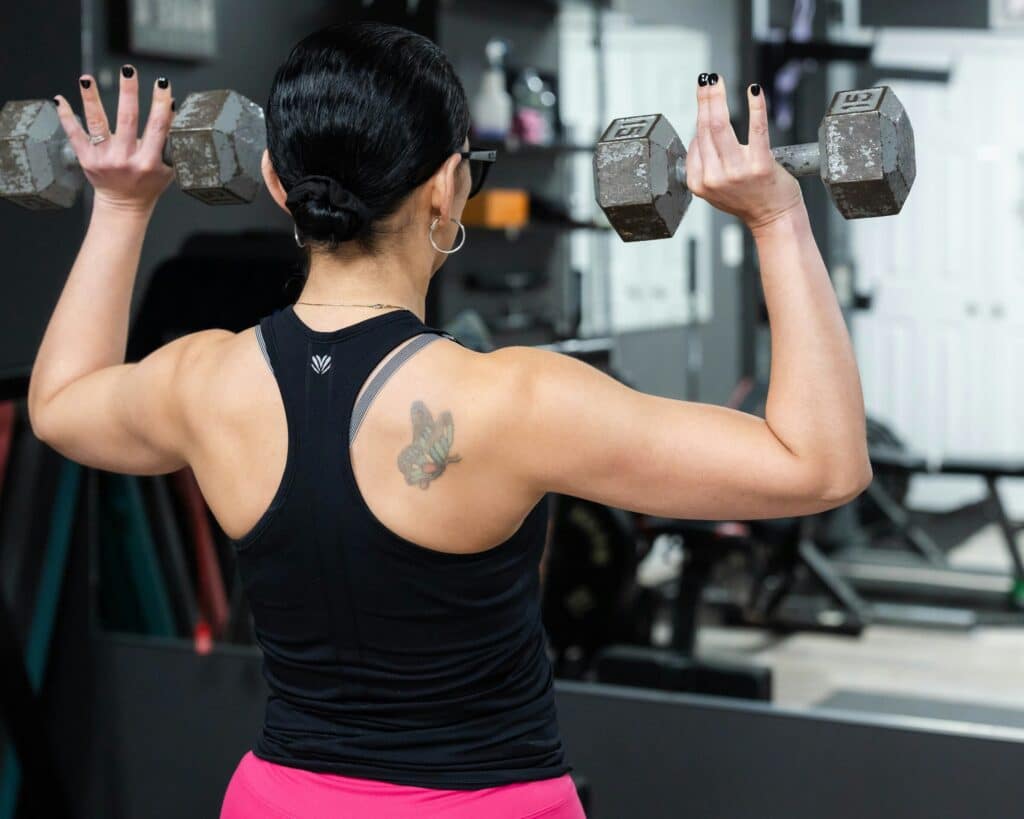
Volume: How Many Sets Per Week
Research reviewed in Sports Medicine journals suggests:
Maintenance (preserve existing muscle):
- Biceps: 6-8 sets weekly
- Triceps: 6-8 sets weekly
Growth (build new muscle):
- Biceps: 10-16 sets weekly
- Triceps: 10-16 sets weekly
Maximum productive volume:
- Biceps: 18-20 sets weekly (beyond this, recovery becomes problematic)
- Triceps: 18-22 sets weekly
Important: “Sets” means hard sets approaching muscular failure (1-3 reps short of complete failure), not light warm-up sets.
Intensity: How Heavy to Lift
For muscle growth (hypertrophy):
- Use weight that allows 6-12 reps with good form
- Last 1-2 reps should feel very challenging
- Aim to reach muscular failure (or 1-2 reps before failure) on final set of each exercise
Rep ranges by goal:
- Strength focus: 6-8 reps, heavier weights
- Hypertrophy focus: 8-12 reps, moderate-heavy weights
- Muscular endurance: 12-15 reps, moderate weights
Most women: 8-12 rep range works best for building defined arms.
Progressive Overload for Arms
Methods to progress:
1. Add weight (most common)
- When you can complete all sets × reps with good form, increase weight
- Typical increases: 1-2kg for bicep exercises, 2.5kg for tricep exercises
Example progression (barbell curls):
- Week 1-2: 20kg × 8, 8, 7 reps
- Week 3-4: 20kg × 8, 8, 8 reps
- Week 5-6: 22.5kg × 8, 7, 6 reps
- Week 7-8: 22.5kg × 8, 8, 7 reps
2. Add reps
- Keep weight same, gradually increase reps until you reach top of range (e.g., 12 reps), then add weight
3. Add sets
- If currently doing 2 sets per exercise, increase to 3 sets
4. Reduce rest periods
- Keep weight and reps same, gradually shorten rest from 90 seconds to 60 seconds
The key: Some form of progression must occur over weeks and months, or arms won’t grow.
Sample Arm Training Workouts
Workout 1: Beginner Arm Session (20 minutes)
Perform after main workout (back or chest day)
- Barbell curls: 3 sets × 10-12 reps
- Rest: 90 seconds
- Hammer curls: 2 sets × 10-12 reps
- Rest: 60 seconds
- Tricep pushdowns: 3 sets × 10-12 reps
- Rest: 90 seconds
- Overhead tricep extension: 2 sets × 10-12 reps
- Rest: 60 seconds
Total sets: 10 (5 biceps, 5 triceps)
Workout 2: Intermediate Dedicated Arm Day (35 minutes)
- Close-grip bench press: 4 sets × 8-10 reps
- Rest: 2 minutes
- Barbell curls: 4 sets × 8-10 reps
- Rest: 90 seconds
- Tricep dips: 3 sets × 8-12 reps
- Rest: 90 seconds
- Incline dumbbell curls: 3 sets × 10-12 reps
- Rest: 75 seconds
- Cable tricep pushdowns: 3 sets × 12-15 reps
- Rest: 60 seconds
- Cable curls: 2 sets × 12-15 reps
- Rest: 60 seconds
Total sets: 19 (9 biceps, 10 triceps)
Workout 3: Advanced High-Volume Arm Session (45 minutes)
- Barbell curls: 4 sets × 6-8 reps (heavy)
- Close-grip bench: 4 sets × 6-8 reps (heavy)
- Superset: Minimal rest between exercises, 2 min rest between supersets
- Hammer curls: 3 sets × 10-12 reps
- Overhead tricep extensions: 3 sets × 10-12 reps
- Superset: Minimal rest between, 90 sec rest between supersets
- Concentration curls: 3 sets × 12-15 reps
- Diamond push-ups: 3 sets × AMRAP (as many reps as possible)
- Superset: Minimal rest between, 90 sec rest between supersets
- Cable curls: 2 sets × 15-20 reps
- Tricep pushdowns: 2 sets × 15-20 reps
- Superset: Minimal rest between, 60 sec rest
Total sets: 24 (12 biceps, 12 triceps)

Common Mistakes in Arm Training
Mistake 1: Training Arms Every Day
Problem: Arms are small muscle groups that require 48-72 hours recovery. Training daily doesn’t allow adequate recovery, limiting growth.
Solution: Train arms 1-2x weekly with at least 2 days between sessions.
Mistake 2: Only Training Biceps
Problem: Triceps make up 60%+ of arm mass. Neglecting them creates imbalanced, less impressive arms.
Solution: Equal or greater volume for triceps compared to biceps (1:1 ratio minimum, 1.5:1 ideal).
Mistake 3: Using Only One Exercise
Problem: Doing only bicep curls week after week provides limited stimulus. Muscles adapt to repeated stress.
Solution: Use 2-3 different bicep exercises and 2-3 different tricep exercises across the week, rotating exercises every 4-8 weeks.
Mistake 4: Neglecting Progressive Overload
Problem: Using same weight for months. If you’re still curling 6kg dumbbells after 6 months, your arms haven’t grown.
Solution: Track weights used, increase when you can complete all target reps with good form.
Mistake 5: Swinging Weights With Momentum
Problem: Using body English and momentum to lift heavier weights reduces tension on target muscle, increases injury risk.
Solution: Control the weight throughout entire range of motion. If you can’t, reduce weight.
How 12REPS App Structures Arm Training
Integrated Into Full Programming
12REPS doesn’t provide “arm-only” programmes. Arms are integrated intelligently into full-body or upper/lower training splits.
Why: Arm development occurs optimally when balanced with overall strength development. Compound lifts (rows, presses) provide significant arm stimulus, direct arm work complements this.
Example Structure (3-Day Full Body)
Day 1 (Lower + Indirect Arm Work):
- Squats, deadlifts, lunges (legs)
- Overhead press (indirect tricep work)
- Barbell rows (indirect bicep work)
- Direct arm work: 2 sets bicep curls, 2 sets tricep pushdowns
Day 2 (Upper + Direct Arm Work):
- Bench press (indirect tricep work)
- Lat pulldowns (indirect bicep work)
- Direct arm work: 3 sets barbell curls, 3 sets close-grip bench press
Day 3 (Full Body + Arm Finisher):
- Hip thrusts, Bulgarian split squats
- Rows, overhead press
- Direct arm work: 2 sets hammer curls, 2 sets overhead extensions
Total weekly arm volume: 7 sets biceps, 7 sets triceps (appropriate for intermediate development)
Progressive Loading Managed Automatically
12REPS tracks your arm exercise performance and suggests weight increases when appropriate:
- Barbell curls: 20kg × 8, 8, 8 reps achieved → app suggests 22.5kg next session
- Tricep pushdowns: 25kg × 12, 12, 11 reps → app suggests aiming for 12, 12, 12 before increasing weight
Result: Systematic progression without guesswork.
Exercise Variety Over Time
12REPS rotates arm exercises every 4-8 weeks:
- Weeks 1-4: Barbell curls + tricep pushdowns
- Weeks 5-8: Dumbbell curls + overhead extensions
- Weeks 9-12: Cable curls + close-grip press
Why: Prevents adaptation, provides varied stimulus, keeps training interesting.
The Bottom Line
Building defined, shapely arms requires proper training—not the ineffective “light weights, high reps” approach most women use.
Key principles for arm development:
✅ Train arms 1-2x weekly (not daily)
✅ Use moderate-heavy weights (6-12 rep range, not 20-30 reps)
✅ Volume: 10-16 sets weekly per muscle group for growth
✅ Equal or greater emphasis on triceps (they’re 60%+ of arm mass)
✅ Progressive overload (increase weight, reps, or sets over time)
✅ Exercise variety (2-3 different bicep exercises, 2-3 tricep exercises)
Best exercises:
✅ Biceps: Barbell curls, hammer curls, cable curls, concentration curls, incline curls
✅ Triceps: Close-grip bench, dips, overhead extensions, pushdowns, diamond push-ups
You will not “get bulky”:
✅ Women have 10-30x less testosterone than men
✅ Building large, “bulky” arms requires years of dedicated training + calorie surplus
✅ Proper arm training creates defined, toned, athletic-looking arms
Common mistakes to avoid:
❌ Training arms daily (insufficient recovery)
❌ Only training biceps (neglecting triceps which comprise 60% of arm mass)
❌ Light weights, 20+ reps (builds endurance, not muscle definition)
❌ No progressive overload (using same weights for months)
❌ Using momentum instead of control
How 12REPS helps:
✅ Integrates arm work into balanced full-body programming
✅ Appropriate volume (10-16 sets weekly per muscle group)
✅ Progressive overload managed automatically
✅ Exercise variety rotated every 4-8 weeks
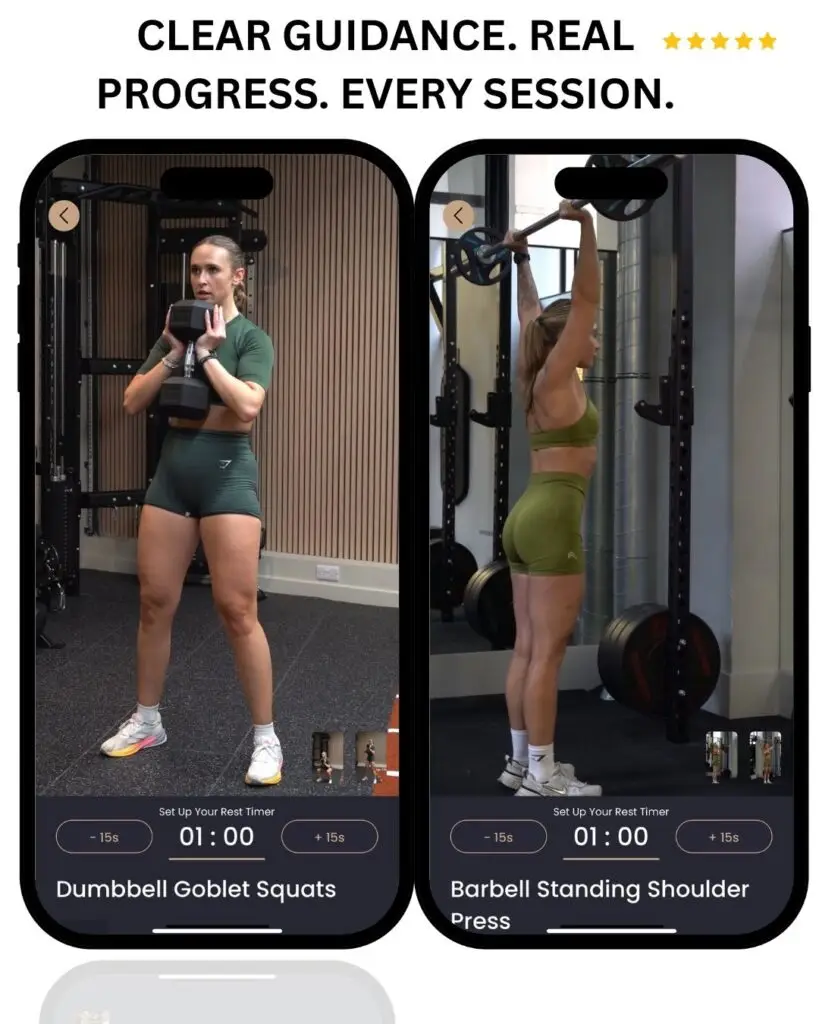
✅ Video demonstrations for proper form (1,500+ exercises)
Try 12REPS free for 7 days. Stop guessing how to train arms—follow structured programming that balances direct arm work with compound movements for optimal development.
The women with the most defined, shapely arms aren’t those doing endless light bicep curls—they’re those who train arms 1-2x weekly with progressive overload, moderate-heavy weights, and balanced bicep/tricep volume.
Your arms will grow when you train them like muscles that need to be challenged, not like delicate flowers that might break.
References
- Schoenfeld, B.J., Ogborn, D., Krieger, J.W. (2017). Dose-Response Relationship Between Weekly Resistance Training Volume and Increases in Muscle Mass: A Systematic Review and Meta-analysis. Journal of Sports Sciences, 35(11), pp.1073-1082. https://doi.org/10.1080/02640414.2016.1210197
- American Council on Exercise. (2014). ACE Study Reveals Best Biceps Exercises. ACE Fitness. [Available online]
- American Council on Exercise. (2012). ACE Study Identifies Top Three Triceps Exercises. ACE Fitness. [Available online]
- Schoenfeld, B.J. (2010). The Mechanisms of Muscle Hypertrophy and Their Application to Resistance Training. Journal of Strength and Conditioning Research, 24(10), pp.2857-2872. https://doi.org/10.1519/JSC.0b013e3181e840f3
- Burd, N.A., West, D.W., Staples, A.W., Atherton, P.J., Baker, J.M., Moore, D.R., Holwerda, A.M., Parise, G., Rennie, M.J., Baker, S.K. and Phillips, S.M. (2010). Low-Load High Volume Resistance Exercise Stimulates Muscle Protein Synthesis More Than High-Load Low Volume Resistance Exercise in Young Men. PLoS ONE, 5(8), e12033. https://doi.org/10.1371/journal.pone.0012033