

You’ve decided to start training your upper body properly. Smart move.
You walk to the bench press area. Empty benches. Dumbbells racked neatly. Nobody’s using them.
But you don’t know how to set up. How much weight to use. Where to lower the dumbbells. How to get heavy dumbbells into position safely. Whether your form is right.
So you grab light dumbbells, awkwardly lie back, press them a few times with questionable technique, and leave feeling like you didn’t accomplish much.
Sound familiar?
I’m Will Duru, a personal trainer with over 10 years’ experience in London. I’ve taught hundreds of women how to bench press properly with dumbbells. The dumbbell bench press is one of the best upper body exercises you can do—but technique matters enormously.
Here’s exactly how to do it correctly, from setup to progression.
Why Dumbbell Bench Press (Not Barbell)
Before the technique, let’s establish why dumbbells.
Dumbbells are safer for beginners. With a barbell, if you can’t complete a rep, you’re stuck with 20-60kg across your chest. With dumbbells, you can drop them to the sides safely.
Dumbbells allow greater range of motion. A barbell stops at your chest. Dumbbells can be lowered slightly below chest level, providing a fuller stretch and better muscle activation.
Dumbbells prevent strength imbalances. If your right side is stronger, a barbell lets it compensate. Dumbbells force each side to work independently.
Dumbbells are more shoulder-friendly. You can adjust hand position and elbow angle to find what feels comfortable. A barbell locks you into one fixed path.
I start every woman on the dumbbell bench press. Once they’ve built a solid strength base (typically pressing 16-20kg dumbbells for reps), we might incorporate barbell work. But many never need to. Dumbbells alone build excellent upper body strength.
Muscles Worked
Primary muscles:
- Pectorals (chest): The main workers. Both upper and mid chest are heavily involved.
- Anterior deltoids (front shoulders): Assist throughout the press.
- Triceps: Work to straighten your elbows at the top.
Secondary muscles:
- Core: Stabilises your torso throughout.
- Lats (back): Provide stability when shoulder blades are retracted.
- Rotator cuff muscles: Stabilise the shoulder joint.
The dumbbell bench press is a compound movement. You’re training multiple muscle groups simultaneously. This is time-efficient and builds functional pressing strength.
Equipment Needed
Essential:
- Flat bench
- Pair of dumbbells (starting weight: 6-12kg per hand for most women)
Optional but helpful:
- Mirror to check form
- Spotter for heavy sets (though less critical than barbell pressing)
Most commercial gyms have all of this. Home setup requires a sturdy bench and adjustable dumbbells.
Setup: Getting Into Position Safely
This is where most beginners struggle. How do you get into position with heavy dumbbells without injury?
The proper setup sequence:
Step 1: Select Appropriate Weight
Start conservatively. You’re learning technique. Ego has no place here.
For complete beginners: 6-8kg dumbbells per hand For those with some training experience: 8-12kg per hand For intermediate lifters: 12-16kg per hand
You should be able to complete 8-10 controlled reps. If you can’t, reduce weight.
Step 2: Position Dumbbells on Thighs
Pick up the dumbbells from the floor or rack using proper deadlift form (bent knees, straight back).
Sit at the end of the bench with dumbbells resting vertically on your thighs, just above your knees. Your palms face each other. The dumbbell ends rest in your hip crease.
Step 3: Lie Back with Momentum
This is the key technique most people botch.
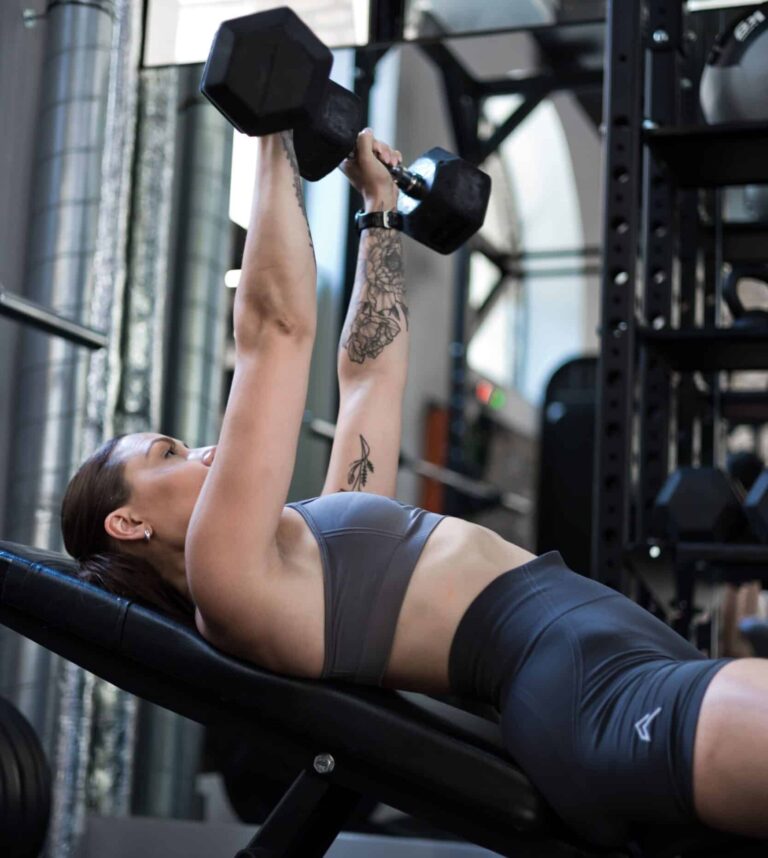
Proper method: As you lean back onto the bench, simultaneously use your thighs to help kick the dumbbells up toward your shoulders. Your legs provide momentum whilst your arms guide the weights into position.
Common mistake: Trying to muscle the dumbbells into position with arms alone. This wastes energy and strains shoulders before you’ve even started the exercise.
Think of it as one fluid motion: lean back → thighs push dumbbells up → arms guide them into starting position.
Step 4: Position Your Body
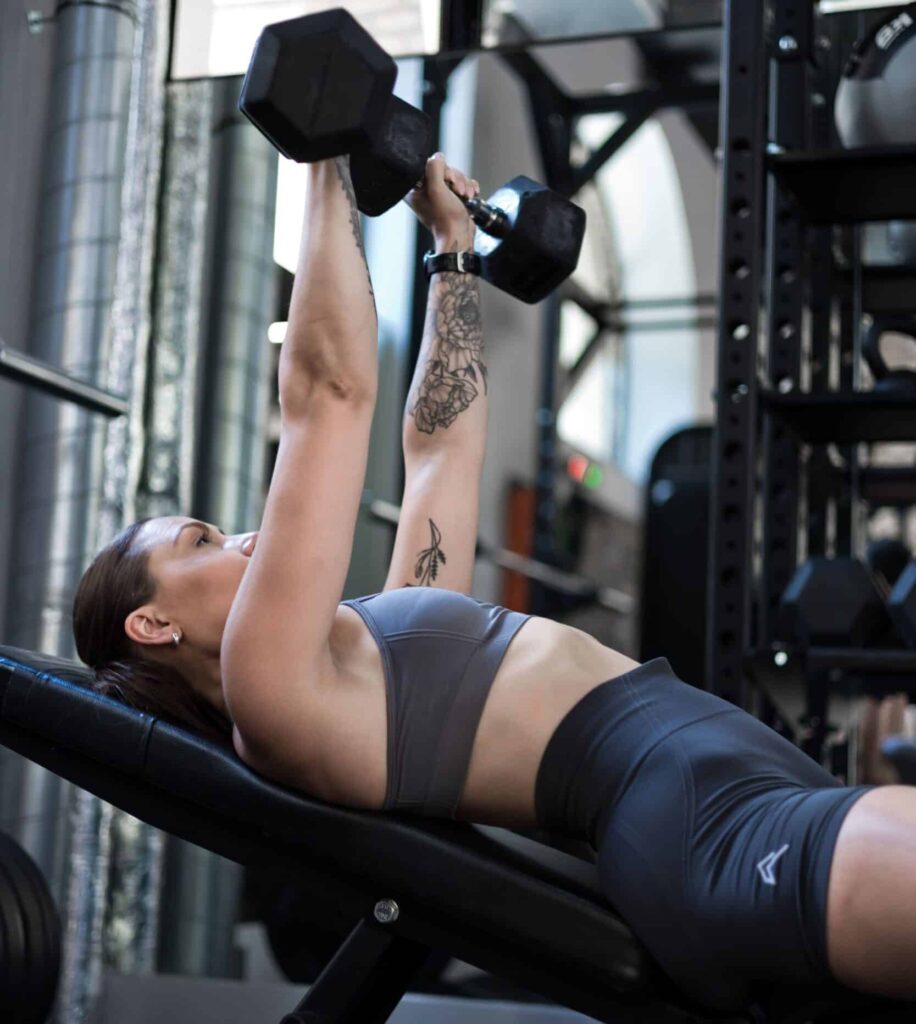
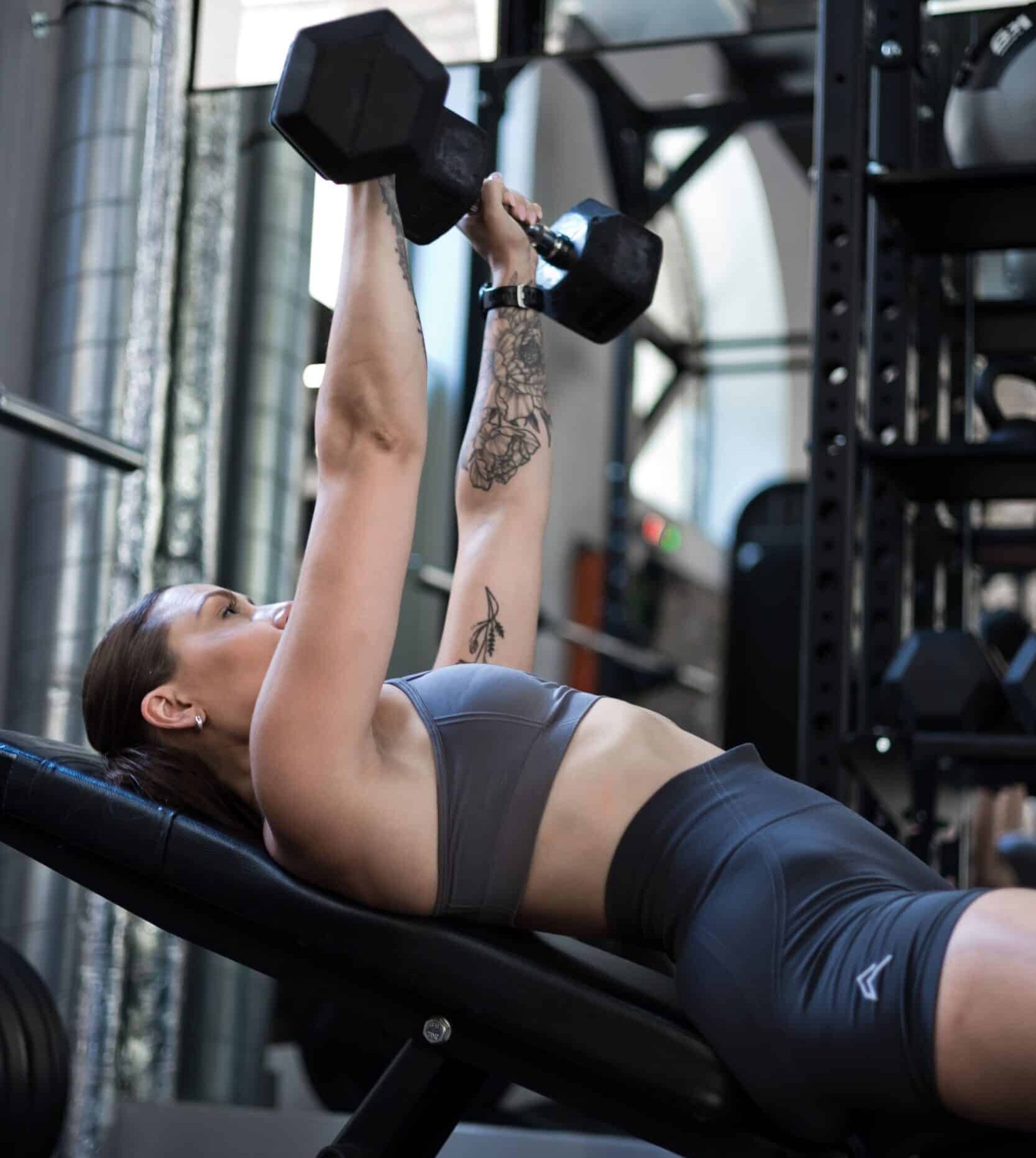
Once lying back with dumbbells held above chest:
Head, shoulders, and glutes: In contact with bench Feet: Flat on floor, roughly hip-width apart Lower back: Slight natural arch (not excessive) Shoulder blades: Retracted (pulled back and down into the bench)
This creates a stable base. You’re now ready to press.
Step 5: Set Starting Position
Hold dumbbells above your chest with arms extended (slight bend in elbows, not locked out).
Palms should face toward your feet (pronated grip). Dumbbells should be roughly shoulder-width apart, positioned directly above your shoulders.
Engage your core. Take a deep breath. You’re ready for your first rep.
Execution: The Perfect Rep
Now the actual pressing movement.
The Descent (Eccentric Phase)
Inhale deeply.
Lower the dumbbells in a controlled arc—down and slightly out to the sides. They should travel both downward AND outward.
Elbow angle: Your elbows should form roughly a 45-degree angle from your torso. Not tucked tight to your sides (too much tricep involvement). Not flared out to 90 degrees (shoulder strain). Somewhere in between.
How far down: Lower until the dumbbells are level with your chest or slightly below. Your upper arms should be roughly parallel to the floor at the bottom.
You should feel a stretch across your chest. If you feel sharp pain in shoulders, you’re likely going too deep or your elbows are flared too wide.
Control the weight. This isn’t a freefall. The eccentric phase should take 2-3 seconds. Controlled descent builds strength and prevents injury.
The Press (Concentric Phase)
Exhale as you press.
Drive the dumbbells back up in an arc, pressing both upward and slightly inward. Think about pressing the weights toward each other as they rise.
Drive through your chest and shoulders. This isn’t an arm exercise. The power comes from your pecs and front delts, with triceps finishing the movement.
Maintain stability. Your shoulder blades stay retracted throughout. Your feet stay planted. Your core stays braced.
Press until arms are extended with a slight bend in elbows. Don’t lock out completely—maintain tension.
The dumbbells should end up close to their starting position, directly above your shoulders.
That’s one rep. Reset, inhale, and descend for rep two.
Common Mistakes Women Make
Mistake 1: Using Dumbbells That Are Too Light
“I don’t want to get bulky” leads women to press 4kg dumbbells for 20 reps.
This builds endurance. Not strength. Not muscle.
If you can do 20+ reps, the weight is too light. Progressive overload requires sufficient resistance.
Use weight that allows 8-12 reps with good form. When you can do 12 reps easily, increase weight.
Mistake 2: Elbows Flared Out to 90 Degrees
This creates excessive shoulder strain. Your elbows should be roughly 45 degrees from your torso—forming an arrow shape, not a “T” shape.
If you experience shoulder discomfort, check your elbow positioning first.
Mistake 3: Bouncing the Dumbbells Off Chest
Momentum isn’t strength. Bouncing dumbbells off your chest to assist the upward press defeats the purpose.
Control the descent. Pause briefly at the bottom. Press with muscular force, not momentum.
Mistake 4: Uneven Pressing
One dumbbell rises faster than the other. This indicates strength imbalance.
Consciously press both dumbbells at the same speed. If one side lags, reduce weight until you can maintain symmetry.
Mistake 5: Holding Breath Throughout
You need oxygen. Breathe.
Inhale on the descent. Exhale on the press. Consistent breathing prevents dizziness and maintains stability.
Mistake 6: Excessive Lower Back Arch
A slight natural arch is good. Bridging your entire back off the bench is dangerous and reduces chest activation.
Your glutes stay on the bench. Your core stays braced. Arch is minimal.
Mistake 7: Not Retracting Shoulder Blades
If your shoulder blades aren’t pulled back and down into the bench, you lose stability and put shoulders at risk.
Before every set: squeeze shoulder blades together. Pin them to the bench. Maintain this throughout.
How to Safely Exit the Exercise
You’ve finished your set. Now what?
DO NOT just drop the dumbbells to the floor. This damages equipment, creates loud noise, and can injure you if dumbbells bounce.
Proper method:
- After your final rep, bring dumbbells together above chest
- Rotate wrists so palms face each other (neutral grip)
- Lower dumbbells to sides of chest
- Use momentum to sit up whilst bringing dumbbells to thighs
- Alternatively: carefully lower dumbbells to floor beside bench whilst still lying down
With lighter weights, you can control them down easily. With heavier weights (16kg+), the sit-up method works better.
Progressive Overload: How to Get Stronger
You start with 8kg dumbbells. How do you progress to 16kg? 20kg? Beyond?
Progressive overload principles:
Stage 1: Add Reps
Start with 3 sets of 8 reps with 8kg dumbbells.
Next session: aim for 3 sets of 9 reps. Session after: 3 sets of 10 reps. Continue until you reach 3 sets of 12 reps
Stage 2: Increase Weight
Once you complete 3 sets of 12 reps comfortably, increase weight.
Move to 10kg dumbbells. You’ll likely drop back to 8-10 reps per set. That’s expected.
Work back up to 3 sets of 12 reps with 10kg. Then increase to 12kg.
Stage 3: Realistic Progression Timeline
Months 1-3: 8kg → 12kg dumbbells Months 4-6: 12kg → 16kg dumbbells Months 7-12: 16kg → 20kg dumbbells Year 2+: 20kg → 24kg+ dumbbells
These are averages for women training consistently 2-3x weekly. Your progression might be faster or slower. Both are fine.
I trained a woman who started pressing 6kg dumbbells. Eighteen months later, she was pressing 20kg dumbbells for reps. The transformation in her upper body strength and physique was remarkable.
But it was gradual. Not 6kg to 20kg in a month. Small, consistent increases over time.
Variations to Consider
Once you’ve mastered the standard dumbbell bench press, these variations add training stimulus.
Incline Dumbbell Bench Press
Set bench to 30-45 degree incline.
Benefits: Emphasises upper chest more than flat bench. Builds well-rounded chest development.
Use slightly lighter weight than flat bench initially. The incline position is mechanically harder.
Floor Dumbbell Press
Lie on floor instead of bench. Lower dumbbells until upper arms touch floor.
Benefits: Reduced range of motion makes this easier. Good for beginners or those with shoulder issues. Forces you to press without momentum.
Neutral Grip Dumbbell Press
Keep palms facing each other throughout (instead of facing feet).
Benefits: More tricep involvement. Less shoulder strain. Good variation if standard grip bothers your shoulders.
Single-Arm Dumbbell Press
Press one dumbbell at a time whilst other arm holds its dumbbell stationary.
Benefits: Increased core stability demand. Helps correct strength imbalances. Advanced variation.
Programming Dumbbell Bench Press
How often should you bench press? How many sets and reps?
For strength building:
- Frequency: 2x weekly (e.g., Monday and Thursday)
- Sets: 3-4 per session
- Reps: 6-10 per set
- Rest: 2-3 minutes between sets
For muscle building (hypertrophy):
- Frequency: 2x weekly
- Sets: 3-5 per session
- Reps: 8-12 per set
- Rest: 60-90 seconds between sets
Sample upper body session:
- Dumbbell bench press: 4 sets × 8-10 reps
- Dumbbell rows: 4 sets × 10-12 reps
- Dumbbell shoulder press: 3 sets × 10-12 reps
- Lateral raises: 3 sets × 12-15 reps
- Tricep extensions: 3 sets × 12-15 reps
Bench press comes first because it’s the most demanding compound movement. You want to be fresh.
Troubleshooting Common Issues
“I Feel It in My Shoulders, Not My Chest”
Cause: Likely elbows flared too wide, or shoulder blades not retracted properly.
Fix: Tuck elbows to 45 degrees. Squeeze shoulder blades together before every set. Lower the weight and focus on chest contraction.
“One Side Is Significantly Weaker”
Cause: Natural strength imbalance. Common.
Fix: Don’t let strong side compensate. Match the weaker side’s reps. Over time, the imbalance will reduce.
“I Can’t Get Heavy Dumbbells Into Position”
Cause: Technique issue, not strength issue.
Fix: Practice the thigh-kick method with lighter weights first. Use momentum from lying back to assist. Consider asking for a spotter’s help to hand you weights once positioned.
“My Wrists Hurt”
Cause: Likely bending wrists backward under load.
Fix: Keep wrists straight and neutral. Imagine the weight transferring through your forearm bones directly into the dumbbells. If pain persists, try neutral grip variation.
“I Get Dizzy”
Cause: Holding breath or hyperventilating.
Fix: Consistent breathing pattern. Inhale during descent. Exhale during press. If still dizzy, reduce weight and ensure you’re eating adequately before training.
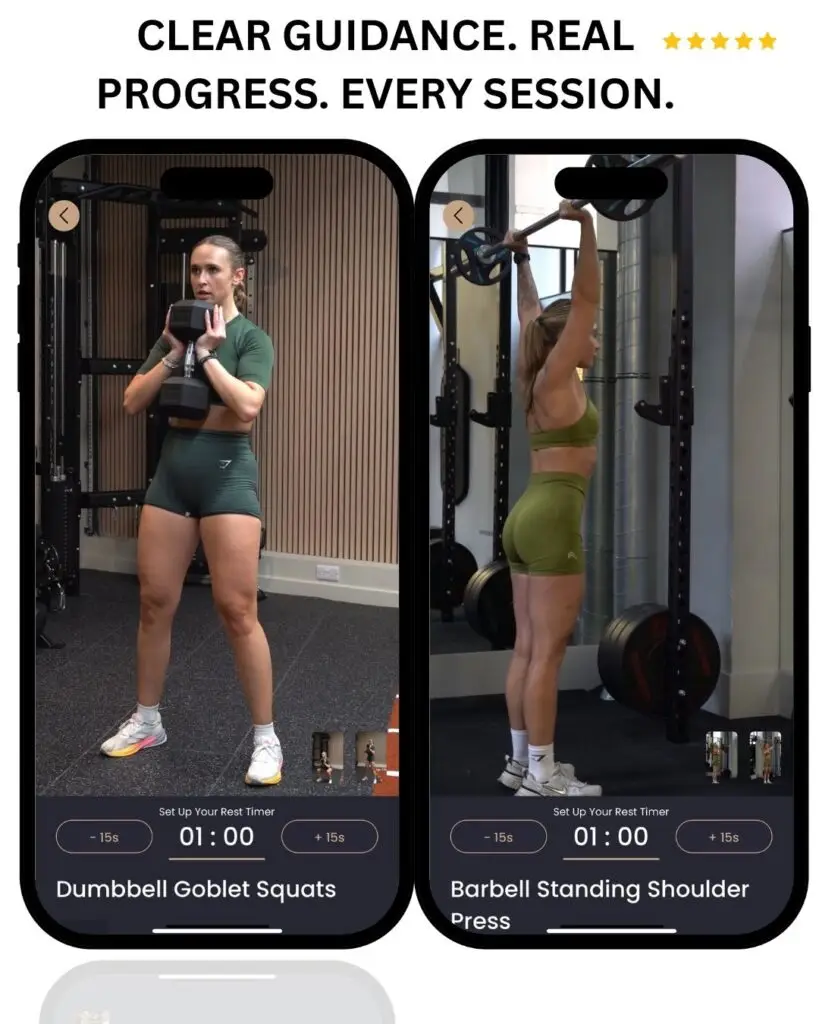
How 12REPS Helps with Bench Press
The challenge with exercises like dumbbell bench press is knowing:
- When to increase weight
- How to programme it alongside other exercises
- Whether your form is improving or deteriorating
- How your pressing strength compares to your pulling strength (balanced development)
12REPS tracks all of this:
Progressive overload tracking: The app knows when you’ve hit 3×12 reps and prompts you to increase weight next session.
Video demonstrations: You can review proper form before every session, ensuring technique doesn’t degrade.
Balanced programming: The app ensures you’re not over-emphasising pushing movements whilst neglecting pulls, preventing muscle imbalances.
Exercise substitutions: Can’t access a bench? The app can suggest floor press or other alternatives whilst maintaining training stimulus.
For women training both at gyms and at home, having programmed bench press sessions that adapt to available equipment removes guesswork entirely.
The Bottom Line
The dumbbell bench press is one of the best upper-body exercises for building chest, shoulder, and tricep strength.
Proper technique:
- Set up safely using the thigh-kick method to get into position
- Retract shoulder blades before every set
- Lower dumbbells in a controlled arc with elbows at 45 degrees
- Press dumbbells up and slightly inward, driving through chest
- Breathe consistently (inhale down, exhale up)
- Exit safely by sitting up or lowering to floor carefully
Progressive overload:
- Start conservative (6-12kg for most women)
- Add reps until you hit 3×12
- Increase weight by 2kg increments
- Expect 8kg → 20kg progression over 12-18 months
Common mistakes to avoid:
- Using weights that are too light
- Flaring elbows to 90 degrees
- Bouncing dumbbells off chest
- Neglecting shoulder blade retraction
- Holding breath
The women I train who progress most rapidly are those who focus relentlessly on technique whilst gradually increasing load. Not the ones who rush to heavy weights with poor form.
Your chest won’t grow overnight. Your pressing strength won’t double in a month. But train consistently with proper form, progressive overload, and adequate protein, and six months from now you’ll be significantly stronger.
The dumbbell bench press isn’t glamorous. It’s just one exercise. But done correctly, it’s one of the most effective tools for building upper body strength and muscle.
Set up properly. Lower with control. Press with power. Repeat.
References
- Saeterbakken, A.H., van den Tillaar, R. and Fimland, M.S. (2011). A Comparison of Muscle Activity and 1-RM Strength of Three Chest-Press Exercises with Different Stability Requirements. Journal of Sports Sciences, 29(5), pp.533-538. https://doi.org/10.1080/02640414.2010.543916
- Welsch, E.A., Bird, M. and Mayhew, J.L. (2005). Electromyographic Activity of the Pectoralis Major and Anterior Deltoid Muscles During Three Upper-Body Lifts. Journal of Strength and Conditioning Research, 19(2), pp.449-452. https://doi.org/10.1519/14513.1
- Barnett, C., Kippers, V. and Turner, P. (1995). Effects of Variations of the Bench Press Exercise on the EMG Activity of Five Shoulder Muscles. Journal of Strength and Conditioning Research, 9(4), pp.222-227.
- Lehman, G.J. (2005). The Influence of Grip Width and Forearm Pronation/Supination on Upper-Body Myoelectric Activity During the Flat Bench Press. Journal of Strength and Conditioning Research, 19(3), pp.587-591. https://doi.org/10.1519/15024.1
- Duffey, M.J. and Challis, J.H. (2007). Fatigue Effects on Bar Kinematics During the Bench Press. Journal of Strength and Conditioning Research, 21(2), pp.556-560. https://doi.org/10.1519/R-20306.1
- Fees, M., Decker, T., Snyder-Mackler, L. and Axe, M.J. (1998). Upper Extremity Weight-Training Modifications for the Injured Athlete: A Clinical Perspective. The American Journal of Sports Medicine, 26(5), pp.732-742. https://doi.org/10.1177/0363546598026005210