

You’ve decided to start strength training. Brilliant. But you’re not joining a gym, maybe you can’t afford it, maybe you haven’t got time, or maybe the thought of lifting weights surrounded by people makes you want to hide under your duvet. Fair enough.
The internet will tell you that home strength training for beginners requires nothing but “motivation” and “bodyweight exercises.” That’s partially true, but it’s also why most women who start training at home quit within a month. They follow some Instagram workout, feel knackered but see no progress, and conclude that strength training “doesn’t work” for them.
I’m Will Duru, a personal trainer with over 10 years’ experience training women in London. I’ve worked with absolute beginners in their homes, in parks, and eventually in gyms. The transition from “I’ve never lifted anything heavier than shopping bags” to “I just squatted 60kg” always starts the same way: at home, with minimal equipment, learning the fundamentals properly.
Here’s what actually works for women starting strength training at home, based on what I’ve seen succeed (and fail) hundreds of times.
Why Most Home Strength Training Advice Fails Women
Before we get into what works, let’s talk about why so much advice online is rubbish.
Problem 1: It’s written for men. Most “bodyweight workout” content is created by male trainers who’ve been lifting for years. They demonstrate advanced variations and assume you’ve got their strength levels. A bloke who can already bang out 20 press-ups will tell you to “just do press-ups.” Cheers, mate. That’s not helpful when you’re struggling to hold a plank for 30 seconds.
I’ve trained dozens of women who felt like failures because they couldn’t do a single proper press-up. That’s not failure, that’s just where you’re starting. We work on incline press-ups first, build strength progressively, and six months later they’re doing proper floor press-ups. But if they’d tried following some generic “30-day press-up challenge,” they’d have packed it in after day three.
Problem 2: It focuses on calorie burning, not strength building. Women get bombarded with “home workouts” that are actually just cardio circuits disguised as strength training. Fifty mountain climbers, thirty jump squats, twenty burpees, you’re sweating buckets, your heart rate’s through the roof, but you’re not building strength.
Building strength requires progressive resistance over time. That means making exercises harder week by week, either by adding resistance or making the movement more challenging. If you’re doing the same bodyweight circuit every session, you’re just getting better at that specific circuit. You’re not getting stronger.
Problem 3: It promises too much, too fast. “Transform your body in 30 days!” No. Stop it. You’re not going to transform anything meaningful in 30 days. You might lose a bit of weight if you sort your nutrition out, you might feel a bit better, but genuine strength development takes months, not weeks.
I tell new clients to commit to 12 weeks minimum. That’s when you actually see and feel real changes. Anything promising dramatic results in less time is selling you fantasy, not fitness.
What You Actually Need to Start
Let’s be practical about equipment. You can start strength training with literally nothing but your body, but you’ll progress faster with some basic kit.
Week 1-4: Genuinely nothing required
You can build foundational strength using only your body weight. I’ve trained clients in their living rooms who couldn’t afford any equipment at all. We used chairs for step-ups, walls for press-ups, and their own body weight for squats and lunges. It worked fine for the first month.
Week 5-12: £30-50 investment
After the first month, you’ll want:
- Resistance bands (£15-25 for a decent set): These add progressive resistance without taking up space. Get a set with different resistances so you can increase difficulty over time.
- Small dumbbells (£20-30 for adjustable pair): Start with 3-8kg range. You don’t need massive weights. I’ve had clients build significant strength with just a pair of 5kg dumbbells by focusing on proper form and high reps.
That’s it. Fifty quid total. Less than two months of a budget gym membership.
Week 12+: Optional upgrades if you’re committed
If you’re still training consistently after three months, consider:
- Heavier adjustable dumbbells (10-20kg range)
- Pull-up bar for the doorway
- Yoga mat if you’re fed up with carpet burn
But genuinely, you can train effectively at home for months with just bands and light dumbbells.
The Fundamental Movement Patterns Every Woman Should Master
Forget exercise names for a moment. Strength training is about movement patterns—ways your body moves that build functional strength. Master these six patterns and you’ll be stronger in everyday life, not just during workouts.
1. Squat Pattern (Lower Body Push)
Why it matters: You squat every time you sit down or stand up. Building squat strength makes daily life easier and builds your quads, glutes, and core.
How to start: Bodyweight squats to a chair. Stand in front of a chair, feet hip-width apart. Lower yourself until your bum touches the chair, then stand back up. This teaches proper depth and control.
I make every beginner start here. No exceptions. I don’t care if you reckon you can do “proper” squats—show me 20 perfect chair squats first, maintaining a neutral spine and hitting consistent depth. Then we’ll talk about progressing.
Common mistake I see constantly: Knees caving inwards. If your knees collapse towards each other as you squat, you’re setting yourself up for knee problems. Focus on pushing your knees out slightly as you descend.
Progression path:
- Week 1-2: Chair squats (3 sets of 10-12)
- Week 3-4: Bodyweight squats without chair (3 sets of 12-15)
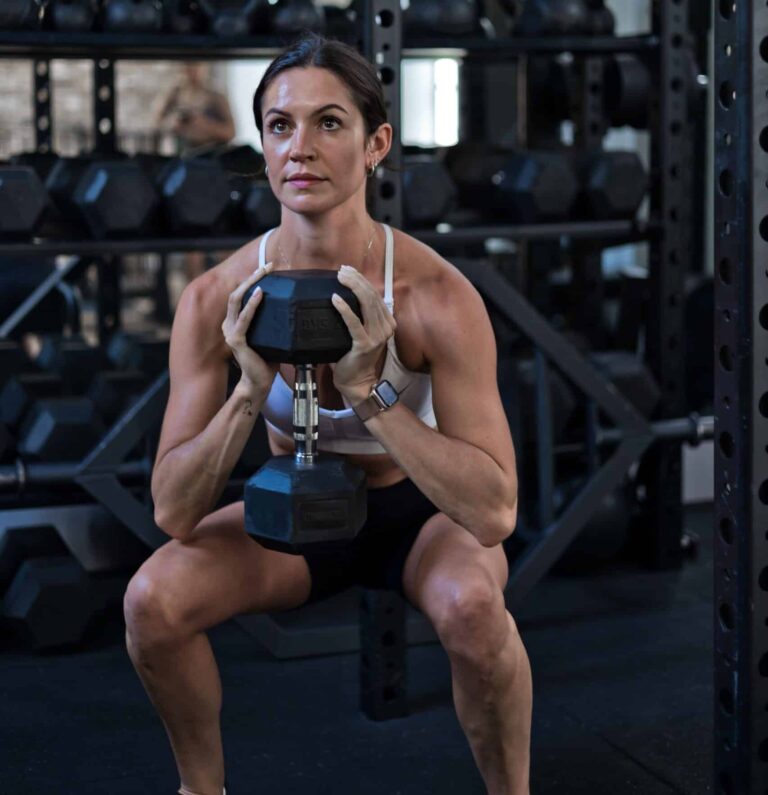
- Week 5-8: Goblet squats holding a dumbbell (3 sets of 10-12)
- Week 9+: Single-leg variations or heavier goblet squats
2. Hinge Pattern (Posterior Chain)
Why it matters: Hinging at the hips loads your glutes, hamstrings, and lower back—muscles that support your spine and power virtually every lower body movement.
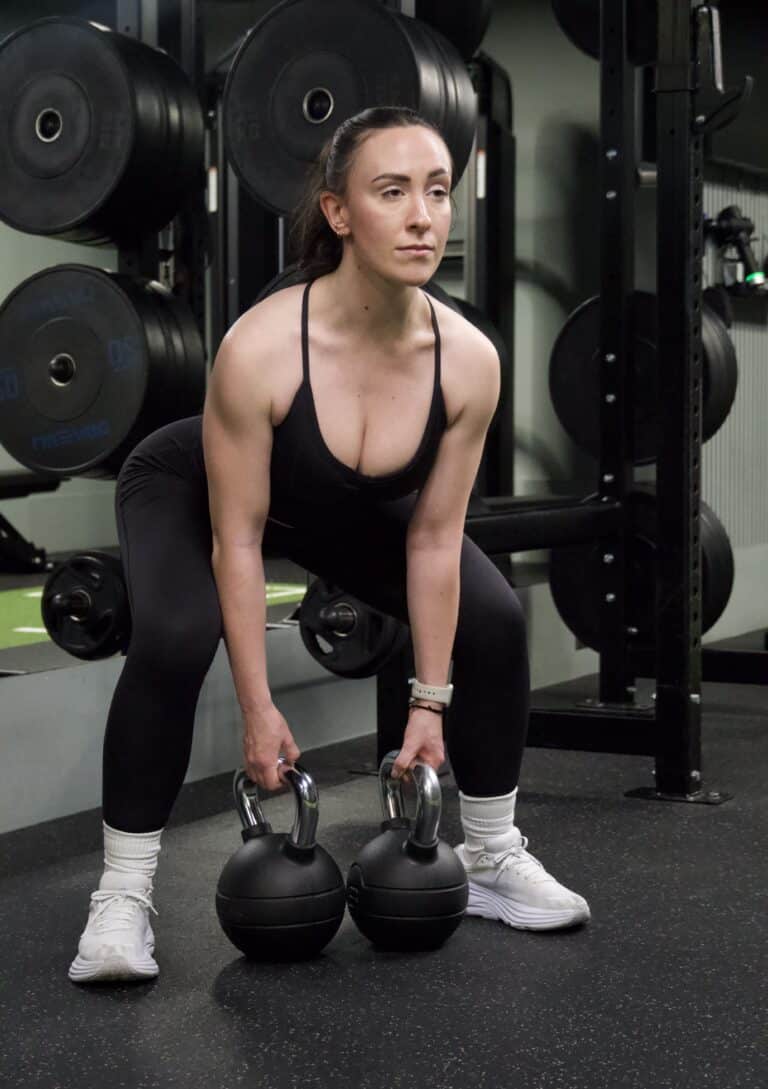
How to start: Romanian deadlift pattern with no weight. Stand with feet hip-width apart, slight bend in knees. Push your hips back whilst keeping your back flat, lowering your hands down your thighs. You should feel a stretch in your hamstrings. Return to standing by driving your hips forward.
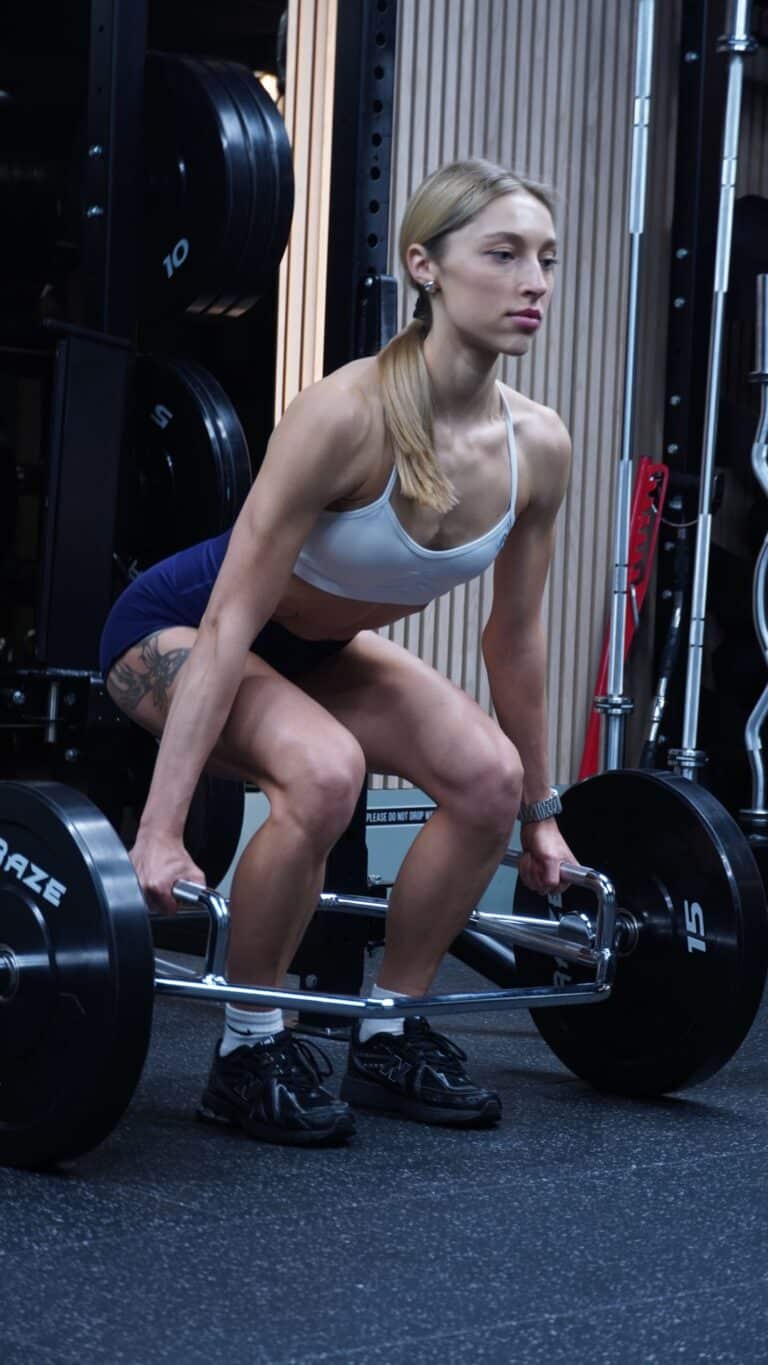
This is the pattern everyone gets wrong. Women tend to bend at the waist (turning it into a back exercise) rather than hinging at the hips. I spend more time teaching proper hinging than any other movement.
The cue that works: “Push your bum backwards like you’re trying to close a car door with your backside.” Sounds ridiculous, but it clicks for people when I say it like that.
Progression path:
- Week 1-2: Bodyweight hinges (3 sets of 12-15)
- Week 3-4: Single-leg Romanian deadlift, bodyweight (balance work)
- Week 5-8: Banded Romanian deadlifts (3 sets of 10-12)
- Week 9+: Dumbbell Romanian deadlifts (3 sets of 8-10)
3. Horizontal Push (Upper Body Push)
Why it matters: Pushing movements build your chest, shoulders, and triceps. Makes carrying shopping easier, pushing things (like your body weight) more manageable.
How to start: Incline press-ups against a kitchen counter or sturdy table. Hands on the edge, body in a straight line from head to heels. Lower your chest to the counter, press back up.
Here’s where women get the most discouraged. Most can’t do a single floor press-up when they start, and that feels rubbish. But incline press-ups? Everyone can do those. Start high up (wall press-ups if needed), get stronger, gradually lower the angle over weeks.
I had a client who started doing press-ups against her kitchen wall. Took her four months to work down to floor press-ups. Now she does sets of 15 with perfect form. The progression works if you’re patient.
Common mistake: Flaring elbows out to the sides. Keep them at roughly 45 degrees to your body, not 90 degrees. Saves your shoulders.
Progression path:
- Week 1-2: Wall press-ups (3 sets of 10-12)
- Week 3-4: Counter press-ups (3 sets of 10-12)
- Week 5-6: Coffee table press-ups (3 sets of 8-10)
- Week 7-8: Knee press-ups on floor (3 sets of 8-10)
- Week 9+: Full press-ups (3 sets of 5-8, building up)
4. Horizontal Pull (Upper Body Pull)
Why it matters: Pulling movements work your back, which counterbalances all the forward-facing movements you do daily (typing, cooking, carrying things in front of you). Prevents rounded shoulders.
How to start: This is the trickiest pattern to train at home without equipment. Options:
- Doorway rows: Stand in a doorway, grab both sides of the frame, lean back with straight arms, pull yourself towards the doorway. Like a standing row.
- Resistance band rows: Wrap band around a sturdy post or table leg, pull towards your chest.
- Improvised weight rows: Fill a shopping bag or rucksack with books, do single-arm rows.
I’ll be honest—this is where home training shows its limitations. Back development needs pulling resistance, and that’s hard to replicate without equipment. But you can still build foundational strength with these variations.
Progression path:
- Week 1-4: Band rows or doorway rows (3 sets of 12-15)
- Week 5-8: Bag rows with progressively heavier load (3 sets of 10-12)
- Week 9+: Consider getting a doorway pull-up bar for assisted pull-ups or inverted rows
5. Vertical Push (Overhead)
Why it matters: Overhead pressing builds shoulder strength and stability. Makes putting things on high shelves less precarious.
How to start: Pike press-ups (downward dog position, bend elbows to lower head towards floor, press back up) or standing dumbbell shoulder press.
Women often have better shoulder mobility than men, which is brilliant for overhead work. But many have weak shoulders from never training them. This movement fixes that.
Progression path:
- Week 1-4: Pike press-ups or light dumbbell press (3 sets of 8-10)
- Week 5-8: Steeper pike press-ups or heavier dumbbells (3 sets of 8-10)
- Week 9+: Feet-elevated pike press-ups or progressive dumbbell loading
6. Core Stability
Why it matters: Your core stabilises your entire body during every movement. Weak core = compensating with your back = back pain.
How to start: Plank holds. Get into press-up position (or knee press-up position), hold steady, focusing on keeping your hips level and core braced.
Stop doing hundreds of crunches. They’re mostly useless. Planks, side planks, and anti-rotation holds build functional core strength that actually transfers to real life.
Progression path:
- Week 1-2: Knee planks (3 sets of 20-30 seconds)
- Week 3-4: Full planks (3 sets of 30-45 seconds)
- Week 5-8: Side planks added (3 sets of 20-30 seconds per side)
- Week 9+: Single-leg planks, plank variations with movement
Your First 12 Weeks: A Realistic Programme
Right, let’s put this together into an actual training programme. Not some aspirational nonsense you’ll never stick to—an actual, achievable plan.
Weeks 1-4: Building the Foundation
Training frequency: 2-3 sessions per week Session length: 20-30 minutes Goal: Master movement patterns with bodyweight, build consistency habit
Session A (Full Body):
- Chair squats: 3 sets of 10-12
- Incline press-ups (counter height): 3 sets of 8-10
- Bodyweight hinges: 3 sets of 12-15
- Knee planks: 3 sets of 20-30 seconds
- Rest 60-90 seconds between sets
Session B (Full Body):
- Lunges (alternating legs): 3 sets of 8-10 per leg
- Band rows or doorway rows: 3 sets of 12-15
- Glute bridges: 3 sets of 12-15
- Side planks: 3 sets of 20-30 seconds per side
Weekly structure:
- Monday: Session A
- Wednesday: Rest or walk
- Friday: Session B
- Weekend: Rest or light activity
This is deliberately simple. You’re learning movements and building the habit. Don’t add extra exercises. Don’t train four days a week “to get faster results.” You need recovery time.
Weeks 5-8: Adding Resistance
Training frequency: 3 sessions per week Session length: 30-40 minutes Goal: Introduce external resistance, increase difficulty
You’ll need resistance bands and ideally some dumbbells by now.
Session A (Lower Body Focus):
- Goblet squats (dumbbell or heavy object): 3 sets of 10-12
- Romanian deadlifts (banded or dumbbell): 3 sets of 10-12
- Walking lunges: 3 sets of 10 per leg
- Single-leg glute bridges: 3 sets of 12 per leg
- Full planks: 3 sets of 30-45 seconds
Session B (Upper Body Focus):
- Press-ups (appropriate progression level): 3 sets of 8-10
- Band rows: 3 sets of 12-15
- Pike press-ups or dumbbell shoulder press: 3 sets of 8-10
- Tricep dips (using chair): 3 sets of 8-10
- Side planks: 3 sets of 30 seconds per side
Session C (Full Body):
- Squats (bodyweight or light load): 3 sets of 15
- Band pull-aparts: 3 sets of 15
- Hip thrusts (bodyweight or banded): 3 sets of 12-15
- Press-ups (challenging variation): 3 sets of max reps
- Dead bugs: 3 sets of 10 per side
Weekly structure:
- Monday: Session A
- Wednesday: Session B
- Friday: Session C
- Other days: Rest or walking/yoga
Now you’re training three days weekly, hitting everything twice, building real strength.
Weeks 9-12: Progressive Overload
Training frequency: 3-4 sessions per week Session length: 35-45 minutes Goal: Systematic progression, pushing intensity
By week nine, you should be seeing visible changes. You’re stronger, movements feel more controlled, everyday activities feel easier. This is where it gets properly rewarding.
The key principle now: Progressive overload. Every week, make something slightly harder:
- Add a rep to each set
- Add a set to an exercise
- Increase resistance (thicker band, heavier dumbbell)
- Make the exercise harder (deeper squat, slower tempo, single-leg variation)
Track your workouts. Write down what you did. If you did 3 sets of 10 goblet squats with a 5kg dumbbell last week, aim for 3 sets of 11 this week, or 3 sets of 10 with a 6kg dumbbell.
This is what women miss. They just “do workouts” without tracking progression. You need to get slightly better each week. That’s literally the entire point.
I make every client keep a training log. The ones who track progress consistently see dramatically better results than those who don’t. It’s not even close.
Session structure: Use the Weeks 5-8 template but increase difficulty systematically. Add a fourth session if you’ve got the time and energy, focusing on whatever you enjoy most or need most work on.
The Five Mistakes That Sabotage Home Training
I’ve watched hundreds of women start home training. These are the mistakes that stop progress dead:
Mistake 1: Training to “Feel Tired” Instead of to Build Strength
You finish a workout dripping with sweat, heart pounding, muscles burning. You feel accomplished. But that feeling doesn’t necessarily mean you’re building strength.
I had a client who did an Instagram “HIIT workout” five days a week for three months. She was exhausted after every session, felt like she was working hard, saw virtually no physical changes. When we switched to proper strength training three days weekly, she built more strength and changed her body composition more in two months than she had in the previous three.
Strength training should feel challenging but controlled. You’re not trying to destroy yourself. You’re trying to expose your muscles to progressively heavier loads so they adapt and grow stronger.
Mistake 2: Not Eating Enough Protein
You cannot build strength without adequate protein. Your muscles are made of protein. When you train, you damage muscle fibres. Protein repairs them stronger.
Most women dramatically under-eat protein. I see this constantly. They’re training hard, doing everything right in the gym, but eating like 40g of protein daily when they need 80-120g.
Aim for roughly 1.6-2.2g per kilogram of body weight. For a 65kg woman, that’s 104-143g daily. Every meal should have a protein source: eggs, Greek yoghurt, chicken, fish, beans, tofu, protein powder.
If you’re not tracking protein intake, you’re probably not eating enough. Track it for a week. I guarantee you’ll be shocked at how little you’re actually consuming.
Mistake 3: Inconsistency Disguised as “Listening to Your Body”
“I’m listening to my body” is often code for “I didn’t feel like training so I skipped it.”
Yes, genuine fatigue and illness require rest. But most days you don’t “feel like” training, you just need to start anyway. Motivation follows action; it doesn’t precede it.
I trained one client who missed sessions constantly for “not feeling up to it.” We implemented a rule: show up and do the warm-up. If after the warm-up you genuinely feel rubbish, fine, stop. In six months, she never stopped after the warm-up. Getting started was the only barrier.
Build the habit of training on scheduled days regardless of motivation. Motivation is fleeting; discipline is reliable.
Mistake 4: Attempting Advanced Variations Too Soon
Instagram is full of women doing single-leg pistol squats, clapping press-ups, and other impressive movements. You see that and think “I should be doing that.”
No. Those women have years of training behind them. You need to master the basics first.
I’ve seen countless women injure themselves trying to copy advanced exercises they’re not ready for. Torn hamstrings from attempting pistol squats with terrible form. Shoulder problems from diving straight into full press-ups when they can barely hold a plank.
Master the progressions I’ve outlined. When 15 full press-ups feel easy, then explore advanced variations. Not before.
Mistake 5: Expecting Linear Progress Forever
The first 8-12 weeks of strength training produce rapid progress. Everything feels easier quickly, you’re adding reps weekly, it’s brilliant.
Then progress slows. You plateau. This is where most people quit, thinking they’ve stopped “working.”
You haven’t stopped working. You’ve just reached the point where progress requires more patience. This is normal. Progress becomes incremental rather than dramatic.
A client once texted me: “I’ve been stuck at the same weights for three weeks, I’m not getting stronger.” I checked her log. Three weeks prior she could barely do five full press-ups. Now she was doing three sets of eight. She’d gained massive strength; it just felt slow because the gains weren’t as dramatic as month one.
Stay consistent. Progress will continue, just at a more gradual pace.
When to Consider Adding Gym Training
Home training works brilliantly for building foundational strength. But there’s a ceiling.
After 6-12 months of consistent home training, you’ll likely want more:
- Heavier loads than home dumbbells provide
- More exercise variety
- The mental benefit of training in a dedicated space
That’s when gym training becomes valuable. But starting at the gym as a complete beginner is often intimidating and unnecessary. Building confidence and competence at home first makes that eventual gym transition much easier.
I’ve had dozens of clients follow this path: start at home for 3-6 months, build foundational strength and confidence, then transition to gym training ready to properly utilise the equipment. They’re not overwhelmed; they already know the movement patterns.
But if gym training never appeals to you, that’s fine too. You can maintain excellent strength training at home indefinitely with modest equipment investment.
How 12REPS Solves the Home Training Challenges
The biggest challenge with home strength training is knowing what to do next. You’ve mastered bodyweight squats—now what? You can do ten press-ups—how do you progress from here?
Most women end up repeating the same workouts indefinitely because they don’t know how to programme progressive overload. Or they find random workouts online that don’t connect to what they did last week.
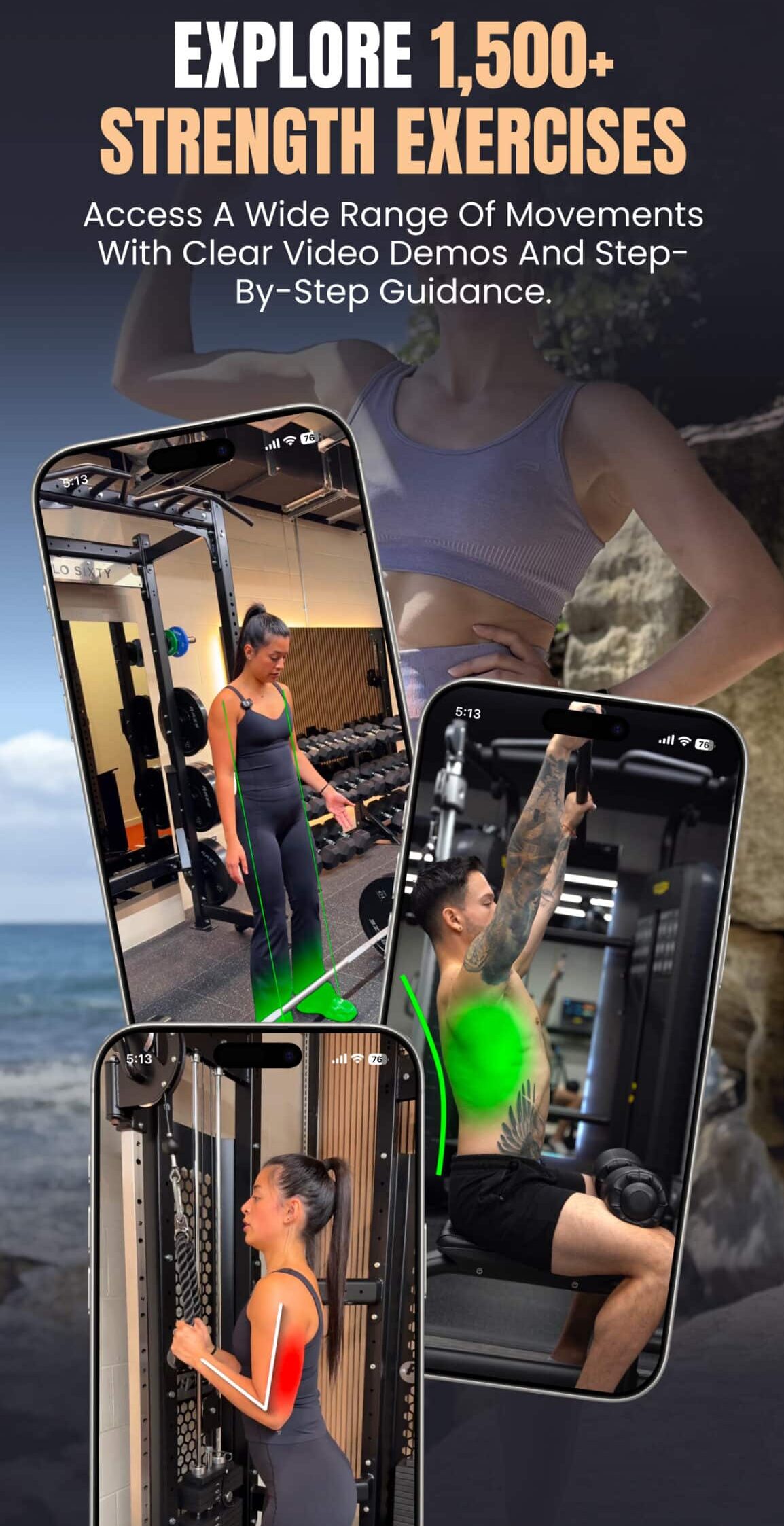
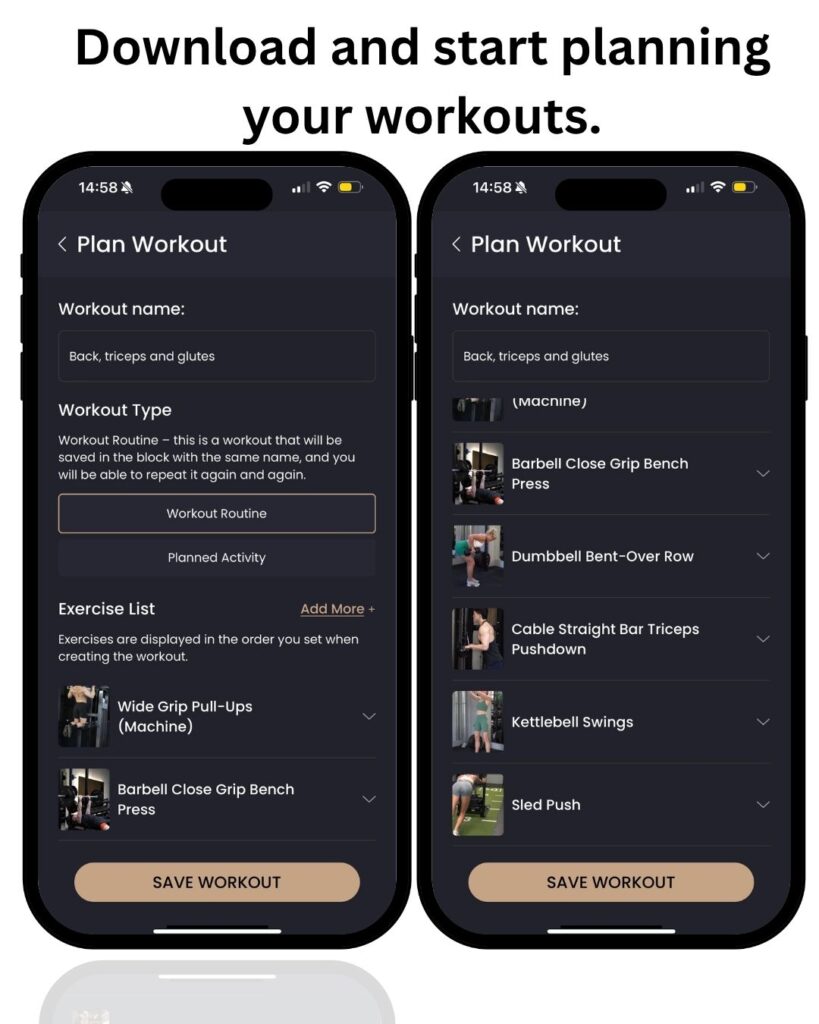
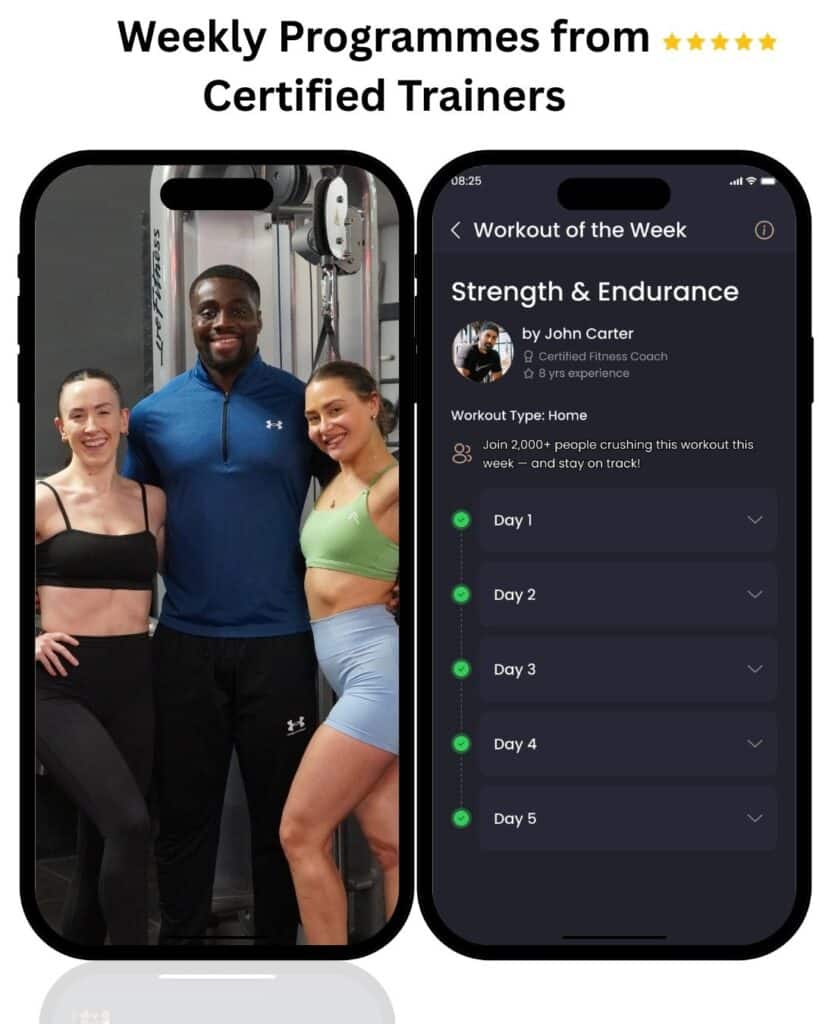
This is what 12REPS was built to solve. The app doesn’t just give you workouts—it programmes progressive training based on your available equipment and current ability.
When you open 12REPS, you tell it you’re training at home. It asks what equipment you’ve got (nothing, bands, dumbbells, etc.). Then it generates progressive workouts that automatically scale difficulty as you get stronger.
Did three sets of eight goblet squats last session? This session it might programme three sets of ten. Or three sets of eight with a pause at the bottom. Or progress to a single-leg variation. The progression happens automatically based on sound training principles.
For complete beginners, this removes the guesswork. You’re not wondering if you’re doing enough, doing too much, progressing too fast, or stalling out. The programme adapts to your progress and keeps you moving forward systematically.
This is what I do manually for in-person clients—plan progressive sessions based on their last performance. 12REPS automates that process so you get proper programming without needing a personal trainer.
Starting Today: Your Action Plan
Right. You’ve read all this. Now what?
This week:
- Clear a space in your home where you can move freely
- Order a set of resistance bands (£15-25)
- Schedule three 30-minute slots in your diary for next week
- Do Week 1, Session A today if you’re feeling keen
This month:
- Complete 8-10 training sessions using the Weeks 1-4 programme
- Track every workout (reps, sets, how it felt)
- Assess your protein intake and adjust if needed
- Buy light dumbbells if you can afford them
This quarter (12 weeks):
- Follow the full 12-week progression outlined above
- Don’t miss more than one scheduled session per week
- Take progress photos every four weeks
- Reassess your goals and plan the next quarter
The women who get results are the ones who actually do this consistently. Not the ones who read about it, get motivated for three days, then fade out.
Commit to 12 weeks. Properly commit. If after 12 weeks you’re not noticeably stronger, you can bin it off. But give it an honest 12 weeks first.
You’ve got this.
References
- Schoenfeld, B.J., Peterson, M.D., Ogborn, D., Contreras, B. and Sonmez, G.T. (2015). Effects of Low- vs. High-Load Resistance Training on Muscle Strength and Hypertrophy in Well-Trained Men. Journal of Strength and Conditioning Research, 29(10), pp.2954-2963. https://doi.org/10.1519/JSC.0000000000000958
- Morton, R.W., Murphy, K.T., McKellar, S.R., Schoenfeld, B.J., Henselmans, M., Helms, E., Aragon, A.A., Devries, M.C., Banfield, L., Krieger, J.W. and Phillips, S.M. (2018). A systematic review, meta-analysis and meta-regression of the effect of protein supplementation on resistance training-induced gains in muscle mass and strength in healthy adults. British Journal of Sports Medicine, 52(6), pp.376-384. https://doi.org/10.1136/bjsports-2017-097608
- Plotkin, D., Coleman, M., Derrick Van Every, D., Maldonado, J., Oberlin, D., Israetel, M., Feather, J., Alto, A., Vigotsky, A.D. and Schoenfeld, B.J. (2022). Progressive overload without progressing load? The effects of load or repetition progression on muscular adaptations. PeerJ, 10, p.e14142. https://doi.org/10.7717/peerj.14142
- Andersen, L.L., Andersen, C.H., Mortensen, O.S., Poulsen, O.M., Bjørnlund, I.B.T. and Zebis, M.K. (2010). Muscle Activation and Perceived Loading During Rehabilitation Exercises: Comparison of Dumbbells and Elastic Resistance. Physical Therapy, 90(4), pp.538-549. https://doi.org/10.2522/ptj.20090167
- American College of Sports Medicine (2009). Progression Models in Resistance Training for Healthy Adults. Medicine & Science in Sports & Exercise, 41(3), pp.687-708. https://doi.org/10.1249/MSS.0b013e3181915670
- Krzysztofik, M., Wilk, M., Wojdała, G. and Gołaś, A. (2019). Maximizing Muscle Hypertrophy: A Systematic Review of Advanced Resistance Training Techniques and Methods. International Journal of Environmental Research and Public Health, 16(24), p.4897. https://doi.org/10.3390/ijerph16244897
- Westcott, W.L. (2012). Resistance Training is Medicine: Effects of Strength Training on Health. Current Sports Medicine Reports, 11(4), pp.209-216. https://doi.org/10.1249/JSR.0b013e31825dabb8