



By Will Duru, BSc (Hons) Sport and Exercise Science, Award-winning Personal Trainer with over 10 years of experience
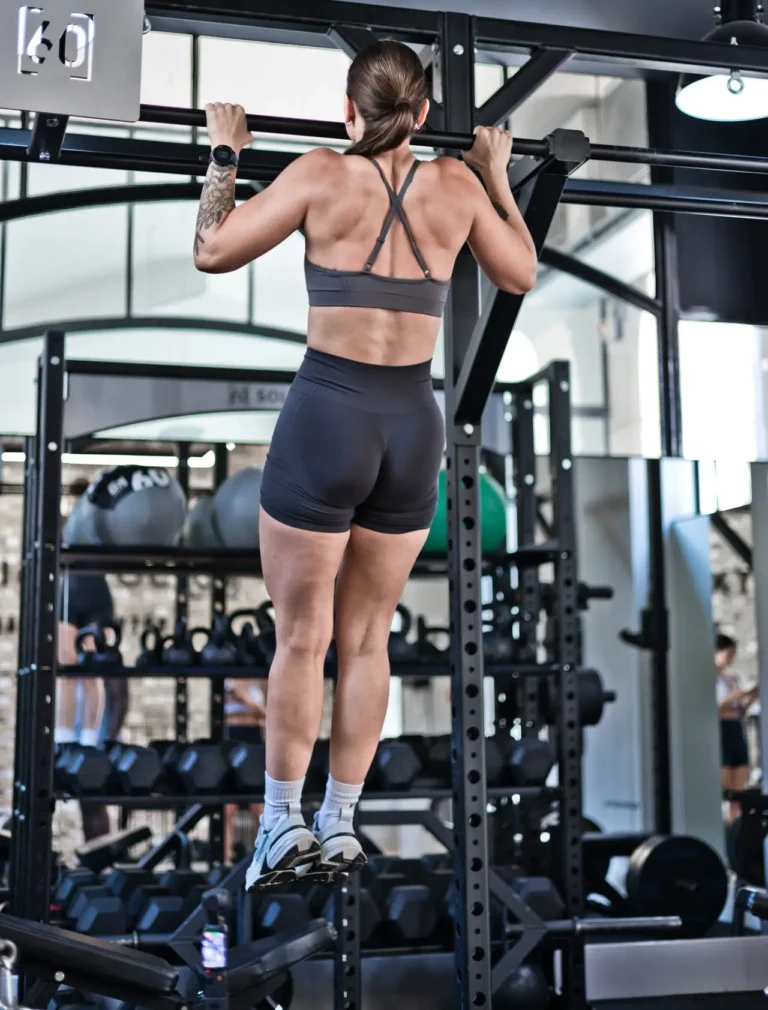
Pull-up is one of the most impressive exercises you can do. It is also one of the hardest to learn.
As a personal trainer with over 10 years of experience, I have helped hundreds of clients achieve their first pull-up. Some came to me having never done one before. Others had tried for years without success. The secret is not just getting stronger. It is following the right pull-up progression training.
In this guide, I will show you exactly how to do a pull-up from scratch, even if you cannot do a single rep right now. Follow this program for 8 to 12 weeks, and you will be doing 5 pull-ups.
Why Pull Ups Are So Hard
Pull-ups are difficult because you are lifting your entire bodyweight. Unlike a lat pulldown, which lets you choose the weight. Research shows that pull-up capability depends on your strength-to-body mass ratio [1]. This means two things matter: how strong your back and arms are, and how much you weigh. You need to work on both.
The good news is that anyone can learn to do pull-ups. I have trained women in their 50s who achieved their first pull-up after following a proper progression. Age and gender do not matter as much as consistency and the right training approach.
The pull-up works multiple muscle groups at once. Studies using EMG (electromyography) have measured exactly which muscles fire during the movement [2].
Primary muscles: Latissimus dorsi (lats), biceps brachii, brachialis, lower trapezius
Secondary muscles: Posterior deltoids, rhomboids, forearms, core
Research found that pull-ups activate the lower trapezius and pectoralis major first, then the biceps and lats complete the movement [3]. Understanding this helps you train the right muscles.
Pull up: Palms facing away from you (overhand grip). This is harder and targets the lats more.
Chin up: Palms facing towards you (underhand grip). This is easier because your biceps can contribute more.
My advice: Start with chin-ups first. Once you can do 5 chin-ups, switch to pull-ups. The chin-up uses more bicep, which most people find easier. EMG research confirms that different grips change muscle activation patterns, with the supinated (chin-up) grip recruiting more biceps [2].
The 4 Phase Pull Up Progression Programme
This pull-up workout programme takes you from zero to 10 reps in 8 to 12 weeks. Train 3 times per week with at least one rest day between sessions.
Phase 1: Build Your Foundation (Weeks 1-2)
Goal: Build grip strength and back muscle activation. You will not do a full pull-up yet.
Exercise | Sets | Reps | Notes |
Dead Hang | 3 | 20-30 sec | Build grip strength |
Scapular Pull Ups | 3 | 8-10 | Activate back muscles |
Inverted Rows | 3 | 10-12 | Use low bar or TRX |
Lat Pulldown | 3 | 10-12 | Build lat strength |
Negative Pull Ups | 3 | 3-5 | 5 second lowering |
Phase 2: Assisted Pull Ups (Weeks 3-4)
Goal: Start doing assisted pull-ups to learn the movement pattern.
Exercise | Sets | Reps | Notes |
Band Assisted Pull Ups | 4 | 5-8 | Use thick band |
Negative Pull Ups | 3 | 5 | 5-8 second lowering |
Inverted Rows (feet raised) | 3 | 10-12 | Harder angle |
Flexed Arm Hang | 3 | 10-20 sec | Chin above bar |
Lat Pulldown | 3 | 8-10 | Increase weight |
Phase 3: Your First Unassisted Pull Up (Weeks 5-8)
Goal: Achieve your first unassisted pull-up and build to 5 reps.
Exercise | Sets | Reps | Notes |
Chin Ups | 4 | 3-5 | Easier grip for beginners |
Pull Ups | 3 | 1-3 | Full range of motion |
Band Assisted Pull Ups | 3 | 6-8 | Use thinner band |
Negative Pull Ups | 2 | 5 | Slow and controlled |
Inverted Rows | 3 | 12-15 | Maintain strength |
Phase 4: Build to 10 Reps (Weeks 9-12)
Goal: Increase your max pull-ups from 5 to 10.
Exercise | Sets | Reps | Notes |
Pull Ups | 5 | Max | Test your max each week |
Chin Ups | 3 | 6-8 | Build volume |
Wide Grip Pull Ups | 3 | 3-5 | Target outer lats |
Weighted Dead Hang | 3 | 20-30 sec | Add 5-10kg |
Commando Pull Ups | 2 | 4-6 each side | Advanced variation |
Key Exercises Explained
Negative Pull Ups: Jump up to the top position with your chin above the bar. Lower yourself as slowly as possible. This builds strength in the exact movement pattern you need.
Band-Assisted Pull-Ups: Loop a resistance band over the bar and place your knee or foot through it. The band helps lift you. Start with a thick band and progress to thinner bands.
Scapular Pull Ups: Hang from the bar with straight arms. Pull your shoulder blades down and back without bending your elbows. This activates your lats and teaches the first part of the pull-up.
Inverted Rows: Set a bar at hip height or use a TRX. Hang underneath with your body straight. Pull your chest to the bar. This works the same muscles as pull-ups, but at a gentler angle.
Common Mistakes to Avoid
- Kipping or swinging: Using momentum cheats your muscles. Keep your body still and controlled.
- Not going low enough: Each rep should start from a dead hang with straight arms. Partial reps do not count.
- Ignoring grip strength: Your grip often fails before your back does. Practice dead hangs regularly.
- Training too often: Pull-ups are hard on your joints. Take rest days to recover.
Track Your Pull-Up Progress
You can build this entire pull-up workout in the 12REPS app. Track your sets, reps, and rest times. Watch video demonstrations of every exercise. Log your progress each week to see how far you have come.
Download 12REPS for free and start your pull-up journey today.
The Bottom Line
Learning to do a pull-up takes time. Most people need 8 to 12 weeks of consistent training. Do not rush the progression. Build your foundation with negatives, inverted rows, and band-assisted work before attempting full pull-ups.
Train 3 times per week. Focus on quality reps, not quantity. Be patient. Once you get your first pull-up, the next 9 come much faster.
Use the 12REPS app to track your workouts and stay consistent. You will be doing 10 pull-ups before you know it.
References
[1] Johnson D, Lynch J, Nash K, et al. (2003). Training college-age women to perform the pull-up exercise. Journal of Strength and Conditioning Research. 17(1):28-36. https://pubmed.ncbi.nlm.nih.gov/12659476/
[2] Dickie JA, Faulkner JA, Barnes MJ, et al. (2017). Electromyographic analysis of muscle activation during pull-up variations. Journal of Electromyography and Kinesiology. 32:30-36. https://pubmed.ncbi.nlm.nih.gov/28011412/
[3] Youdas JW, Amundson CL, Cicero KS, et al. (2010). Surface electromyographic activation patterns and elbow joint motion during a pull-up, chin-up, or perfect-pullup rotational exercise. Journal of Strength and Conditioning Research. 24(12):3404-14. https://pubmed.ncbi.nlm.nih.gov/21068680/
About the Author: Will Duru holds a BSc (Hons) in Sport and Exercise Science and is an award-winning personal trainer with over 10 years of experience in strength training. He is the founder of the 12REPS app and just12reps.com.