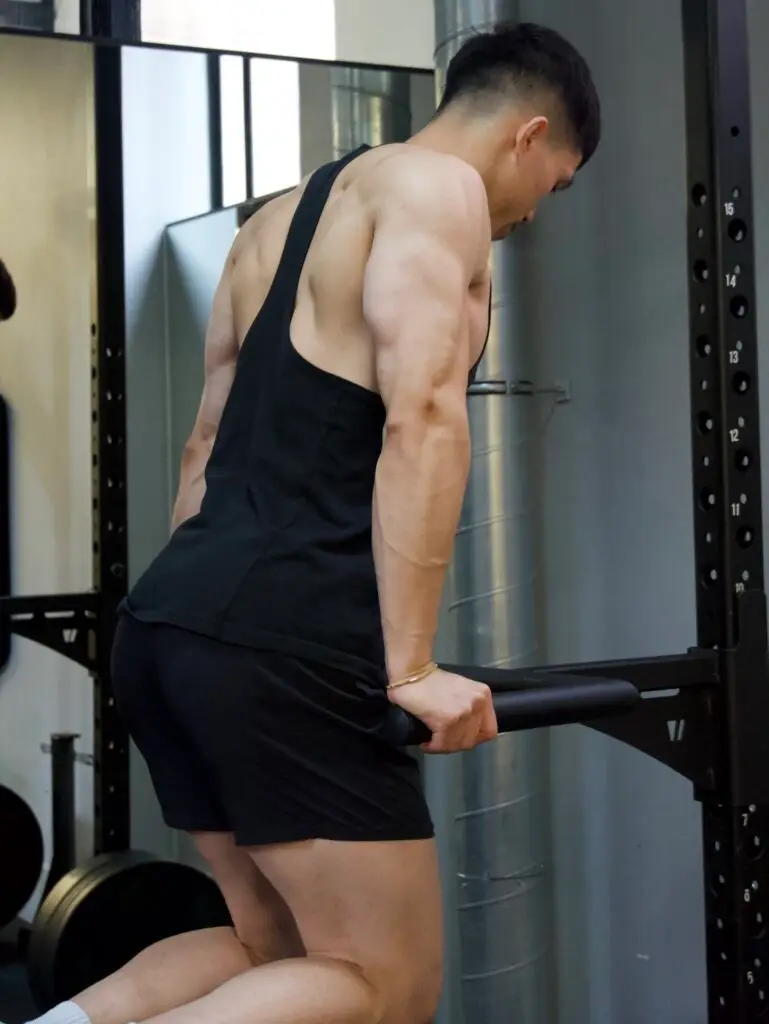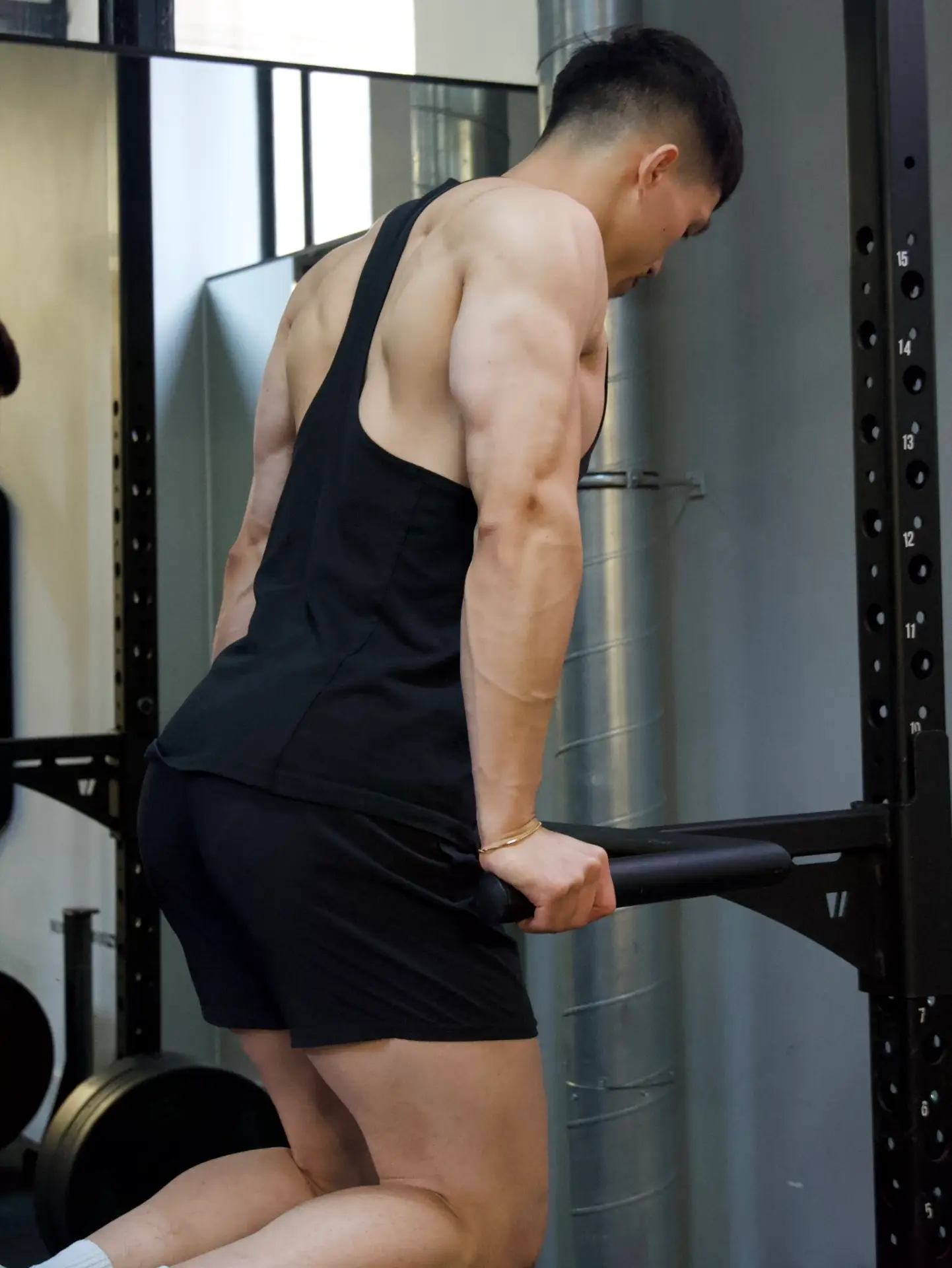



This arm workout uses six exercises, three for your biceps and three for your triceps, to build arm muscle with dumbbells and a cable machine. Every exercise follows the same pattern: one warm-up set, four working sets of 16 down to 12 reps, then a drop set. Add a little weight or a few reps over time, and your arms have a clear reason to grow.
How to grow your arms: the basics
Your arms grow the same way any muscle grows. You give them enough hard work, then add a little more over time. That gradual increase is called progressive overload, and our beginner’s guide to progressive overload explains it step by step.
Your upper arm has two main muscle groups:
- Biceps on the front bend your elbow. The brachialis underneath and the brachioradialis in your forearm help.
- Triceps on the back straighten your elbow. They have three heads (parts) and are a big muscle, so train them as hard as your biceps.
Do you need high reps to grow your arms?
No. Higher reps work, but they are not the only option. A 2017 meta-analysis found that muscle growth was similar across a wide range of loads, from lighter to heavier. A meta-analysis pools the results of many studies.
This workout uses 12 to 20 reps per set, which lets you train hard with moderate weights and good form. What matters most is that the last few reps of each working set feel hard.
How hard should each set be?
Stop each working set when you have only a few good reps left. Some lifters track this as reps in reserve (RIR): how many more clean reps you could have done. You do not need to grind to total failure every time. The American College of Sports Medicine’s 2026 resistance training guidelines found that training to failure did not consistently change results for most healthy adults.
How the sets work
Every exercise below uses the same set pattern:
| Set | Reps | What to do |
|---|---|---|
| Warm-up | 20 | Light weight, steady and controlled. |
| Set 1 | 16 | A weight that feels hard by the last few reps. |
| Set 2 | 16 | Same weight, or slightly heavier if set 1 felt easy. |
| Set 3 | 14 | Add a little weight. |
| Set 4 | 12 | Add a little more. This is your heaviest set. |
| Drop set | About 20 | Straight after set 4, pick a much lighter weight and keep going. |
A drop set means you finish a set, then lower the weight right away and do more reps with little or no rest. A 2023 meta-analysis found that drop sets built muscle about as well as standard sets, and some versions took far less time. So treat the drop set as a time-saver, not a must.
New to warm-up sets? Our guide to the importance of warm-up sets explains how they prepare you for heavier work.
The 6-exercise arm workout
Alternate between biceps and triceps exercises in the order below. Each one has a short demonstration video.
1. Dumbbell biceps curl
The standard curl trains your biceps through a full range of motion.
- Stand tall with a dumbbell in each hand, arms by your sides and palms facing forward.
- Keep your elbows close to your sides.
- Bend your elbows to curl the dumbbells up toward your shoulders.
- Squeeze at the top, then lower slowly until your arms are straight.
Cue: Keep your upper arms still. If your body swings, the weight is too heavy.
2. Rope triceps extension
Also called a rope pushdown, this cable exercise keeps tension on your triceps through the whole movement. See the rope triceps extension exercise page for a full breakdown.
- Attach a rope to a high cable pulley and hold one end in each hand.
- Stand close, with your elbows tucked in at your sides.
- Push the rope down until your arms are straight, pulling the ends slightly apart at the bottom.
- Let the rope rise slowly until your forearms are just above parallel to the floor.
Cue: Only your forearms should move. Keep your elbows pinned to your sides.
3. Dumbbell hammer curl
Hammer curls use a neutral grip, with your palms facing each other. They work the same elbow muscles as a standard curl and give you a different grip to train with.
Many people think hammer curls hit the forearm much harder. One small 2015 study found brachioradialis activity was similar with a neutral grip and a palms-up grip, and higher with a palms-down grip. So treat hammer curls as a useful variation, not a special forearm move.
- Stand tall with a dumbbell in each hand, palms facing your thighs.
- Keep your elbows by your sides.
- Curl the dumbbells up, keeping your palms facing in.
- Lower slowly to the start.
4. Cable double biceps curl
This curl uses a cable machine and works both arms at once. The cable keeps tension on your biceps from start to finish, which suits higher-rep sets.
- Set up the cable handles as shown in the video and take one in each hand.
- Keep your upper arms still and your body upright.
- Curl the handles toward you by bending your elbows.
- Squeeze your biceps, then return slowly until your arms are straight.
No double cable setup? Try the cable rope biceps curl or the cable straight bar biceps curl instead.
5. Dumbbell skull crusher
This lying triceps extension trains your triceps with your upper arms pointing up, rather than by your sides.
- Lie on a flat bench holding a dumbbell in each hand above your chest, palms facing each other.
- Keep your upper arms still and pointing up.
- Bend your elbows to lower the dumbbells slowly beside your head.
- Straighten your arms to lift them back up.
Cue: Start light and lower with control, because the dumbbells travel close to your head. Prefer a bar? Try the EZ bar skull crusher.
6. Dumbbell triceps kickback
- Hold a dumbbell in each hand. Hinge forward from your hips, with a slight bend in your knees and a flat back.
- Bring your upper arms up so they stay close to your sides, roughly parallel to the floor.
- Straighten your elbows to push the dumbbells back.
- Pause, then bend your elbows to return.
Cue: Keep your upper arms still and use a weight you can control with your arms fully straight.
How often should you do this arm workout?
Your arms already work during upper-body sessions. Your biceps help with rows and pulldowns, and your triceps help with presses and push-ups. This workout adds direct arm work on top.
For most people, doing it once a week alongside other upper-body training is a good start. A 2016 meta-analysis found that training a muscle twice a week led to more growth than once a week. The ACSM 2026 guidelines also advise training each major muscle group at least twice a week.
Your pushing and pulling days count toward that total. If arms are a priority, you could split this workout into two shorter sessions on different days.
How to progress
- Write down the weight and reps for every set.
- When you can complete all four working sets with good form, add a small amount of weight next time.
- If you can’t add weight yet, add a rep or two instead.
- Keep your form the same as the weights go up.
For more on arm anatomy, exercise choice and volume, read our complete guide to building bigger arms.
Common mistakes
- Swinging the weight: if your back or hips move, go lighter.
- Letting your elbows drift: keep them still so your biceps and triceps do the work.
- Dropping the weight: lower every rep under control.
- Adding weight too soon: only go heavier when every rep looks the same.
Exercise swaps
No dumbbells or cables free? These 12REPS exercise pages work the same muscles:
| In the workout | Swap for | When it helps |
|---|---|---|
| Dumbbell biceps curl | Z-bar biceps curl | You prefer a bar. |
| Rope triceps extension | Straight bar triceps pushdown | No rope attachment. |
| Cable double biceps curl | Cable rope biceps curl | Only one cable station. |
| Dumbbell skull crusher | EZ bar skull crusher | You prefer a bar. |
| Dumbbell triceps kickback | Triceps dip | You can control your bodyweight. |
| Any curl at home | Resistance band standing biceps curl | You train at home with bands. |
Balance your week with lower-body work too. These five leg exercises for strength and muscle pair well with this session.
Want to track every set without a notebook? 12REPS lets you enter the reps and weight for each set and remembers what you lifted, so you have a number to beat next time. Every exercise comes with a trainer demonstration, and you can build a session around the muscle you want to train, your equipment and your time.
Sources
- Schoenfeld BJ, Grgic J, Ogborn D, Krieger JW. Strength and hypertrophy adaptations between low- vs. high-load resistance training: a systematic review and meta-analysis. Journal of Strength and Conditioning Research, 2017. https://www.pubmed.gov/28834797/
- Schoenfeld BJ, et al. Effects of Resistance Training Frequency on Measures of Muscle Hypertrophy: A Systematic Review and Meta-Analysis. Sports Medicine, 2016. https://pubmed.ncbi.nlm.nih.gov/27102172/
- ACSM Unveils Landmark 2026 Resistance Training Guidelines: First Update in 17 Years. American College of Sports Medicine via Newswise, 2026. https://www.newswise.com/articles/acsm-unveils-landmark-2026-resistance-training-guidelines-first-update-in-17-years
- Sødal LK, Kristiansen E, Larsen S, van den Tillaar R. Effects of Drop Sets on Skeletal Muscle Hypertrophy: A Systematic Review and Meta-analysis. Sports Medicine – Open, 2023. https://doaj.org/article/21e0b210caf1433594359186eee617b9
- Kleiber T, Kunz L, Disselhorst-Klug C. Muscular coordination of biceps brachii and brachioradialis in elbow flexion with respect to hand position. Frontiers in Physiology, 2015. https://frontiersin.org/articles/10.3389/fphys.2015.00215/full