




You train hard. You eat properly. You’re doing everything right.
But you’re not making progress. Your lifts have stalled. You’re constantly tired. Your muscles ache continuously. You drag yourself to the gym anyway because rest feels like giving up.
Here’s what you need to understand: rest isn’t the opposite of progress. Rest IS progress.
I’m Will Duru, a personal trainer with over 10 years’ experience in London. The biggest mistake I see women make isn’t training too little, it’s training too much without adequate recovery. They think more training equals more results. It doesn’t. Beyond a certain point, more training without rest actually reverses your progress.
Here’s the complete guide to rest, recovery, and why taking days off builds more muscle than grinding through fatigue.

Why Rest Days Actually Build Muscle
This seems counterintuitive. Surely lifting weights builds muscle, not resting?
Wrong. Let me explain what actually happens.
Training breaks your muscles down. When you lift weights, you create microscopic damage to muscle fibers. This is intentional. The damage itself doesn’t make you stronger. It’s just damage.
Rest allows your body to rebuild. During recovery periods—particularly during sleep—your body repairs those muscle fibers. But it doesn’t just repair them back to baseline. It rebuilds them slightly stronger and larger than before. This process is called supercompensation.
Without adequate rest, you never complete the rebuild phase. You keep breaking down muscle tissue without allowing the reconstruction phase to finish. Result? You get weaker, not stronger.
Think of it like renovating a house. You can knock down walls (training), but if you immediately start knocking down more walls before rebuilding the first ones, you end up with a pile of rubble, not a better house.
I trained a woman who came to me frustrated. She was training six days weekly, doing full-body circuits each session. She’d been stuck at the same weights for five months. Zero progress. She assumed she needed to train more.
I reduced her to three training days weekly with programmed rest days. Within two months, her lifts increased noticeably. She’d been chronically under-recovered, breaking down muscle faster than her body could rebuild it.

What Actually Happens During Rest
Recovery isn’t passive. Your body is extraordinarily busy during rest days.
Muscle protein synthesis peaks post-training. After you lift weights, your body increases muscle protein synthesis (MPS) for 24-48 hours. This is when new muscle tissue is actually built. If you train the same muscle group again before this process completes, you interrupt it.
Inflammation resolution occurs. Training creates localised inflammation. This isn’t bad—inflammation is part of the repair signal. But chronic inflammation from inadequate rest prevents healing. Rest days allow inflammation to resolve properly.
Nervous system recovery happens. Your central nervous system coordinates every movement. Heavy lifting taxes this system enormously. Unlike muscles which recover in 48-72 hours, your nervous system needs longer. Training daily doesn’t allow full CNS recovery.
Energy stores replenish. Training depletes muscle glycogen (stored carbohydrate). Adequate rest with proper nutrition allows these stores to refill. Training on depleted stores reduces performance and limits adaptations.
Hormonal balance is restored. Training elevates cortisol (stress hormone). Cortisol is useful acutely but damaging chronically. Rest days allow cortisol to normalise whilst anabolic hormones (testosterone, growth hormone, IGF-1) work optimally.
All of this happens during rest. You’re not being lazy. You’re building muscle.

How Many Rest Days Do Women Need?
The frustrating answer: it depends. But let me give you practical guidelines.
For women training 2-3 days weekly: You likely have adequate rest built in naturally. Training Monday, Wednesday, Friday gives you 4 rest days weekly. This works well for most people.
For women training 4-5 days weekly: You need to structure rest intelligently. Don’t train the same muscle groups on consecutive days. Split your training so each muscle group gets 48-72 hours recovery.
For women training 6+ days weekly: You’re likely over-training unless you’re varying intensity significantly. Most women don’t need this frequency and won’t recover adequately.
Practical recommendation: 1-2 complete rest days weekly minimum. Ideally 2-3 rest days for optimal recovery.
But frequency matters less than understanding muscle-group specific recovery.
Muscle-Specific Recovery Requirements
Different muscle groups recover at different rates.
Larger muscle groups take longer: Your glutes, quads, hamstrings, and back muscles are massive. They require more recovery—typically 48-72 hours after heavy training.
Smaller muscle groups recover faster: Biceps, triceps, calves, abs recover more quickly—often within 24-48 hours.
This impacts programming: You can train upper body Monday and legs Tuesday because you’re using completely different muscle groups. But you shouldn’t squat heavy Monday and deadlift heavy Tuesday—both tax your legs, lower back, and central nervous system.
Sample intelligent split:
- Monday: Lower body (squats, hip thrusts)
- Tuesday: Upper body (bench press, rows)
- Wednesday: Rest
- Thursday: Lower body (deadlifts, lunges)
- Friday: Upper body (overhead press, pull-ups)
- Weekend: Rest
This provides 48-72 hours between training the same muscle groups.
Signs You Need More Rest
Your body tells you when recovery is inadequate. Learn to recognise these signals.
Sign 1: Persistent fatigue
You wake up tired despite adequate sleep. You feel exhausted before workouts even begin. Coffee doesn’t help. This indicates systemic fatigue from insufficient recovery.
Sign 2: Strength decreases
Your lifts are going backwards. Last week you squatted 60kg for 8 reps. This week you barely manage 6 reps with the same weight. Temporary strength decreases signal inadequate recovery.
Sign 3: Constant muscle soreness
Mild soreness 24-48 hours post-workout is normal. But if you’re continuously sore, never feeling fresh, you’re not recovering between sessions.
Sign 4: Sleep disturbances
Overtraining disrupts sleep quality. You feel exhausted but can’t sleep properly. This creates a vicious cycle—inadequate training recovery plus inadequate sleep recovery.
Sign 5: Irritability and mood changes
You’re snappy. Small things bother you. Training feels like a chore rather than energising. Mental fatigue often precedes physical breakdown.
Sign 6: Increased injury occurrence
Minor niggles that won’t resolve. Chronic inflammation. Overuse injuries. Your body is literally breaking down faster than it can repair.
Sign 7: Plateau or regression in progress
Despite training consistently, you’re not improving. Or worse, you’re getting weaker. This is the classic overtraining signature.
If you’re experiencing three or more of these simultaneously, you need more rest immediately.
I trained a woman who exhibited all seven signs. She was training six days weekly, doing high-intensity circuit training. She’d been stuck at the same fitness level for a year and couldn’t understand why.
We implemented proper rest days and reduced training to four days weekly. Within one month, her energy returned. Within three months, she was significantly stronger than she’d been after that year of relentless training.

Active Recovery vs Complete Rest
Rest doesn’t always mean lying on the sofa all day.
Complete rest days: Zero structured exercise. Walk to the shops. Take the stairs. Normal daily movement only. These are essential 1-2 times weekly minimum.
Active recovery days: Light movement that increases blood flow without creating training stress. These accelerate recovery without interfering with adaptation.
Good active recovery activities:
- Walking (30-60 minutes, easy pace)
- Gentle swimming
- Easy cycling
- Yoga or stretching
- Light mobility work
- Foam rolling
Bad “active recovery”:
- HIIT classes (this is training, not recovery)
- Running hard
- Intense group fitness classes
- Any activity that leaves you breathless
The key distinction: active recovery should feel restorative, not exhausting. If you’re sweating heavily and breathing hard, it’s training, not recovery.
Sample week structure:
- Monday: Heavy lower body training
- Tuesday: Upper body training
- Wednesday: Complete rest
- Thursday: Lower body training
- Friday: Upper body training
- Saturday: Active recovery (60-minute walk)
- Sunday: Complete rest
This provides adequate recovery whilst maintaining some movement.

Sleep: The Foundation of Recovery
You cannot out-train poor sleep. Recovery happens primarily during sleep.
During sleep:
- Growth hormone peaks (critical for muscle repair)
- Protein synthesis accelerates
- Inflammation resolves
- Memory consolidates (including motor patterns learned in training)
- Energy stores replenish
Sleep requirements for women who train: 7-9 hours nightly. Not 5-6 hours. Not “I’ll catch up on weekends.” Consistently 7-9 hours.
Poor sleep sabotages training in multiple ways:
- Reduced testosterone and growth hormone
- Elevated cortisol
- Impaired glucose metabolism
- Decreased motivation
- Poor coordination and technique
- Increased injury risk
If you’re training hard but sleeping poorly, your training is largely wasted effort. Prioritise sleep as seriously as you prioritise training.
Sleep optimisation basics:
- Consistent sleep and wake times (even weekends)
- Dark, cool bedroom (16-19°C ideal)
- No screens 60 minutes before bed
- No caffeine after 2 pm
- No alcohol (it disrupts sleep architecture despite making you drowsy)
Nutrition for Recovery
Rest days aren’t cheat days. Your body needs proper nutrition to rebuild.
Protein remains critical: Muscle protein synthesis continues for 48 hours post-training. On rest days, maintain your protein intake (1.6-2.2g per kg bodyweight). Don’t reduce protein on rest days.
Carbohydrates matter: Rest days are when your body replenishes muscle glycogen. Adequate carbohydrate intake supports this process. You can reduce carbs slightly compared to training days, but don’t eliminate them.
Don’t drastically cut calories: Some women treat rest days as low-calorie days to “compensate” for not training. This is counterproductive. Your body needs calories to fuel recovery processes.
Sample rest day nutrition (65kg woman):
- Protein: 110-120g (same as training days)
- Carbs: 150-200g (slightly lower than training days)
- Fats: 50-70g
- Total: ~1,800-2,000 calories
This provides adequate nutrients for recovery without excess.
Hydration matters: Recovery processes require adequate hydration. Aim for 2-3 litres of water daily, including rest days.

Deload Weeks: Planned Recovery
Beyond daily rest, you need a periodic reduction in training volume and intensity.
What is a deload week? Every 4-6 weeks of hard training, you intentionally reduce volume (sets/reps) and intensity (weight lifted) by 40-60% for one week.
Why deload?
- Allows accumulated fatigue to dissipate
- Lets minor niggles heal
- Prevents overtraining syndrome
- Maintains training stimulus without excessive stress
- Mentally refreshing
Sample deload week:
Normal week:
- Squats: 4 sets × 6 reps at 70kg
- Bench press: 4 sets × 8 reps at 40kg
Deload week:
- Squats: 2 sets × 6 reps at 40kg
- Bench press: 2 sets × 8 reps at 25kg
You maintain movement patterns and technique but drastically reduce stress.
Common mistake: Women often skip deload weeks thinking they’ll lose progress. The opposite happens. Regular deloads allow you to train harder during working weeks, producing better long-term results.
I programme deload weeks for all clients. Without exception, they return from deload weeks feeling fresh and typically hit personal records in the following training block.

Age and Recovery
Recovery capacity changes with age. This is reality, not excuse.
Women in their 20s-30s: Generally recover quickly. Can often handle 4-5 training days weekly with adequate rest days.
Women in their 40s: Recovery slows slightly. May need an extra rest day or lower weekly training frequency. Sleep quality often declines, requiring more attention.
Women in their 50s+: Recovery takes longer. Three well-structured training days weekly often produces better results than five days of mediocre training. This isn’t weakness—it’s biology.
The key: Train according to what you can recover from, not what you could recover from a decade ago. Progress is still absolutely possible at any age, but recovery must be respected.
Stress, Recovery, and Training
Training is physical stress. But your body doesn’t distinguish between training stress and life stress.
High life stress reduces recovery capacity: If you’re managing work stress, family stress, financial stress, relationship stress, your body’s recovery resources are already taxed. Adding intense training on top creates total stress load your body cannot manage.
During high-stress periods:
- Reduce training frequency (3 days instead of 4)
- Reduce training intensity (lighter weights, fewer challenging sets)
- Increase rest days
- Prioritise sleep even more rigorously
- Consider active recovery instead of intense training
This doesn’t mean stop training during stress. Exercise helps manage stress. But recognise that your recovery capacity is reduced and adjust accordingly.

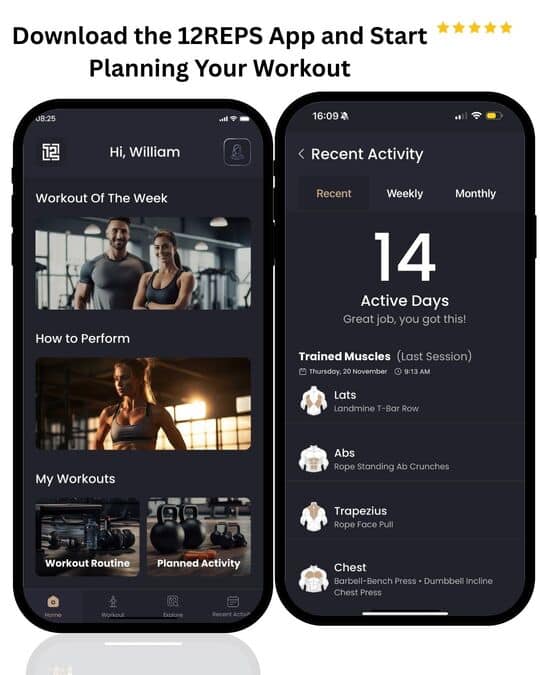
How 12REPS Manages Recovery
Proper recovery requires tracking multiple variables:
- Which muscle groups are trained when
- Training volume and intensity
- Adequate rest days between sessions
- Periodic deload weeks
- Life stress considerations
12REPS automates this:
Intelligent scheduling: The app ensures adequate recovery between training the same muscle groups. You won’t accidentally train legs heavily two days consecutively.
Programmed deload weeks: Every 4-6 weeks, the app automatically programmes lighter training to facilitate recovery.
Volume tracking: The app monitors total weekly training volume, preventing excessive accumulation that impairs recovery.
Adaptive programming: If you log poor sleep or high stress, the app can adjust that day’s training to be more recovery-focused.
Rest day guidance: The app suggests appropriate active recovery activities on rest days rather than leaving recovery to chance.
For women managing training across gyms and home with varying schedules, this intelligent recovery management prevents overtraining whilst maximising progress.
Common Recovery Mistakes
Mistake 1: Training through persistent fatigue
You’re exhausted but train anyway because your programme says it’s a training day. Sometimes the most productive thing is an unscheduled rest day.
Mistake 2: Treating rest days as cheat days
Eating poorly on rest days because “I didn’t earn these calories.” Your body needs quality nutrition for recovery.
Mistake 3: Eliminating all movement on rest days
Lying on the sofa all day. Some movement (walking, gentle activity) actually accelerates recovery by increasing blood flow.
Mistake 4: Not deloading regularly
Grinding through fatigue for months without planned lighter weeks. This leads to injury or burnout.
Mistake 5: Ignoring sleep
Prioritising training over sleep. If you’re sleeping 5-6 hours to fit in early morning workouts, you’re sabotaging your progress.
Mistake 6: Training through minor injuries
“It’s just a niggle, I’ll train through it.” Minor issues become major injuries when you don’t allow healing.
Mistake 7: Comparing your recovery to others
“She trains six days weekly, why can’t I?” Because you’re different people with different recovery capacities, stress levels, sleep quality, and genetics.

The Bottom Line
Rest is not the opposite of progress. Rest IS progress.
Key principles:
- Muscle growth happens during recovery, not during training
- Minimum 1-2 complete rest days weekly
- 48-72 hours recovery between training the same muscle groups
- Sleep 7-9 hours nightly without exception
- Maintain protein intake on rest days
- Deload every 4-6 weeks
- Adjust training based on life stress and recovery capacity
Signs you need more rest:
- Persistent fatigue
- Strength decreases
- Constant soreness
- Sleep disturbances
- Irritability
- Frequent minor injuries
- Stalled progress
Remember: You don’t get stronger by training. You get stronger by recovering from training. Training provides the stimulus. Recovery provides the adaptation.
The women I train who make the fastest progress aren’t those who train most frequently. They’re those who train hard when they train, then rest properly to allow adaptation to occur.
Stop thinking of rest as laziness or wasted time. Start thinking of rest as the period when your body builds the stronger, more muscular version of yourself.
Train hard. Rest harder. Progress follows.
References
- Damas, F., Libardi, C.A. and Ugrinowitsch, C. (2018). The Development of Skeletal Muscle Hypertrophy Through Resistance Training: The Role of Muscle Damage and Muscle Protein Synthesis. European Journal of Applied Physiology, 118(3), pp.485-500.
- Schoenfeld, B.J., Grgic, J. and Krieger, J. (2019). How Many Times Per Week Should a Muscle Be Trained to Maximize Muscle Hypertrophy? A Systematic Review and Meta-Analysis. Journal of Sports Sciences, 37(11), pp.1286-1295.
- Kellmann, M., Bertollo, M., Bosquet, L., Brink, M., Coutts, A.J., Duffield, R., Erlacher, D., Halson, S.L., Hecksteden, A., Heidari, J. and Kallus, K.W. (2018). Recovery and Performance in Sport: Consensus Statement. International Journal of Sports Physiology and Performance, 13(2), pp.240-245.
- Bonnar, D., Bartel, K., Kakoschke, N. and Lang, C. (2018). Sleep Interventions Designed to Improve Athletic Performance and Recovery: A Systematic Review of Current Approaches. Sports Medicine, 48(3), pp.683-703.
- Halson, S.L. (2014). Sleep in Elite Athletes and Nutritional Interventions to Enhance Sleep. Sports Medicine, 44(Suppl 1), pp.13-23.
- Kraemer, W.J. and Ratamess, N.A. (2005). Hormonal Responses and Adaptations to Resistance Exercise and Training. Sports Medicine, 35(4), pp.339-361.
- Hackney, A.C. and Lane, A.R. (2015). Exercise and the Regulation of Endocrine Hormones. Progress in Molecular Biology and Translational Science, 135, pp.293-311.