

You’ve seen people squatting in the gym. It looks straightforward. You stand up. You sit down. What’s so complicated?
Then you try it. Your knees hurt. Your heels lift off the floor. You lean forward excessively. You’re not sure how low to go. You wonder if you’re doing it wrong.
You are. Most people are.
I’m Will Duru, a personal trainer with over 10 years’ experience in London. I’ve taught hundreds of women to squat properly. The squat is the most fundamental lower body movement—but technique matters enormously. Get it right and squats build incredible leg strength whilst protecting your joints. Get it wrong and you create knee pain, back strain, and frustration.
Here’s exactly how to squat with perfect form, from bodyweight to loaded barbell squats.
Why Squats Are Essential
Before technique, understand why this movement is non-negotiable.
Squats are the most functional movement pattern. Every time you sit in a chair and stand up, you’re squatting. Picking up objects from low surfaces. Getting in and out of cars. Playing with children. Squatting is fundamental to daily life.
Squats build strength in everything. Your quads, glutes, hamstrings, calves, core, and even upper back all work during squats. It’s the ultimate lower body compound movement.
Squats improve mobility. Proper squatting requires and builds ankle, hip, and thoracic spine mobility. This transfers to everything else you do.
Squats build bone density. Loading your skeleton with heavy resistance stimulates bone growth. Critical for women, particularly for preventing osteoporosis.
Squats improve athletic performance. Want to jump higher? Run faster? Build power? Squat.
I trained a woman who couldn’t squat to parallel without her heels lifting. Through mobility work and proper technique coaching, within three months she was squatting past parallel with perfect form. Her knee pain disappeared entirely.
Muscles Worked
Primary muscles:
- Quadriceps (front thighs): Main movers during the ascent
- Glutes: Drive hip extension, especially in deeper squats
- Hamstrings: Assist glutes in hip extension
- Adductors (inner thighs): Stabilise during the movement
Secondary muscles:
- Calves: Ankle stability
- Core (abs and obliques): Maintain upright torso
- Spinal erectors (back): Keep spine neutral
- Upper back: Maintains posture with loaded squats
The squat trains nearly every muscle below your waist whilst building tremendous core strength.
Equipment Needed
For bodyweight squats:
- Nothing. Just you and space.
For loaded squats:
- Barbell (20kg Olympic bar standard)
- Squat rack with safety bars
- Weight plates
- Flat-soled shoes or lift barefoot (no cushioned trainers)
Alternative loading options:
- Dumbbells (for goblet squats)
- Kettlebell (for goblet squats)
- Resistance bands
Start with bodyweight. Master technique completely before adding any weight.
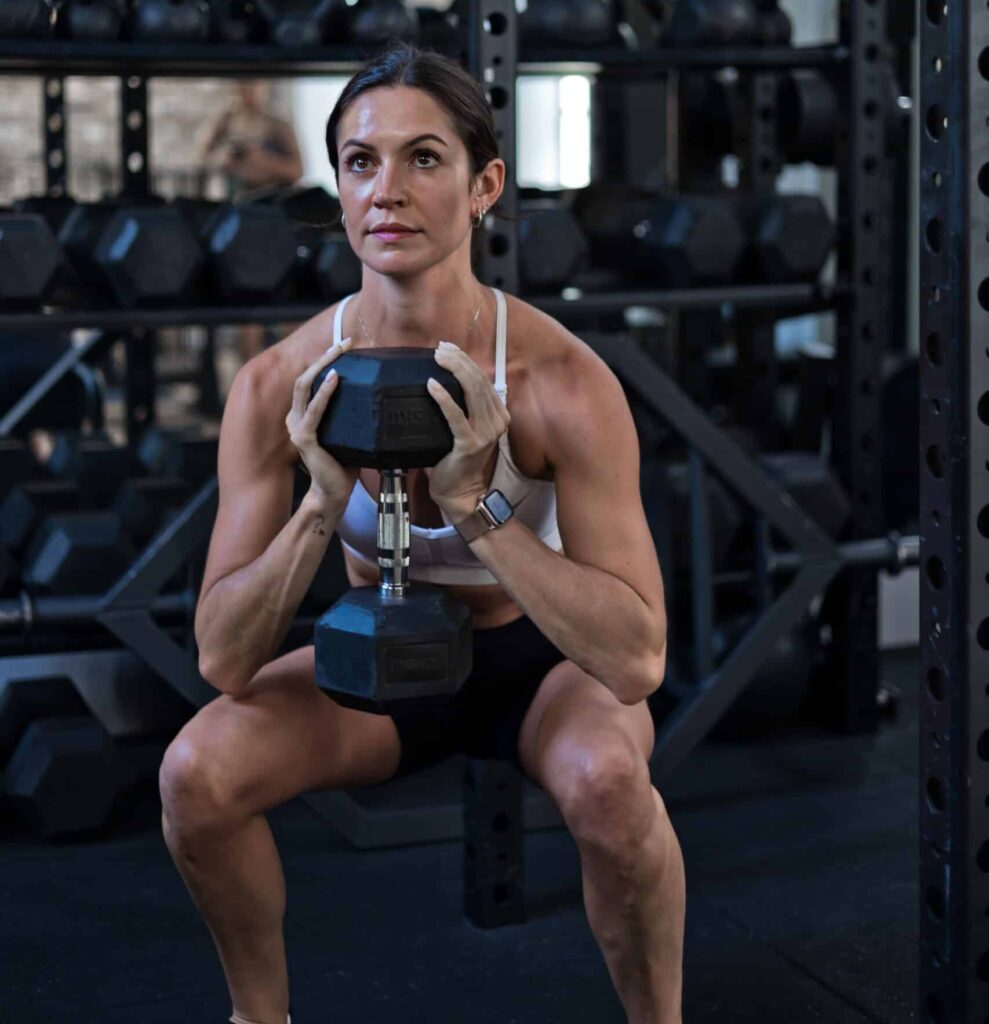
The Bodyweight Squat: Perfect Technique
Master this first. Everything else builds from here.
Starting Position
Feet: Hip to shoulder-width apart. Experiment to find what’s comfortable. Taller women often need wider stance.
Toes: Pointed slightly outward (10-15 degrees). Think 11 o’clock and 1 o’clock on a clock face.
Weight distribution: Evenly across entire foot. Feel pressure on big toe, little toe, and heel equally.
Posture: Stand tall. Chest proud. Shoulders back. Core braced.
The Descent
1. Initiate by pushing hips backward
Don’t start by bending your knees. Start by pushing your hips back as if sitting into a chair behind you.
2. Knees track over toes
As you descend, your knees move forward and slightly outward. They should track in the same direction as your toes. Never let knees cave inward.
3. Maintain upright torso
Your torso will lean forward slightly (this is normal and necessary), but your chest stays proud. Think about keeping a logo on your shirt visible to someone in front of you.
4. Keep heels planted
Your entire foot stays flat. If heels lift, you either lack ankle mobility or you’re shifting weight forward incorrectly.
5. Descend to appropriate depth
Minimum depth: Thighs parallel to floor (hip crease level with knee).
Ideal depth: Slightly below parallel if mobility allows.
Maximum depth: As low as you can go whilst maintaining neutral spine and keeping heels down.
Don’t force excessive depth if your mobility doesn’t allow it. Depth comes with practice.
The Ascent
1. Drive through entire foot
Don’t think about standing up. Think about pushing the floor away from you. Drive through your whole foot—big toe, little toe, heel.
2. Lead with chest
As you rise, your chest should drive upward. This prevents you from folding forward.
3. Knees and hips extend together
Your knees straighten and hips thrust forward simultaneously. Don’t let hips shoot up first whilst chest stays down.
4. Squeeze glutes at top
At full standing position, squeeze your glutes to complete hip extension.
5. Breathe properly
Inhale at the top or during descent. Exhale during the ascent. Don’t hold your breath for multiple reps.
That’s one perfect rep. Reset and repeat.
Common Mistakes Women Make
Mistake 1: Knees Caving Inward
The error: As you squat down or stand up, your knees collapse toward each other.
Why it’s wrong: This creates enormous knee stress. It’s called “valgus collapse” and it’s the primary mechanism for knee injuries.
The fix: Actively push knees outward throughout the entire movement. Think “knees out” as a constant cue. Use a resistance band around thighs to give tactile feedback—push against the band.
Mistake 2: Heels Lifting Off Floor
The error: Your heels come off the ground as you descend.
Why it’s wrong: This shifts your centre of gravity forward, reduces glute activation, increases knee stress, and makes the movement unstable.
The fix: Focus on sitting back more aggressively into hips. Improve ankle mobility through calf stretches. Temporarily, elevate heels on small plates (5-10mm) whilst working on mobility.
Mistake 3: Excessive Forward Lean
The error: Your torso folds forward dramatically, chest pointing toward floor.
Why it’s wrong: Excessive forward lean puts strain on lower back and reduces quad activation.
The fix: Initiate movement by sitting hips backward, not by folding forward. Keep chest proud throughout. Film yourself from the side—your torso should maintain relatively consistent angle.
Mistake 4: Not Squatting Deep Enough
The error: You barely bend your knees, stopping well above parallel.
Why it’s wrong: You’re missing the majority of the strength and muscle-building benefits. Partial squats are dramatically less effective.
The fix: Gradually work on increasing depth. Use a box or bench as a target—squat until you lightly touch it, then stand. Lower the box progressively over weeks.
Mistake 5: Knee Sliding Forward Excessively
The error: Your knees travel far forward over your toes immediately.
Why it’s wrong: This turns the squat into a quad-dominant movement, reducing glute involvement and potentially creating knee discomfort.
The fix: Initiate by pushing hips backward first. This loads the posterior chain (glutes/hamstrings) properly.
Mistake 6: Looking Up or Down
The error: Craning your neck to look at the ceiling or staring at the floor.
Why it’s wrong: Your body follows your head. Looking up causes lumbar hyperextension. Looking down causes forward lean.
The fix: Keep head neutral. Eyes look straight ahead or slightly downward at a point 2-3 meters in front of you on the floor.
Mistake 7: Not Bracing Core
The error: Breathing normally throughout, not creating intra-abdominal pressure.
Why it’s wrong: Your spine has no support. This is dangerous, especially with loaded squats.
The fix: Before each rep: take a deep breath into your belly, brace your abs as if someone’s about to punch you, maintain this tension throughout the rep.
Progressive Overload: From Bodyweight to Barbell
You’ve mastered bodyweight squats. Now what?
Phase 1: Bodyweight Mastery (Weeks 1-4)
Focus: Perfect every aspect of technique.
Volume: 3-4 sets of 12-15 reps, 2-3x weekly
Goal: 15 perfect reps with full depth, heels down, knees out, chest proud, no form breakdown.
Film yourself regularly. Compare against these checkpoints.
Phase 2: Goblet Squats (Weeks 5-12)
Why goblet squats: Holding weight at chest naturally keeps torso upright and teaches proper bar path.
How to do it:
- Hold a dumbbell or kettlebell at chest height, elbows pointing down
- Squat exactly as you would with bodyweight
- The weight pulls you slightly forward, teaching you to fight to stay upright
Starting weight: 8-10kg dumbbell
Progression:
- Week 5-6: 8kg, 3 sets × 10 reps
- Week 7-8: 10kg, 3 sets × 10 reps
- Week 9-10: 12kg, 3 sets × 10 reps
- Week 11-12: 16kg, 3 sets × 8 reps
Once you’re goblet squatting 16-20kg comfortably, you’re ready for barbell work.
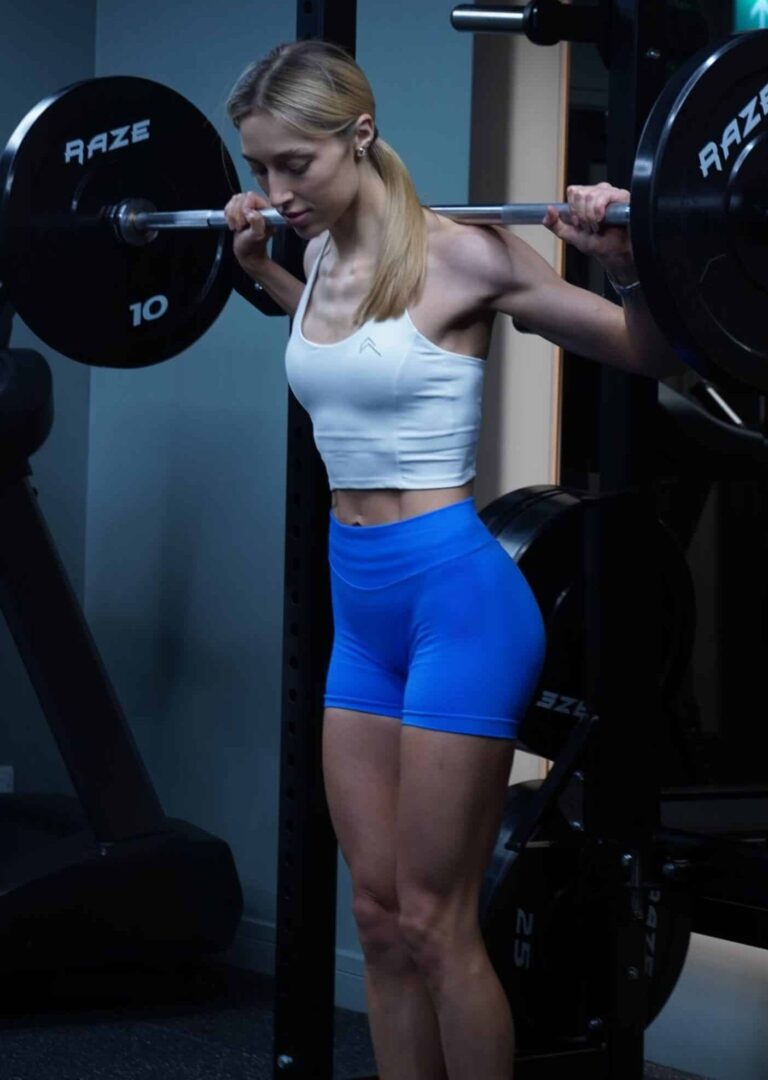
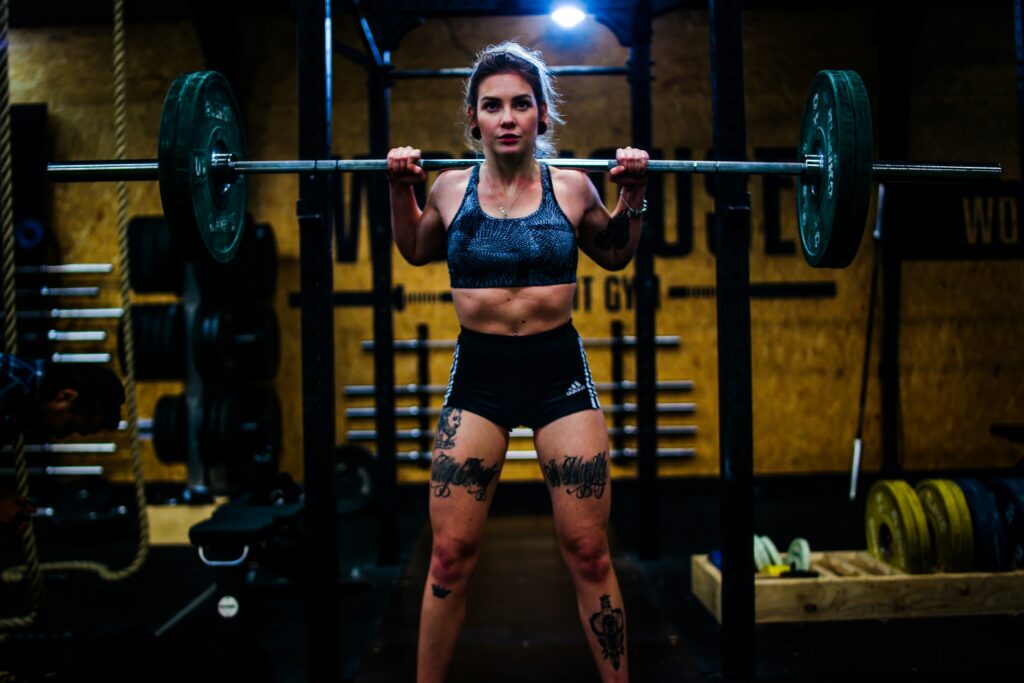
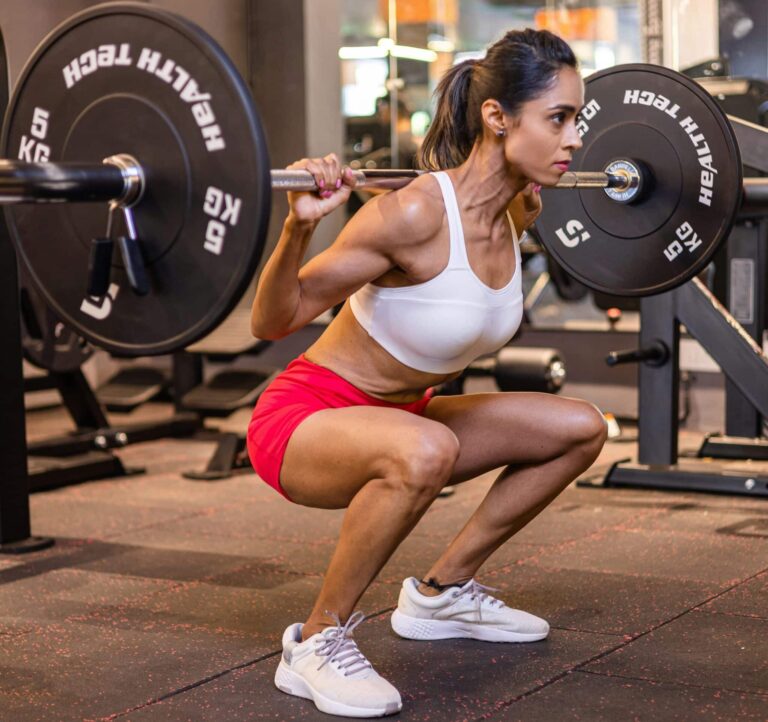
Phase 3: Barbell Back Squats (Month 4+)
The setup:
- Set bar height: In squat rack, bar should be roughly collarbone height
- Position yourself: Step under bar so it rests on your upper back/traps (not on your neck)
- Grip the bar: Hands slightly wider than shoulder-width, creating “shelf” with your upper back
- Unrack the bar: Stand up with bar, step backward 2-3 steps
- Set your stance: Feet hip to shoulder-width, toes slightly out
- Brace hard: Deep breath, core tight
- Squat: Exactly as you’ve practised with bodyweight/goblet squats
Starting weight: Empty 20kg bar
Progression:
- Weeks 1-2: 20kg bar, 3 sets × 8 reps (perfect form)
- Weeks 3-4: 30kg, 3 sets × 8 reps
- Weeks 5-6: 40kg, 3 sets × 6 reps
- Weeks 7-8: 50kg, 3 sets × 6 reps
- Continue adding 5-10kg every 2 weeks
Realistic timeline:
Month 6: 40-50kg for reps Month 12: 60-70kg for reps Month 18-24: 80-90kg for reps
This assumes consistent training 2-3x weekly. Your progression may differ.
I trained a woman who started with bodyweight squats, unable to reach parallel. Eighteen months later, she was back squatting 75kg for reps. She was 58 years old when she started.
Squat Variations
Box Squats
Squat down until you touch a box/bench, then stand.
Benefits: Teaches proper depth. Builds confidence. Great for learning.
Front Squats
Bar rests across front of shoulders instead of upper back.
Benefits: More upright torso. Less lower back stress. Emphasises quads more. Good if back squats bother your back.
Split Squats (Bulgarian)
One foot elevated behind you on bench.
Benefits: Unilateral (single-leg) strength. Corrects imbalances. Requires less weight.
Sumo Squats
Much wider stance, toes pointed out 30-45 degrees.
Benefits: Different emphasis (more inner thigh/glutes). Good variation for those with hip structure suited to wider stance.
Programming Squats
Frequency: 2-3x weekly
Unlike deadlifts, squats can be performed more frequently because they’re less systemically taxing.
Sample week:
Monday (Heavy):
- Back squats: 4 sets × 5 reps (80-85% max)
- Bulgarian split squats: 3 sets × 8 per leg
- Supporting work: leg curls, calf raises
Wednesday (Moderate):
- Goblet squats: 3 sets × 12 reps
- Romanian deadlifts: 3 sets × 10 reps
- Supporting work: hip thrusts, core
Friday (Light/Volume):
- Bodyweight squats: 3 sets × 15 reps
- Walking lunges: 3 sets × 12 per leg
- Supporting work: glute bridges, core
This provides three squat stimulus sessions weekly with varying intensity.
Troubleshooting Common Issues
“My Knees Hurt When I Squat”
Possible causes:
- Knees caving inward (valgus collapse)
- Not squatting deep enough (stopping at worst leverage point)
- Knees sliding too far forward
- Pre-existing knee issues
Solutions:
- Film yourself. Check knee tracking.
- Try deeper squats (counterintuitive but often helps)
- Push hips back more at initiation
- See physiotherapist if pain persists
“I Can’t Keep My Heels Down”
Cause: Limited ankle dorsiflexion (mobility issue).
Solutions:
- Stretch calves daily
- Elevate heels temporarily on 5-10mm plates
- Wear lifting shoes (have small heel elevation)
- Box squats to reduce depth requirement initially
“I Lean Forward Too Much”
Causes:
- Weak upper back
- Not sitting back into hips
- Quad-dominant movement pattern
- Poor core bracing
Solutions:
- Practise goblet squats (weight keeps you upright)
- Focus on “hips back” initiation
- Strengthen upper back (rows, pull-ups)
- Improve core bracing
“I Can’t Squat Deep Without Losing Form”
Causes:
- Hip mobility limitations
- Ankle mobility limitations
- Motor control issues
Solutions:
- Hip mobility work: hip flexor stretches, deep squat holds
- Ankle mobility work: calf stretches, ankle rocks
- Box squats at achievable depth, gradually lower box
- Don’t force depth if mobility isn’t there yet
How 12REPS Helps with Squats
Squat programming requires balancing:
- Frequency (2-3x weekly)
- Intensity (heavy, moderate, light days)
- Volume (total weekly sets and reps)
- Progression (when to add weight)
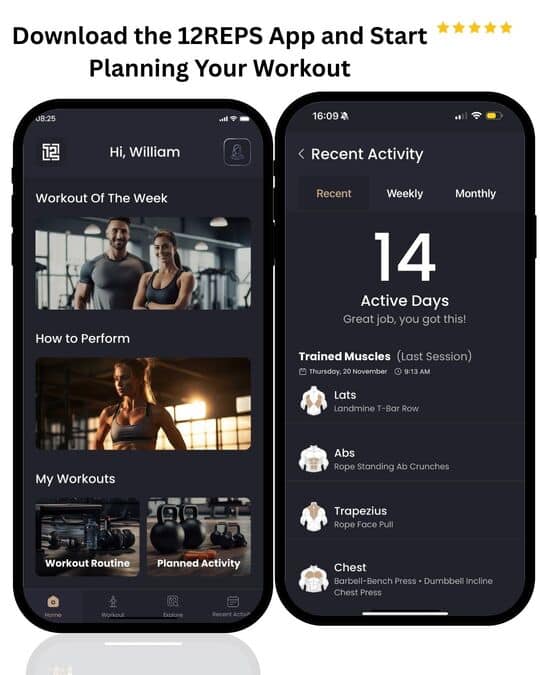
12REPS automates this entirely:
Periodised programming: The app programmes heavy, moderate, and light squat sessions automatically, preventing burnout whilst maximising gains.
Form reminders: Video demonstrations before each session ensure technique stays sharp.
Progressive overload tracking: The app knows when you’re ready to add weight based on performance, removing guesswork.
Exercise substitutions: Can’t access a squat rack today? The app suggests goblet squats or split squats that maintain training stimulus.
For women training at gyms and at home, this flexibility whilst maintaining progression is critical.
The Bottom Line
The squat is the most fundamental lower body strength exercise.
Proper bodyweight technique:
- Feet hip to shoulder-width, toes slightly out
- Initiate by pushing hips backward
- Descend to at least parallel (thighs level with floor)
- Keep heels planted, knees tracking over toes
- Maintain proud chest, neutral spine
- Drive through entire foot to stand
- Squeeze glutes at top
Progressive overload:
- Master bodyweight squats completely (4 weeks)
- Progress to goblet squats 8-20kg (8 weeks)
- Transition to barbell squats starting with 20kg bar
- Add 5-10kg every 2 weeks whilst maintaining form
- Expect bodyweight → 60-80kg over 12-18 months
Common mistakes to avoid:
- Knees caving inward
- Heels lifting off floor
- Excessive forward lean
- Insufficient depth
- Not bracing core
- Poor head position
Master bodyweight squats before adding weight. Perfect technique before chasing numbers. Film yourself regularly. Be patient with mobility limitations.
Women who squat consistently develop incredible leg strength, better posture, increased bone density, and functional fitness that transfers to everything else in life.
Start with bodyweight. Perfect your technique. Add load gradually. Eighteen months from now, you’ll be squatting weights that currently seem impossible.
And you’ll be stronger than you ever imagined.
References
- Schoenfeld, B.J. (2010). Squatting Kinematics and Kinetics and Their Application to Exercise Performance. Journal of Strength and Conditioning Research, 24(12), pp.3497-3506. https://doi.org/10.1519/JSC.0b013e3181bac2d7
- Caterisano, A., Moss, R.F., Pellinger, T.K., Woodruff, K., Lewis, V.C., Booth, W. and Khadra, T. (2002). The Effect of Back Squat Depth on the EMG Activity of 4 Superficial Hip and Thigh Muscles. Journal of Strength and Conditioning Research, 16(3), pp.428-432.
- Comfort, P., Kasim, P. and Fairclough, S. (2013). Effect of Knee and Trunk Angle on Kinetic Variables During the Squat. International Journal of Sports Physiology and Performance, 8(2), pp.190-196. https://doi.org/10.1123/ijspp.8.2.190
- Hartmann, H., Wirth, K., Klusemann, M., Dalic, J., Matuschek, C. and Schmidtbleicher, D. (2013). Influence of Squatting Depth on Jumping Performance. Journal of Strength and Conditioning Research, 27(12), pp.3243-3261. https://doi.org/10.1519/JSC.0b013e31828c1b03
- Gryzło, S.M., Patek, R.M., Pink, M. and Perry, J. (1994). Electromyographic Analysis of Knee Rehabilitation Exercises. Journal of Orthopaedic & Sports Physical Therapy, 20(1), pp.36-43. https://doi.org/10.2519/jospt.1994.20.1.36
- Pallarés, J.G., Cava, A.M., Courel-Ibáñez, J., González-Badillo, J.J. and Morán-Navarro, R. (2020). Full Squat Produces Greater Neuromuscular and Functional Adaptations and Lower Pain Than Partial Squats After Prolonged Resistance Training. European Journal of Sport Science, 20(1), pp.115-124. https://doi.org/10.1080/17461391.2019.1612952