



By Will Duru, BSc (Hons) Sport and Exercise Science Award-winning Personal Trainer with over 10 years of experience in strength training and optimising recovery
On one hand, you’re afraid of getting injured by lifting too heavy. You’ve heard the horror stories, seen the gym fail videos, and you don’t want to be that person who pushed too hard. On the other hand, you know you need to challenge yourself to get stronger. You understand that staying in your comfort zone won’t deliver the results you’re after. So how do you find that perfect balance? How do you know when it’s time to reach for the next dumbbell up?
This is a decision that stumps so many of the women I train in the City of London. They get comfortable with a certain weight—it feels manageable, safe, predictable—and they’re afraid to leave it. I’ve had clients stick with the same 8kg dumbbells for months, not because they can’t handle more, but because they don’t have a clear signal telling them they’re ready. My passion is to give them the confidence and the tools to know when to push. Progress lives just outside your comfort zone, and crossing that threshold is what transforms your body and your strength.
This guide will give you a clear, simple system for knowing exactly when to increase your weights, so you can keep making progress safely and effectively. No more guessing, no more playing it overly safe, and no more unnecessary risk. Just a straightforward method for continuous improvement.
The Golden Rule: Form Before Weight
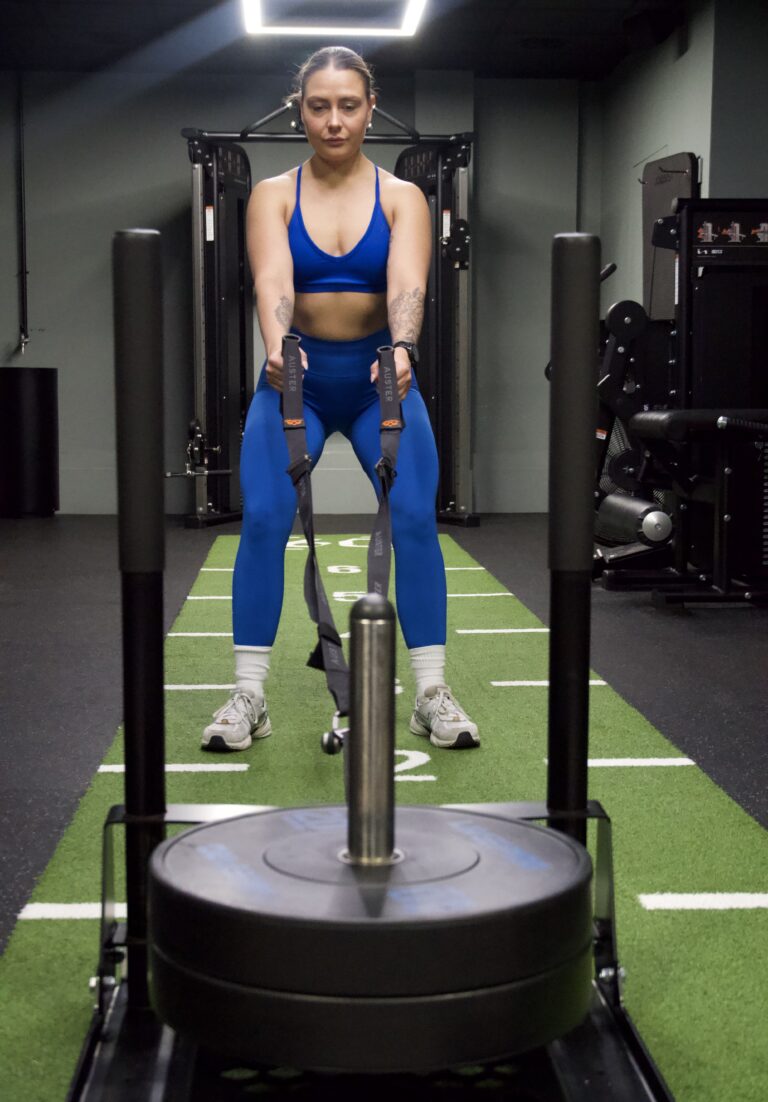
Before we talk about when to increase weight, we need to establish the non-negotiable foundation: form always comes first.
Form is Non-Negotiable
You should never, under any circumstances, increase the weight at the expense of good form. This isn’t about being cautious or conservative; it’s about being effective. I would rather see a client lift 5kg with perfect form than 10kg with terrible form. Why? Because good form isn’t just about preventing injury, though that’s certainly important. Good form is about actually working the muscle you’re trying to target.
When your form breaks down, when you start swinging weights, using momentum, or compensating with the wrong muscles, you’re no longer training the intended muscle effectively. You might be moving weight, but you’re not building the strength you want in the right places. Worse, you’re ingraining poor movement patterns that become harder to correct over time.
I’ve seen this countless times: someone lifts impressively heavy weight with compromised form and wonders why they’re not seeing the results they expect or why they’re constantly dealing with nagging pains. Meanwhile, someone else lifts more modest weights with pristine technique and makes steady, sustainable progress.
What Does Good Form Look Like?
While specific form cues vary by exercise, here are universal principles that apply to virtually all movements:
Controlled movement: No swinging, jerking, or using momentum to move the weight. Both the lifting phase and the lowering phase should be deliberate and controlled. If you have to use momentum to get the weight moving, it’s too heavy.
Full range of motion: You should be able to complete the entire movement pattern without cutting it short. If you can only squat halfway down with a certain weight but you can squat all the way down with a lighter weight, you’re not ready for the heavier load.
Feeling the exercise in the target muscle: This is your internal feedback system. If you’re doing a row and you’re feeling it primarily in your biceps instead of your back, something’s off. If you’re doing a squat and your lower back is doing most of the work instead of your legs, your form has broken down.
Video Yourself
Here’s a practical tip that I give to all my clients: prop your phone up and record a set. You’ll be amazed at what you see. We all have a mental image of what we look like when we exercise, and it’s often quite different from reality. Video doesn’t lie.
Recording yourself is like having your own personal trainer providing feedback. You can compare your form to instructional videos, identify areas that need work, and track your improvement over time. This practice also makes you much more aware of your movement quality, which naturally leads to better form even when you’re not recording.

The Signal: When Your Body Says It's Ready
Now let’s get to the heart of the matter: how do you know when you’re ready to increase the weight?
Introduce the ‘2-Rep Rule’
My go-to method for knowing when to progress is what I call the 2-Rep Rule. It’s simple, objective, and takes the guesswork out of the decision. Here it is: when you can perform two or more reps above your target rep range in your last set, with good form, for two consecutive workouts, it’s time to increase the weight.
This rule is brilliant because it’s based on demonstrated capability, not arbitrary feelings or timelines. You’re not guessing whether you’re ready, you’re proving it through performance.
Example in Practice
Let’s walk through a concrete example so you can see exactly how this works.
Say your workout plan calls for three sets of ten reps on the goblet squat with a 10kg dumbbell. You complete your first two sets of ten reps as prescribed. On your third set, you feel strong, so you keep going and end up completing twelve reps with solid form. You make a note in your workout tracker: “Hit 12 reps on final set.”
Next workout, same exercise. Again, on your third set, you complete twelve reps. That’s your green light. You’ve now demonstrated twice that the current weight is no longer challenging enough. Next time you do goblet squats, you’ll reach for the 12kg dumbbell.
The beauty of requiring two consecutive demonstrations is that it accounts for good days versus typical days. We all have sessions where everything feels easier, maybe you had great sleep, low stress, and perfect nutrition. Requiring two consecutive workouts ensures that your increased capacity is consistent, not just a one-off good day.
The Importance of a Workout Log
Here’s the critical point: the 2-Rep Rule is impossible to follow consistently if you’re not tracking your workouts. Your memory will fail you. You won’t remember whether you got twelve reps last workout or just ten. You won’t remember if it was one workout ago or two workouts ago that you hit the threshold.
The 12reps app is the best strength training app for implementing this system. It’s your data, your proof of progress, and your decision-making tool all in one. When you log every set, the weight, the reps, how it felt, you create an objective record that tells you exactly when you’re ready to progress. Download it for a free trial and eliminate the guesswork from your training decisions.
Without tracking, progression becomes random and inefficient. With tracking, it becomes systematic and inevitable.

How to Make the Jump
You’ve hit your 2-Rep Rule threshold. Now what? How do you actually make the progression?
Small Increments
This isn’t a time for big ego jumps. When you increase the weight, do so by the smallest possible increment available. If you’ve been using an 8kg dumbbell, go to the 9kg or 10kg dumbbell, not the 12kg. If you’ve been squatting with 40kg on the barbell, add 2.5kg to 5kg, not 10kg.
Why small jumps? Because they’re sustainable and safe. A small increase provides a new stimulus that your body can adapt to relatively quickly, allowing you to maintain momentum. A large jump might be too great a stimulus, leading to form breakdown, excessive fatigue, or even injury. It also risks being discouraging; if the weight feels impossibly heavy, you might lose confidence and revert to your old weight.
Progress is a marathon, not a sprint. Small, consistent increases compound dramatically over time. Adding just 2kg per month doesn’t sound impressive until you realise that’s 24kg in a year. The person who makes steady, modest increases will ultimately surpass the person who makes dramatic jumps followed by long plateaus or setbacks.
Expect a Rep Drop
When you increase the weight, you should absolutely expect the number of reps you can complete to decrease. This is not a failure, it’s normal and expected. You might go from doing twelve reps with the old weight to only eight reps with the new weight. This is what progression looks like in practice.
Think of it this way: you’ve just increased the difficulty level. You’re now working your way back up through the rep range with this heavier weight. In a few weeks, you’ll be hitting ten reps, then eleven, then twelve again. And when you do, you’ll apply the 2-Rep Rule and move up once more.
This is why tracking is so valuable, you can look back and see that four weeks ago, you could only do eight reps with this weight, and now you’re doing twelve. That’s concrete evidence of adaptation and growth.
It’s a Cycle
This is the beautiful, endless cycle of strength training: you get strong enough at a certain weight to increase the load, your reps drop, you gradually build back up, and then you repeat the process. This cyclical progression is what continuous improvement looks like. It’s not linear, it’s a series of steps up.
Each time you complete this cycle, you’re stronger than you were before. The weight that once challenged you for eight reps becomes something you can handle for twelve reps. The weight that initially felt intimidatingly heavy becomes familiar and manageable. This is adaptation in action, and it never stops as long as you keep providing appropriate stimulus.

Conclusion
Don’t be afraid to challenge yourself. The fear of lifting too heavy keeps many women stuck using weights that stopped challenging them long ago. But now you have a clear system: maintain perfect form as your foundation, apply the 2-Rep Rule to know when you’re ready to progress, and increase in small, sustainable increments.
Reaching for that next weight is a victory in itself. It’s a tangible sign that you’re getting stronger, and you should be proud of that moment. It represents all the workouts you’ve completed, all the effort you’ve invested, and all the adaptation your body has made.
Remember the key points: form always comes before weight—never compromise technique to lift heavier. Use the 2-Rep Rule as your objective signal that you’re ready to progress. When you do increase weight, expect your reps to drop and understand that working back up is part of the process. And track everything so you have the data to make smart decisions.
Next time you hit your 2-Rep Rule target, don’t hesitate. Increase the weight, log it in your workout tracker, and celebrate your new personal best. This is how you transform from someone who lifts weights to someone who gets progressively stronger. The difference is systematic progression, and you now have the system.