

Time-efficient workouts can build strength and muscle in much less time than most people expect. Research suggests a few hard sets of multi-joint exercises, done at least twice a week, give you most of the benefit. You don’t need hours in the gym.
A 2021 review by Iversen and colleagues, No Time to Lift? Designing Time-Efficient Training Programs for Strength and Hypertrophy, looked at how to design shorter strength programs. This guide explains what it found, what the 2026 ACSM guidelines add, and how to use both in your own training.
Why limited time stops people training
Many people think building strength takes long, grueling gym sessions. That belief often leads to skipping workouts altogether.
Iversen’s review notes that traditional programs, with a warm-up and stretching, often run over an hour. Most of that time can be trimmed without losing much of the result.
What the research says about time-efficient workouts
Do at least 4 hard sets per muscle each week
A set is one run of reps without rest. Weekly volume is the total number of hard sets you do for a muscle group in a week.
Iversen advises at least 4 weekly sets per muscle group, using loads you can lift for about 6 to 15 reps. More sets give more muscle growth, and the ACSM’s 2026 position stand points to about 10 weekly sets per muscle group for hypertrophy (muscle growth).
So 4 sets is a minimum that works, not the most you can do. Start there when time is tight, and add sets when you can.
Weekly volume matters more than frequency
Iversen found that how often you train matters little when weekly volume is the same. You can fit your sets into one longer session or several shorter ones, so pick the pattern you will stick with.
There is one useful rule of thumb. A meta-analysis found that training each muscle twice a week led to more growth than once a week. The NHS also recommends strengthening activities for all major muscle groups on at least 2 days a week. Two short full-body sessions is a good target. Our guide on how often you should lift goes into more detail.
Choose compound exercises
Compound (multi-joint) exercises train several muscle groups at once, so you need fewer exercises. Iversen suggests at least one lower-body exercise, one upper-body push and one upper-body pull. The review’s examples are the leg press, seated row and bench press.
- Squats or leg press
- Deadlifts
- Bench press or push-ups
- Rows or pull-ups
Train hard, but failure is optional
Each set should be challenging. But Iversen notes that regularly training to muscular failure, the point where you cannot complete another rep, is not essential for muscle growth when you use heavier loads. The 2026 ACSM position stand also treats training to failure as optional for most healthy adults.
A simple way to judge effort is RIR, or reps in reserve: how many more reps you could have done at the end of a set. Our guide to RPE and RIR explains how to use it.
Rest long enough to keep your sets productive
Very short rests save time, but they can cost you reps on later sets. Iversen advises beginners to rest 1 to 2 minutes between sets, and trained lifters 2 minutes or more. A 2024 meta-analysis found resting longer than 60 seconds may give a small advantage for muscle growth, with little extra benefit past about 90 seconds.
For heavy strength work, ACSM’s 2009 position stand suggests 3 to 5 minutes of rest. If that feels like too much waiting, use supersets instead. See our guide on how long to rest between sets.
Use supersets to save time
A superset pairs two exercises back to back, often for opposing muscles such as a chest press and a row. You rest after the pair, not after each exercise.
Iversen found that supersets, drop sets and rest-pause training roughly halve training time while keeping the same volume. They may suit muscle growth better than maximal strength. The review advises against using these methods on heavy compound free-weight lifts such as the squat and bench press. Learn the basics in our easy guide to supersets.
Keep your warm-up specific
Iversen advises warm-ups specific to the exercise, such as a few lighter sets of your first lift, instead of long general routines. It suggests prioritizing stretching only if improving flexibility is one of your goals.
How to build a time-efficient workout
- Choose compound movements. Pick 3 to 5 exercises that cover your lower body, an upper-body push and an upper-body pull.
- Use supersets. Pair push and pull exercises on machines or dumbbells, such as a chest press machine with a seated row, to cut rest time.
- Train close to failure. Make each set hard, stopping just short of failure on most sets.
- Keep workouts short but consistent. Train at least twice a week. Two to four short sessions works, so choose the number you can keep up.
- Track and progress. Log your weights and reps and add a little over time. This is progressive overload: gradually increasing the challenge so your body keeps adapting.
Want a ready-made session? Try this 20-minute dumbbell workout, set up as a full-body circuit, or this 25-minute dumbbell workout with straight sets.
Why short workouts work
- Consistency wins. Short workouts are easier to fit in, so you are more likely to keep going. The 2026 ACSM guidelines put a consistent routine ahead of a perfect program.
- Progressive overload still applies. Gradually adding weight, reps or sets drives strength and muscle gains, whatever the session length.
- Quality over quantity. Good form on a few well-chosen exercises gets more from the time you have.
Train with a plan that fits your time
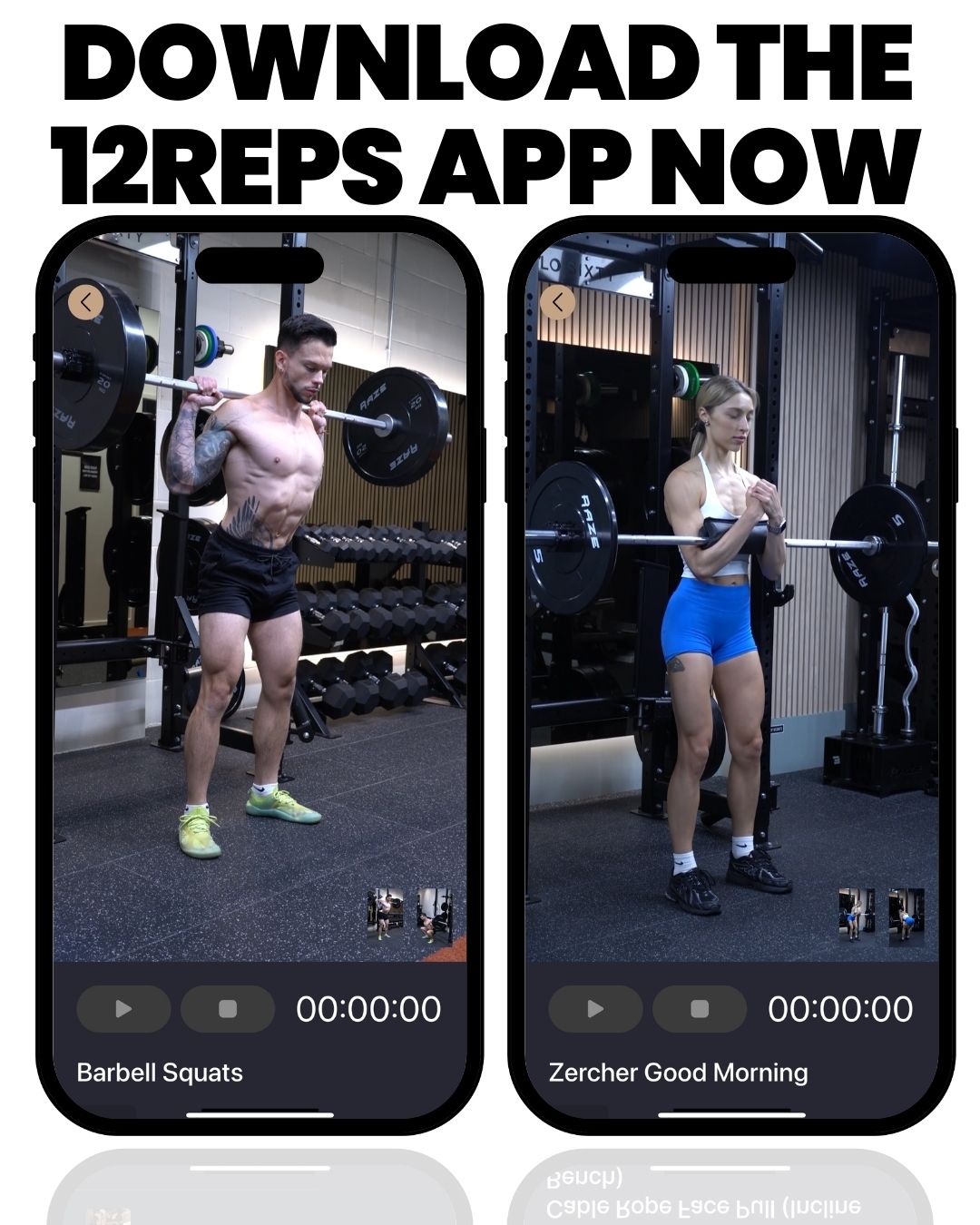
A busy schedule doesn’t have to stop you getting stronger. With 12REPS, you choose the muscle, equipment and time you have, and it builds the session for you. Each exercise comes with a trainer demonstration, and the app remembers what you lifted so you have a number to beat.
Sources
- No Time to Lift? Designing Time-Efficient Training Programs for Strength and Hypertrophy: A Narrative Review (Iversen VM, Norum M, Schoenfeld BJ, Fimland MS). Sports Medicine 51(10):2079-2095, 2021. https://pmc.ncbi.nlm.nih.gov/articles/PMC8449772/
- Resistance Training Position Stand infographic: Resistance training prescription for muscle function, hypertrophy, and physical performance in healthy adults. American College of Sports Medicine, 2026. https://acsm.org/wp-content/uploads/2026/03/Resistance-Training-Position-Stand-infographic.pdf
- Consistency over perfection, new resistance-training guidelines say. McMaster University News, 2026. https://news.mcmaster.ca/?p=30899
- Effects of Resistance Training Frequency on Measures of Muscle Hypertrophy: A Systematic Review and Meta-Analysis (Schoenfeld BJ, Ogborn D, Krieger JW). Sports Medicine 46:1689-1697, 2016. https://link.springer.com/10.1007/s40279-016-0543-8
- Give it a rest: a systematic review with Bayesian meta-analysis on the effect of inter-set rest interval duration on muscle hypertrophy (Singer A, et al.). Frontiers in Sports and Active Living, 2024. https://frontiersin.org/journals/sports-and-active-living/articles/10.3389/fspor.2024.1429789/abstract
- American College of Sports Medicine position stand. Progression models in resistance training for healthy adults. Medicine & Science in Sports & Exercise 41(3):687-708, 2009. https://pubmed.ncbi.nlm.nih.gov/19204579/
- Physical activity guidelines for adults aged 19 to 64. NHS, 2024. https://www.nhs.uk/live-well/exercise/physical-activity-guidelines-for-adults-aged-19-to-64/